

What Is iGaming CRM? The Complete 2026 Guide
Updated on June 17, 2026
What Is iGaming CRM? The Complete 2026 Guide
If you have ever wondered why some online casinos feel like they actually know you, your preferences, your timing, your favorite games, and others feel like you are just a number in a database, the answer almost always comes down to one thing: CRM. Customer Relationship Management in iGaming goes well beyond a backend tool. It is the difference between players who stick around for years and players who bounce after their first deposit.
The most effective iGaming operators combine advanced personalization with seamless retention strategies powered by CRM automation. Many of the best iGaming CRM platforms also integrate sophisticated loyalty features, reflecting the growing demand for loyalty CRM software across regulated markets, including solutions recognized among the best online casino CRM platforms in Paraguay.
This guide covers everything you need to know about iGaming CRM in 2026: what it is, why it matters, how the best operators use it, what risks to manage, and what a modern CRM setup looks like in practice.
What Is iGaming CRM?
At its core, CRM (Customer Relationship Management) is a system that helps businesses manage their relationships and interactions with customers. In iGaming specifically, that means tracking player behavior, personalizing communication, managing loyalty programs, and automating the right messages at the right time.
But here is where it gets interesting: iGaming CRM is not the same as a standard CRM you would use in retail or SaaS. The player lifecycle in online casino gaming is fast, emotionally charged, and deeply data-rich. A player might log in six times in a day, trigger dozens of behavioral signals, and churn completely within a week, all without a single human-to-human interaction.
That is why casino CRM platforms are built differently. They need to process real-time data, respond instantly, and deliver personalized experiences at scale. Think of it less like a contact database and more like a smart, always-on engagement engine.
Modern platforms increasingly combine real-time engagement with CRM automation, advanced loyalty systems, and gamification CRM features to drive player activity. These capabilities have become standard among the best player CRM solutions and leading USA iGaming CRM software platforms.
Why CRM Matters More Than Ever in 2026
The iGaming market is more competitive now than at any point in history. Global online gambling revenues are projected to exceed $130 billion by 2027, according to Grand View Research, and player acquisition costs keep climbing. Getting someone to your platform is expensive. Keeping them is where the real money is.
And yet many operators still rely on generic email blasts and one-size-fits-all bonus structures. Players notice. They have been trained by Netflix, Spotify, and Amazon to expect personalization as a baseline.
{{cta-banner}}
A well-executed CRM for iGaming fixes this. It lets operators:
- Send the right message to the right player at exactly the right moment
- Identify at-risk players before they churn, not after
- Build loyalty programs that feel personal rather than transactional
- Automate repetitive tasks so teams can focus on strategy
- Comply with responsible gaming regulations through smarter player monitoring
The operators winning in 2026 are the ones treating CRM not as a marketing tool, but as the backbone of their entire player engagement strategy. As acquisition costs rise, operators are turning to gamification in CRM and advanced engagement models to improve retention, alongside innovations from leading iGaming software providers. This reflects the growing importance of CRM in online casino management, a trend also seen in fintech with data-driven systems similar to the top CRM for fintech.
Key Features of a Modern iGaming CRM
Not all CRM platforms are created equal. Here is what separates a solid online casino CRM from a generic solution duct-taped to an iGaming platform:
- Real-time data processing: Player behavior happens fast. A CRM that updates every 24 hours is already too slow. Modern iGaming CRMs process behavioral signals in real time and trigger responses within seconds.
- Segmentation and player profiling: Rather than blasting your entire player base with the same offer, a good CRM lets you build granular segments, high rollers, casual weekend players, slot enthusiasts, sports bettors, and tailor everything accordingly.
- Multi-channel communication: Players live across email, SMS, push notifications, and in-app messages. A strong CRM manages all of these from a single dashboard, keeping messaging consistent and avoiding the dreaded double-send.
- Automation workflows: From welcome sequences to win/loss triggers to reactivation campaigns, automation removes the manual work while keeping the experience feeling personal.
- Gamification integration: Points, missions, leaderboards, and rewards are not just fun, they are scientifically proven engagement drivers. The best iGaming CRM platforms have gamification baked in, not bolted on.
- Responsible gaming tools: Behavioral flags, self-exclusion tracking, and spend limit monitoring help operators meet compliance requirements and actually protect their players.
- Analytics and reporting: You cannot improve what you cannot measure. A good CRM surfaces actionable insights, not just vanity metrics.
How Gamification Fits Into iGaming CRM
Gamification deserves its own section because it is one of the most powerful tools available to iGaming operators, and it works best when it is fully integrated with CRM data.
The idea is straightforward: players are more engaged when their activity feels like progress. Points accumulate. Levels are unlocked. Missions give them something to work toward beyond just the games themselves. Research published by Frontiers in Psychology shows that progress mechanics and variable rewards significantly increase sustained engagement.
When gamification connects to your CRM, it gets smarter. A player who has been quiet for five days might get a personalized mission that matches their game history. A player on a losing streak might receive a well-timed bonus that feels helpful rather than predatory. A high-value player might unlock an exclusive loyalty tier with real, tangible benefits.
This is unified gamification CRM in practice, where the loyalty layer and the engagement layer are not two separate systems awkwardly talking to each other, but a single, coherent experience.
7 Signs Your iGaming CRM Strategy Needs Work
Sometimes the problem is that what you have at your disposal is not being used well. Here are seven clear signs your online casino CRM strategy needs attention:
- Your email open rates are below 15%. This usually means your segmentation is off, your timing is wrong, or your content is not relevant to the people receiving it.
- You are sending the same bonus to everyone. Generic promotions feel cheap and train players to wait for discounts rather than engaging naturally.
- You find out a player churned after the fact. A good CRM flags at-risk players before they leave, giving you a window to act.
- Your loyalty program has low enrollment. If players are not opting in, it means the value proposition is not clear, or it is not personal enough to feel worth it.
- Your reactivation campaigns are not working. If you are reaching out to lapsed players with the same message they ignored the first time, you need better triggers and better content.
- You cannot tell which campaigns drove revenue. If your reporting cannot connect a specific campaign to player behavior and revenue, you are flying blind.
- Your compliance team is managing player safety manually. Responsible gaming monitoring should be automated and built into your CRM workflows, not handled through spreadsheets and manual reviews.
Personalization in iGaming Loyalty Programs: Getting It Right
Personalization in loyalty programs is one of those things that sounds obvious but is surprisingly hard to do well. Most operators know they should personalize. Fewer actually pull it off.
The reason it is hard is that true personalization requires connecting multiple data streams: what players play, when they play, how much they spend, how they respond to different types of offers, what communication channel they prefer, and how their behavior changes over time. That is a lot of variables.
The good news is that modern CRM automation handles most of this for you. Instead of manually building dozens of audience segments, you define the rules, "if a player has not logged in for 7 days and their last session was playing slots, send this," and the system executes automatically.
According to McKinsey, companies that get personalization right generate around 40% more revenue from those activities than their slower-growing competitors. That relationship is even stronger in iGaming, where the link between personal relevance and player lifetime value is direct and measurable.
A few personalization tactics that work:
- Behavioral triggers over time-based triggers. Sending an offer because a player just hit a specific milestone in their game history performs far better than a weekly Tuesday email.
- Reward what matters to them, not what is easiest for you. Free spins are great for slot players. They are irrelevant to someone who only plays table games. Know the difference.
- Make loyalty tiers feel like genuine status, not just marketing labels. Players who feel like VIPs behave like VIPs, spending more, engaging more, and churning far less.
CRM Automation: The Engine Under the Hood
CRM automation is what makes everything above scalable. Without it, delivering personalized, timely, multi-channel communication to tens of thousands of players would require a team of hundreds. With it, a small CRM team can manage sophisticated campaigns across an entire player base.
Here is how automation works in a typical iGaming CRM setup. A player registers. The system automatically kicks off a welcome sequence tailored to their registration source and first game. Three days later, if they have not made a deposit, a behavioral trigger fires a personalized incentive. If they do deposit and become active, they enter a different flow, one focused on engagement and discovery. If they go quiet after 10 days, the system flags them as at-risk and launches a reactivation sequence.
All of this happens without a human pressing send. The CRM team's job shifts from execution to strategy: building better triggers, testing new content, analyzing what is working, and improving the flows. High-performing marketing teams are far more likely to use AI and automation than their peers. In iGaming, where player behavior moves at a pace humans cannot match manually, automation is no longer optional.
How Smartico.ai Approaches iGaming CRM
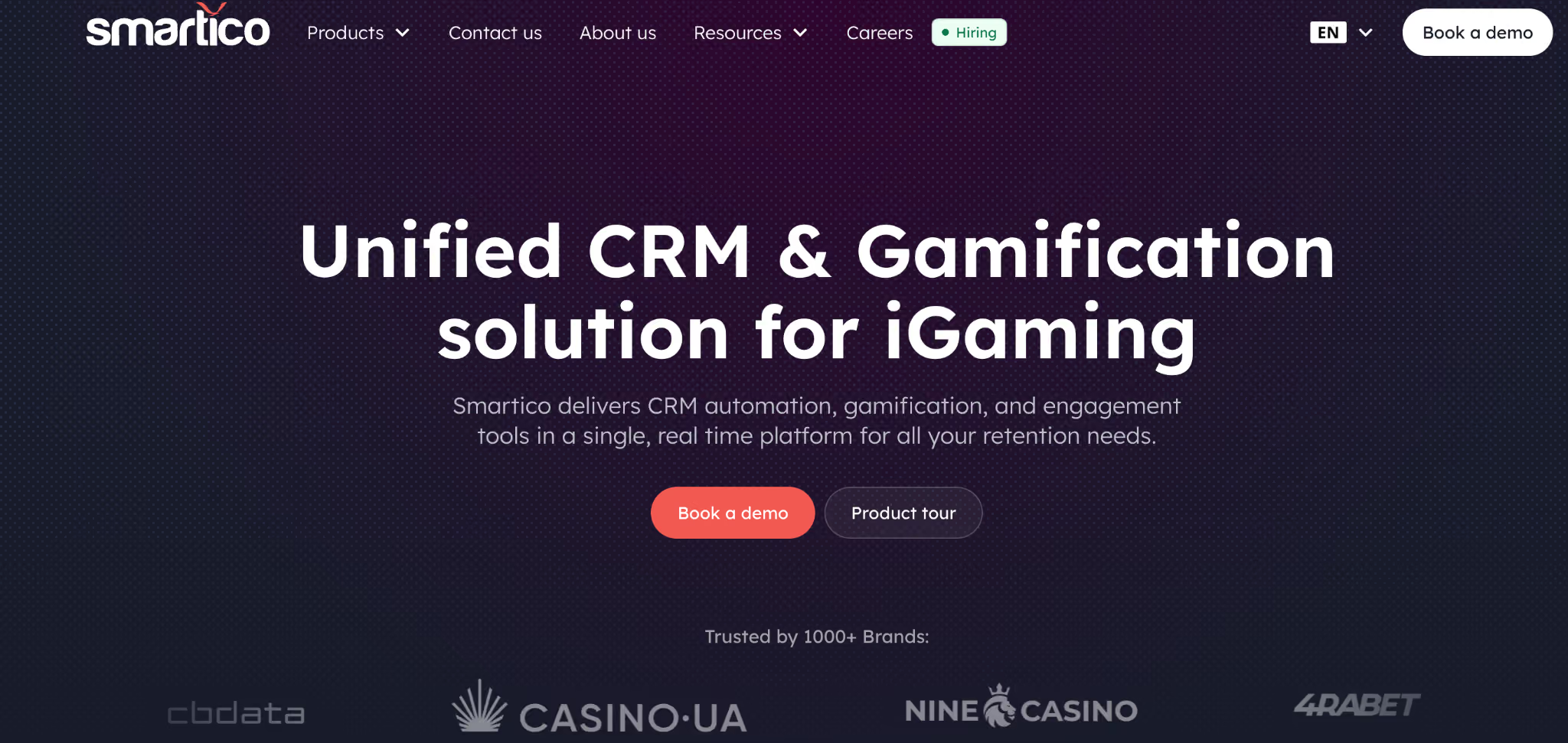
Smartico provides a powerful unified system designed as the central hub for managing dynamic engagement experiences. Smartico gamification portal solutions let operators build immersive player environments filled with customizable mechanics that feel natural and exciting. The platform integrates everything needed for real-time control, from reward distribution to campaign oversight, making it simple to maintain a lively atmosphere that users love returning to every day.
Key Features:
Our platform offers a range of powerful features:
CRM Automation: We streamline every step of the player journey, from onboarding to loyalty, with hyper-personalized messaging and automated workflows.
Gamification: Our customizable gamification tools bring fun, rewards, and loyalty seamlessly integrated within your CRM.
Free-to-Play Games: We offer a suite of customizable mini-games like the Loyalty Wheel, Scratch cards, and Daily Loot Boxes to boost player engagement.
Bonus Engine: Our system helps lower bonus costs with rewards tailored to player behavior, manageable in real-time or scheduled for optimal impact.
Jackpots: We provide customizable jackpots, both player-funded and operator-funded, to enhance any game from any provider.
AI Models: Our AI turns player data into actionable predictions, helping optimize engagement, prevent churn, and deliver rewards at the perfect moment.
Raffle: Transforms simple promos into fun, gamified experiences that boost engagement, spark excitement, and keep users coming back.
Tournaments: Transforms standard competitions into exciting real-time battles where players compete for major prizes while climbing dynamic leaderboards.
Avatars: Lets players create, earn, and customize unique AI-powered identities that increase emotional connection and player loyalty.
Banners: Delivers dynamic and hyper-personalized promotions to every player based on their status, location, and behavior in real time.
Integration and Support:
One of our key strengths is our effortless integration process. Our engineers manage the entire integration, reducing the load on your R&D resources. We support all major SMS, email, and instant messaging providers, and we integrate with all iGaming platforms.
Expertise and Partnership:
We're not just a software provider; we're a partner invested in your growth. Our team works alongside you to build CRM expertise within your team, guiding strategy and offering practical insights throughout our partnership.
Pricing and Availability:
Our pricing is based on monthly active users and includes both CRM automation and gamification, along with a dedicated Success Manager. While we don't offer a trial version, we're happy to provide a detailed demo to show you exactly how Smartico works.
At Smartico, we're committed to helping iGaming businesses improve retention and engagement. We'd love to show you how our platform can benefit your operations. Feel free to book a demo or reach out with any questions you might have.
{{cta-banner}}
Building Your iGaming CRM Strategy: A Practical Framework
Strategy first, software second. Here is a framework that works whether you are starting from scratch or improving an existing setup.
Step 1: Define your player segments. Do not try to personalize for everyone at once. Start with your highest-value segments, VIPs, new depositors, and at-risk churners, and build flows specifically for them.
Step 2: Map the player lifecycle. Identify the key moments where communication matters: registration, first deposit, first session, 7-day mark, 30-day mark, first churn risk. These are your trigger points.
Step 3: Build your communication templates. Write copy for each lifecycle stage. Make it feel human. Test subject lines. Keep messages short. Lead with value.
Step 4: Set up your automation workflows. Start simple. One welcome flow. One reactivation flow. One win-back flow. Measure, learn, then expand.
Step 5: Integrate gamification. Layer in missions and rewards that connect to your CRM data. Make sure your loyalty program rewards are personalized by player type.
Step 6: Measure what matters. Track player lifetime value, retention rates by segment, campaign attribution, and responsible gaming metrics. Review monthly. Adjust constantly.
Risks to Manage When Implementing an iGaming CRM
A CRM project pays off when it is planned with care. Choosing the right solution and rolling it out methodically is worth every penny, but there are four risk areas worth managing from day one.
Privacy and Security
Sensitive player data can be exposed, by accident or through bad actors. Clear data-handling policies and well-defined access permissions reduce that risk substantially. In a regulated industry, this is not optional, it is core to keeping your license and your players' trust.
Pricing and Upgrade Risk
If you over-invest in heavy customization, you can run into cost problems later when it is time to upgrade the platform. The way to avoid that is to keep the setup as clean and as accessible to your team as possible, rather than customizing for its own sake.
Time and Cost
CRM implementation and ongoing management cost both time and money. A precise, structured rollout plan, a clear understanding of what your players want, and good communication with your team make the difference between a smooth launch and an expensive one.
Switching From Cloud to On-Premise
If you run a cloud-based CRM and later want to move on-premise, there is a real risk of losing data in the transition. Timely, detailed communication with your vendor is the best way to keep that migration safe.
The Role of AI in Modern iGaming CRM
Artificial intelligence has moved from interesting experiment to practical necessity. In the context of iGaming CRM, AI shows up in a few key areas.
Predictive churn modeling uses historical behavioral data to flag players who are likely to stop engaging before they actually do, giving operators a meaningful intervention window. Propensity modeling identifies which players are most likely to respond to a specific offer, improving conversion rates on promotions. Natural language processing helps analyze player feedback and support interactions at scale.
According to Gartner, AI adoption in marketing automation is accelerating across all industries, and iGaming is no exception. The operators building AI-native CRM workflows now are creating competitive advantages that will be very hard to replicate in two or three years.
The important caveat: AI is only as good as the data feeding it. Before implementing any AI layer, make sure your data collection, segmentation, and tagging are solid. A predictive model trained on messy data produces confident wrong answers, which is arguably worse than no model at all.
Leveraging AI Models to Predict Player Behavior in iGaming CRM
AI models bring new possibilities to iGaming CRM. They analyze player actions and spot patterns that humans might miss. Teams use AI models to make timely decisions about rewards and messages.
AI models help with predictions on churn and player value. This information supports better targeting across different player groups. Short campaigns work well when data drives them. Longer term plans benefit too from ongoing adjustments based on fresh inputs. Operators mix several data points to create full pictures of each player's journey.
- Identify at risk players early
- Time communications for best results
- Match rewards to individual preferences
Such approaches lead to smoother operations and more consistent experiences for players.
Implementing Gamification Features to Drive Engagement
Gamification adds excitement to standard player interactions. It turns routine activities into rewarding challenges. Players enjoy missions and progress tracking that feel personal.
Gamification solutions integrate directly with CRM automation. They allow for custom elements like levels and badges. Raffle promotions stand out as popular choices. These create anticipation and bring players back regularly when teams choose raffle promotions. Free to play games offer another layer of fun without extra risk.
Lists help organize ideas here too. Bullet points show common elements:
- Missions based on real behavior
- Leaderboards that update live
- Points systems for flexible rewards
These tools fit naturally into daily workflows for many operators.
Latest News In 2026
Developments shape iGaming CRM throughout 2026 with stronger emphasis on real time responses to player activity. Systems manage complex personalization at larger scales through smoother integration of different tools. This setup helps operators handle multiple brands from one central place. Responsible gaming options receive more attention in automated processes while AI models advance with higher accuracy in behavior forecasts. New ideas in gamification maintain player interest and regulatory updates push for better data protection in communications. Platforms adjust quickly to balance compliance with effective player experiences.
FAQ: iGaming CRM
How do AI models support iGaming CRM efforts?
AI models examine layered player data to uncover hidden connections between actions and preferences. This process creates reliable forecasts about player lifetime value and engagement levels. The technology spots subtle activity shifts that open chances for timely intervention. As more interactions feed into the system the models grow smarter at recognizing unique segments. Such capabilities refine campaign strategies and align them closely with actual player needs over longer periods.
What makes gamification effective in player retention?
Gamification succeeds by tapping into desires for achievement and competition within daily player activities. It turns ordinary sessions into experiences players look forward to repeating. Different mechanics match varied motivations so operators reach broader audiences. When built with care these elements create progress and belonging that strengthen platform connections. The range of options lets approaches adapt as interests evolve naturally.
How important is CRM automation for multi brand operations?
CRM automation centralizes control over messaging and journeys across several brands at once. It removes repetitive manual work while keeping quality standards consistent. Centralized rules make insights from one brand easy to apply elsewhere in the portfolio. This foundation supports efficient scaling without adding heavy operational load. The result stays organized for communications and loyalty work across sites.
Can raffle promotions fit into broader loyalty strategies?
Raffle promotions add shared excitement that layers naturally with other loyalty activities. They encourage steady participation through chances at bigger rewards alongside everyday benefits. The format brings variety to standard reward setups without replacing them. When aligned with full player journeys, raffles enhance the entire system. Their flexible design fits different campaign goals and group preferences smoothly.
What challenges come with implementing new CRM tools?
New CRM tools require careful data preparation to match with existing systems. Teams spend time learning features and updating workflows for smooth adoption. Data quality stays key so the tools deliver expected performance. A phased rollout catches issues early before full use. Regular tweaks based on actual operations improve daily support from the tools.
How does personalization change over time in iGaming CRM?
Personalization grows from basic groupings to detailed individual experiences as player histories build up. Early efforts use general details while mature stages pull from rich behavioral records. This shift keeps interactions relevant as lifestyles and preferences develop. Advanced platforms update profiles automatically with each new touchpoint. The ongoing evolution helps sustain interest through timely and fitting content.
What is the difference between a standard CRM and an iGaming CRM?
Standard CRMs are designed for slower sales cycles and B2B relationships. iGaming CRMs are built for speed, scale, and real-time behavioral data. They need to process thousands of player signals simultaneously, trigger responses in seconds, and manage loyalty mechanics that standard CRMs were not designed to handle.
How long does it take to see results from a CRM implementation?
It depends on your starting point, but most operators see measurable improvements in player retention within 60 to 90 days of a proper setup. Automation workflows often show ROI within the first month, particularly reactivation campaigns targeting lapsed players.
Is CRM automation compliant with responsible gaming regulations?
It can be, and it should be. A well-configured iGaming CRM includes responsible gaming flags, spend monitoring, self-exclusion integration, and behavioral alerts. Done right, CRM automation actually improves compliance because it removes human inconsistency from the monitoring process. The UKGC and other regulators increasingly expect operators to have proactive monitoring systems in place.
How do you measure CRM success in iGaming?
Key metrics include player lifetime value (LTV), monthly retention rate by cohort, campaign-attributed revenue, unsubscribe and opt-out rates, reactivation campaign conversion rates, and loyalty program enrollment and engagement. Avoid vanity metrics like raw email open rates without connecting them to downstream player behavior.
Can small operators benefit from iGaming CRM?
Yes, and arguably more than large ones. Small operators often compete on player experience rather than volume. A CRM that automates personalized communication and loyalty management lets a small team punch well above its weight. The key is choosing a platform that scales with you rather than one built exclusively for enterprise.
What is the biggest mistake operators make with CRM?
Treating it as a marketing tool rather than a player experience tool. CRM is most powerful when it is connected to every touchpoint of the player journey, not just promotional emails. Operators who use CRM only for campaigns miss the majority of the value.
Conclusion
iGaming CRM has moved well beyond basic email marketing. In 2026, the operators who win on retention are the ones who have built intelligent, automated, data-driven player engagement systems, ones that feel personal because they are.
The fundamentals are not complicated: understand your players, communicate at the right moments, make your loyalty programs genuinely rewarding, and let automation handle the execution. What makes it hard is doing it at scale, in real time, across the full player lifecycle.
If you'd like to find out how Smartico's CRM can help you raise loyalty and retention like nothing you've tried before, book you free in-depth demo HERE.