


Marketing AI Tools: The Essential Stack for 2026
.jpg)
You know that feeling when you're staring at a mountain of customer data, three campaign deadlines, and a content calendar that looks more like a wish list? Yeah, we've all been there. But while you're manually segmenting audiences and A/B testing subject lines, your competitors are already two steps ahead with AI doing the heavy lifting.
2026 is not about choosing whether to use AI in marketing. That ship sailed. The real question is which tools you should actually be using, and how to build a stack that works together instead of creating yet another tech mess to manage.
Here’s what you need to know…
The Real Talk About AI Marketing Tools Right Now
.jpg)
Walk into any marketing team meeting this year, and you'll hear the same story. Someone's testing AI for content creation. Another person swears by their new predictive analytics platform. And meanwhile, nobody can quite figure out how to make it all work together without doubling their workload.
Here's what's actually happening: marketers are getting a 3.7x return for every dollar invested in generative AI. But only when they're using the right tools for the right jobs. The difference between AI that saves you time and AI that wastes it comes down to understanding what each tool category actually does.
Think of your AI marketing stack like a kitchen. You wouldn't use a blender to slice vegetables, right? Same principle applies here. Content creation tools, CRM automation platforms, predictive analytics software – they all have their place, but trying to force one tool to do everything is how you end up frustrated and back to doing things manually.
Content Creation: Where Speed Meets Substance
.jpg)
Let's start with the obvious one. Writing content at scale used to mean hiring a team or burning out your existing writers. Now, AI content tools have changed that equation entirely.
But here's where people get it wrong: they think these tools replace human creativity. They don't. What they do is handle the first draft, the outline, the initial structure so you can focus on adding the insights and personality that actually matter.
The best content AI tools in 2026 work more like a writing partner than a replacement. You give them context about your audience, your brand voice, your topic – and they give you something to work with instead of a blank page. Some analyze your existing content to match your style. Others suggest headlines based on what's actually getting clicks in your industry.
Where this gets interesting for marketing teams is the integration piece. The tools that stand out connect with your CRM data, pull in customer insights, and help you create content that's actually relevant to specific segments. Writing a blog post? Cool. Writing five versions of that post optimized for different buyer personas based on their behavior data? That's where AI starts paying for itself.
Predictive Analytics: Reading the Room Before You Enter
.jpg)
Remember when "data-driven marketing" meant looking at last month's numbers and hoping they'd tell you something useful about tomorrow? Predictive analytics basically laughed at that whole approach and said "watch this."
The AI tools in this category analyze patterns across thousands of customer interactions to tell you what's likely to happen next. Which customers are about to churn. Which leads are actually worth your sales team's time. What offer is most likely to convert based on current behavior.
This isn't magic – it's math. Really, really good math that spots patterns humans would never catch because we'd still be sorting spreadsheets while the insight walked out the door.
Research shows companies actively using AI in marketing increase ROI from advertising campaigns by an average of 30%. A lot of that comes from predictive tools helping you stop wasting budget on the wrong audiences at the wrong times.
Here's a practical example: instead of sending the same email blast to everyone who downloaded your ebook, predictive AI tells you which of those people are most likely to actually buy something in the next two weeks. You focus your energy there, get better results, everyone's happy.
CRM Automation and Personalization: The Power Couple
.jpg)
If you're still manually updating contact records and building static email sequences, we need to talk. CRM automation has moved way past basic drip campaigns into territory that feels almost creepy – except it's exactly what customers expect now.
The shift happening in 2026 is all about intelligent automation that adapts based on behavior. Not "if they click this, send that" but "based on what 10,000 similar customers did, here's the optimal next message, timing, and channel for this specific person."
What makes this work is the personalization layer. We're not talking about dropping someone's first name into an email subject line. We're talking about AI analyzing browsing patterns, purchase history, email engagement, and customer service interactions to create genuinely different experiences for different people.
{{cta-banner}}
Think about loyalty programs in the iGaming industry. Traditional approach: everyone earns points the same way, spends them the same way, gets the same promotions. AI-powered approach: the system learns that Player A loves tournaments while Player B responds to cashback offers, and automatically adjusts what each person sees and receives.
That level of personalization used to require massive teams and complex rules. Now it's happening automatically based on machine learning models that get smarter over time.
Audience Insights and Research: Actually Understanding Who You're Talking To
.jpg)
You can't personalize what you don't understand. And while traditional market research gave you snapshots, AI-powered audience insights give you living, breathing data that updates in real time.
The tools in this category do a few things really well. They analyze conversations across social media, reviews, support tickets, and surveys to pull out themes and sentiment. They identify emerging trends before they hit mainstream. They segment your audience based on actual behavior patterns instead of demographic assumptions.
What's different about 2026 is the quality of data these tools can access. Some platforms work with proprietary survey data from nearly a million consumers across 50+ markets, giving you insights that aren't just scraped from public sources but based on actual consumer research.
For marketing teams, this means you can ask questions like "how are people in this segment talking about sustainability?" and get answers backed by real data, not guesswork. You can spot shifts in customer priorities before your competitors even know to look.
Email and Campaign Automation: Set It and Don't Forget It
.jpg)
Email's not dead – shocking, right? What's changed is how we approach it. The best email AI tools in 2026 go beyond scheduling to actually optimize the entire experience.
It turns out that 1:1 personalization at scale increases conversion rates substantially when powered by generative AI. That's because modern email automation doesn't just send messages on a schedule – it analyzes when each person typically engages, what content they respond to, and adjusts accordingly.
Subject line testing happens automatically. Send times optimize per recipient. Content blocks rearrange based on what similar users found most engaging. The whole system learns from every interaction and gets better without you touching it.
For teams running complex nurture campaigns, this is huge. You set up the framework once, and the AI handles the optimization. Your job shifts from managing campaigns to analyzing results and adjusting strategy.
Visual Content and Design: Creating at the Speed of Ideas
.jpg)
Video content, social graphics, ad creatives – they all need to happen faster than your design team can possibly manage without help. AI visual tools have gone from "interesting experiment" to "how did we ever do this manually" in the past couple years.
Text-to-image generation creates custom visuals on demand. Video editing tools let you cut and caption footage by editing the transcript. Social media schedulers generate platform-specific graphics automatically. And the quality is getting scary good.
The practical use case most marketing teams care about: testing creative variations at scale. Instead of making three versions of an ad and hoping one works, AI tools can generate dozens of variations, test them, and tell you what's actually driving results.
This doesn't replace your creative team – it multiplies their output. They focus on strategy and concepts. AI handles the execution and iteration.
Social Media Management: Staying Sane While Staying Active
.jpg)
Managing social media for a brand in 2026 means juggling multiple platforms, time zones, content types, and audience expectations. Doing it manually is a recipe for burnout.
AI social tools have evolved from basic scheduling to actual social listening and response management. They track what people are saying about your brand across platforms. They identify which content types are gaining traction. They suggest optimal posting times based on when your specific audience is most engaged.
Some platforms analyze your successful posts to understand what works and suggest similar content. Others monitor competitor activity and alert you to emerging trends in your space. The goal is making social media management less about constant firefighting and more about strategic engagement.
Chatbots and Conversational AI: Customer Service That Actually Helps
.jpg)
Here's where AI went from "neat concept" to "customer expectation" faster than anyone predicted. People expect instant responses now. They want answers at 2am. They'll abandon a purchase if they can't get quick help.
Modern conversational AI handles this without sounding like a robot reading a script. Natural language processing understands context and intent. Machine learning improves responses based on past interactions. Integration with your knowledge base ensures accurate answers.
The result? Customer questions get answered immediately. Simple issues resolve without human intervention. Your support team focuses on complex problems that actually need a human touch. And customers get better service overall.
For marketing specifically, this means your chatbots can qualify leads, schedule demos, provide product recommendations, and even handle basic objections – all while you sleep.
Building Your AI Marketing Stack: The Integration Reality
.jpg)
Here's the part nobody talks about enough: having the best individual tools means nothing if they don't work together. Your content AI needs to pull from your CRM. Your predictive analytics should inform your email automation. Your social listening should feed into your content strategy.
The marketing teams seeing the biggest wins in 2026 aren't necessarily using the most tools – they're using the right tools that actually talk to each other. This means prioritizing platforms with strong APIs, native integrations, and data sharing capabilities.
Most marketers say they lack the technology to execute fully integrated campaigns. The solution isn't more tools, but better integration of the tools you already have.
The Data Foundation: Why Your AI Is Only As Good As Your Information
.jpg)
Every AI tool we've talked about runs on data. And if your data is messy, incomplete, or siloed across different platforms, even the smartest AI will give you garbage results.
Smart teams in 2026 are investing in their data infrastructure before they invest in more AI tools. They're centralizing customer information in proper CRM systems. They're cleaning up duplicate records and standardizing data formats. They're ensuring their various platforms can actually share information.
Think of it like this: AI is the engine, but data is the fuel. You can have the fastest car in the world, but if you're putting bad gas in the tank, you're not going anywhere.
Smartico's AI Agents: Intelligence Built Into Your CRM
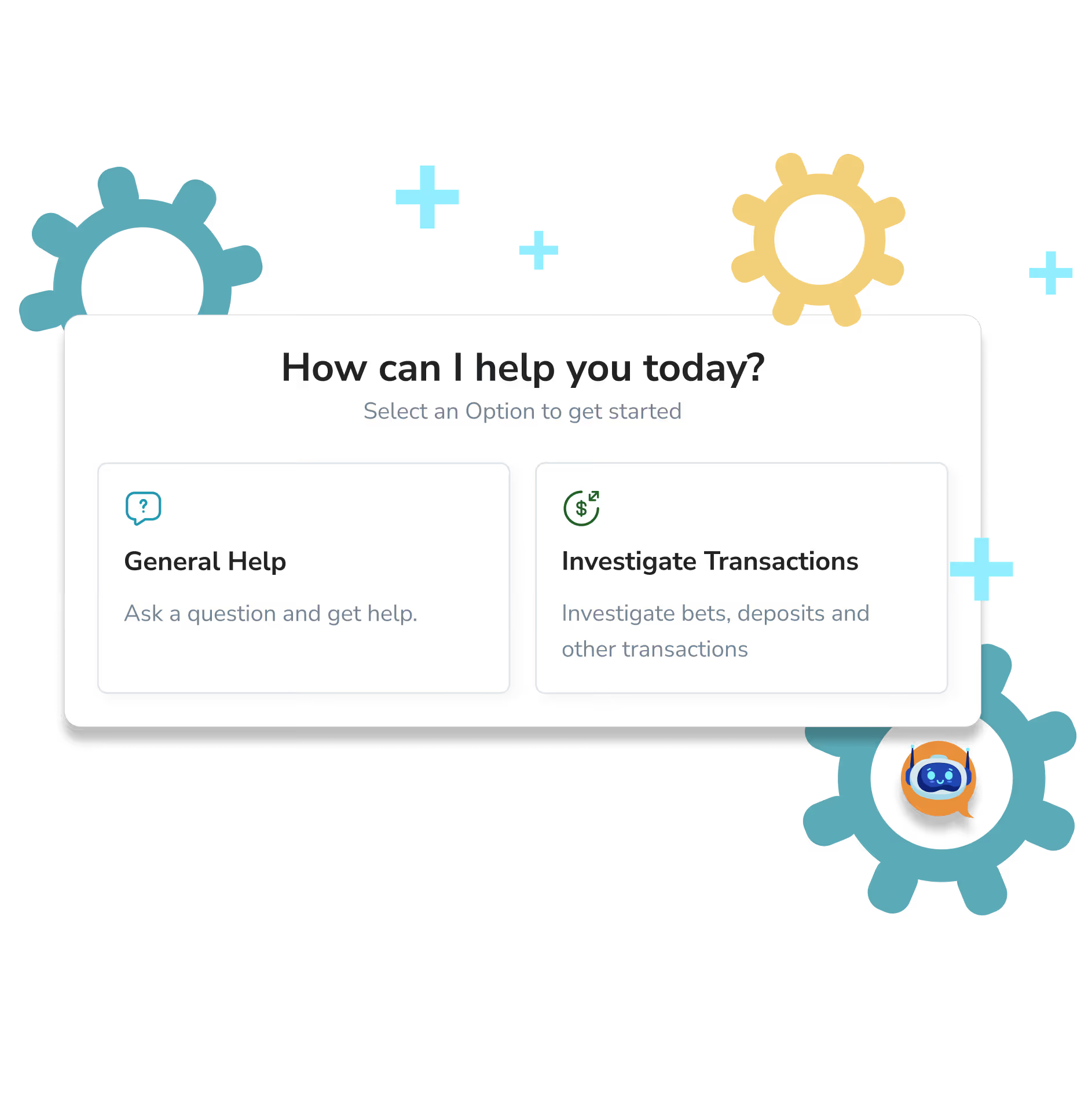
When we talk about AI tools that actually solve real problems, Smartico's approach stands out for a simple reason: the intelligence is built into the platform you're already using, not bolted on as an afterthought.
Their AI Agents system includes two distinct helpers working inside your CRM environment. The General Help Agent answers questions about platform features and configurations – basically a never-sleeping expert, always on stand by for you. The Transactions Agent analyzes your data, generates charts, and provides insights using natural language queries.
What makes this valuable for marketing teams is the context awareness. These agents tap into your platform's knowledge base and data warehouse for relevant, accurate responses specific to your setup. You're not getting generic advice, but answers based on your actual data and configurations.
For teams managing complex loyalty programs or running sophisticated CRM automation, this means faster problem-solving and deeper insights without switching tools or waiting for support. Ask a question in plain language, get actionable answers immediately, and keep your workflow moving.
{{cta-banner}}
Founded in 2019, Smartico.ai pioneered the unified approach to CRM automation and engagement tools. The solution combines real-time mechanics for user engagement, automated customer interactions, loyalty program management, and personalization engines – all working together instead of requiring you to stitch together multiple point solutions.
Making AI Work Without Adding Complexity
.jpg)
The irony of most marketing AI stacks is they promise to save time but end up creating more work through complexity. Learning curves. Integration headaches. Tools that overlap or contradict each other.
The solution isn't simpler tools, but smarter implementation. Start with one category where you're feeling the most pain. Master that before adding more. Focus on integration from day one. Measure actual results, not just activity.
And remember: AI should reduce your workload, not become another full-time job to manage.
What 2026 Really Looks Like for Marketing Teams Using AI
.jpg)
The marketing teams winning right now aren't the ones using every new AI tool that launches. They're the ones who've built coherent stacks that multiply human creativity instead of replacing it.
They use AI for the repetitive stuff – data analysis, content first drafts, campaign optimization, routine customer interactions. They use human judgment for strategy, creativity, relationship building, and anything requiring empathy or complex decision-making.
Marketing automation has shifted from static rules to adaptive systems using machine learning. Instead of "if this, then that" workflows, we have AI analyzing thousands of data points to predict and optimize outcomes continuously.
The practical result? Teams spend less time on busywork and more time on what actually moves the needle. They launch campaigns faster. They personalize at scale. They spot opportunities before competitors. They deliver better customer experiences without burning out their people.
The Bottom Line on Your AI Marketing Stack
Building the right AI marketing stack for 2026 comes down to three things: choosing tools that solve actual problems (not just impress people in meetings), ensuring those tools work together seamlessly, and maintaining the human element in everything you do.
AI won't replace marketers. But marketers using AI will absolutely replace those who don't. It’s all about how quickly you can integrate them effectively while maintaining the strategy and creativity that makes marketing actually work.
Start with your biggest pain point. Find the AI tool that addresses it best. Integrate it properly with your existing systems. Measure results. Then move to the next challenge. That's how you build a stack that actually pays off instead of just adding to your monthly software bill.
And remember: the goal isn't having the most AI tools. It's delivering better marketing outcomes with less manual effort. Sometimes that means using five tools really well. Sometimes it means using fifteen. What matters is the results, not the resumé.
Frequently Asked Questions
1. What's the difference between traditional marketing automation and AI-powered marketing tools?
Traditional marketing automation follows rules you set manually – think "if someone clicks this link, send that email." AI-powered tools learn from data and make decisions based on patterns across thousands of interactions. They adapt automatically, optimize in real-time, and handle complexity that would be impossible to program manually. The practical difference? Traditional automation does what you tell it. AI automation figures out what works best and adjusts accordingly.
2. Do I need technical skills to use AI marketing tools in 2026?
Not really, and that's the whole point. The AI tools gaining traction in 2026 are designed for marketers, not data scientists. You interact through normal interfaces – dashboards, chat windows, visual builders – and the AI handles the complex math behind the scenes. That said, understanding basic marketing metrics and being willing to experiment helps you get better results faster.
3. How do I measure ROI from AI marketing tools?
Start by establishing baseline metrics before implementation – campaign conversion rates, cost per acquisition, time spent on specific tasks, customer engagement scores. After rolling out AI tools, track those same metrics. Most platforms also provide their own analytics showing optimization improvements, time saved, and revenue impact. The key is connecting AI activities to actual business outcomes, not just measuring tool usage.
4. Can small marketing teams compete with AI, or is this only for enterprises?
Small teams actually have some advantages with AI. You're more agile, you can implement faster, and many AI tools have scaled pricing that makes them accessible. The challenge for enterprises is often coordination across teams and legacy systems. For small teams, the challenge is choosing wisely since you can't implement everything at once. Focus on tools that solve your biggest bottlenecks, and you'll see results regardless of team size.
5. What's the biggest mistake marketers make when adopting AI tools?
Trying to do too much at once. Teams get excited, implement five different AI tools simultaneously, create chaos, get overwhelmed, and abandon the whole thing. Better approach: identify one clear problem, find the AI tool that solves it, implement it properly with good data and integration, prove the value, then expand. Also, treating AI as a replacement for strategy rather than a tool to execute strategy better is a close second for biggest mistakes.
6. How important is data quality for AI marketing tools?
Critical. AI tools learn from your data, so if your data is messy – duplicate contacts, incomplete records, siloed across platforms – your AI will learn from that mess and give you messy results. Before investing heavily in AI tools, invest in cleaning and organizing your data. Set up proper tagging, ensure your CRM is current, eliminate duplicates, and establish processes to maintain data quality going forward. It's not exciting, but it makes everything else work better.
Want to see how AI can upgrade your marketing operations like nothing you’ve tried before? Request a demo of Smartico.ai and find out how unified CRM automation and AI-powered personalization can help you engage customers more effectively while reducing manual workload.
Did you find this article helpful? If so, consider sharing it with other industry professionals such as yourself.
Ready to use Smartico?
Join hundreds of businesses worldwide engaging players with Smartico.