


Emotional Intelligence Integration in CRM Systems: Reading Between the Lines of Customer Behavior

Companies don't just win customers anymore. They decode them. While most businesses chase after features and pricing, the smart ones are busy cracking a different code: the emotional DNA of customer behavior.
The numbers tell a story that's hard to ignore. Companies with strong emotional intelligence capabilities consistently outperform their competitors by significant margins in customer satisfaction. More importantly, the emotion detection and recognition market is experiencing explosive growth, projected to reach $136.46 billion by 2030 , driven by businesses recognizing that understanding customer feelings isn't optional anymore, but essential.
But here's what makes this interesting: we're not talking about reading minds or playing psychological games. We're talking about CRM systems that can sense when someone's frustrated before they slam their laptop shut, or detect excitement in an email before the customer even hits send.
When Your CRM Gets Feelings

Modern CRM systems are evolving beyond simple data repositories into sophisticated emotional intelligence platforms. These systems integrate sentiment analysis, tone detection, and emotional pattern recognition to create what industry experts call "emotion-aware customer management".
Think about the last time you called customer service while genuinely angry. A traditional CRM might flag you as a "frequent caller" or note your purchase history. An emotionally intelligent CRM, however, would detect the stress in your voice, automatically route you to the most empathetic agent, and suggest communication strategies that actually calm you down instead of making things worse.
{{cta-banner}}
Real-time sentiment analysis can increase sales by up to 20% and improve lead quality by 25%. The technology works by analyzing multiple data streams simultaneously—voice patterns, written communication, response times, and even the specific words customers choose—to create comprehensive emotional profiles.
Companies implementing these systems report impressive results. One tech company saw escalation rates decrease by 40% after introducing emotional intelligence to their voice agents. Another retail business experienced a 15% rise in positive feedback by using sentiment analysis to refine their marketing efforts.
The Science Behind Emotional AI

The mechanics of emotional intelligence in CRM systems rely on three core technologies working together: natural language processing (NLP), machine learning algorithms, and multimodal emotion recognition.
NLP enables systems to understand not just what customers say, but how they say it. Machine learning algorithms continuously improve accuracy by analyzing patterns across thousands of interactions. Meanwhile, multimodal fusion systems combine facial expressions, voice patterns, physiological signals, and contextual text data to achieve 15-20% higher accuracy than single-modality approaches.
Key emotional indicators that modern CRM systems can detect include:
- Voice tone and pitch variations that signal frustration or excitement
- Written communication patterns that reveal underlying concerns
- Response timing that indicates engagement levels
- Language choice that suggests emotional states
- Interaction frequency that patterns that predict churn risk
The technology has reached remarkable sophistication. Emotion detection systems now achieve accuracy rates of up to 87%, often outperforming human listeners in some cases. This precision allows businesses to respond appropriately to customer emotional states in real-time, turning potentially negative interactions into positive experiences.
Five Ways Emotional Intelligence Transforms Customer Relationships

1. Proactive Problem Resolution
Instead of waiting for customers to complain, emotionally intelligent CRM systems identify dissatisfaction early through subtle behavioral cues. They analyze interaction patterns, response delays, and communication tone to flag potential issues before they escalate.
A telecommunications company reduced customer complaint escalations by 38% after implementing emotion regulation training combined with AI-powered early warning systems. The system detected emotional decline patterns across repeated interactions, triggering automated recovery workflows before customers reached their breaking point.
2. Dynamic Communication Adaptation
These systems automatically adjust communication style based on detected emotional states. If a customer shows signs of confusion, the CRM might suggest simpler language and step-by-step explanations. If someone appears rushed, it prioritizes concise, action-oriented responses.
Businesses using this approach see customers who are 71% more likely to purchase when they feel personally connected. The key is matching the emotional tone of communication to the customer's current state rather than using one-size-fits-all messaging.
3. Intelligent Routing and Escalation
Emotional intelligence enables smarter ticket routing by matching customer emotional states with agent strengths. Frustrated customers get routed to agents with high empathy scores, while excited prospects connect with agents skilled at enthusiasm amplification.
This targeted approach has resulted in first-call resolution rates increasing by 25% and customer loyalty improvements of 30% in companies implementing comprehensive emotional AI frameworks.
4. Predictive Churn Prevention
By analyzing emotional sentiment trends over time, these systems can predict which customers are likely to leave before traditional metrics would flag them as at-risk. They identify subtle shifts in engagement patterns, satisfaction indicators, and communication frequency.
Companies using sentiment analysis for churn prediction report reducing customer churn by 10-20% while increasing customer retention efforts effectiveness by 30%. The early warning capabilities allow businesses to intervene with personalized retention strategies while relationships are still salvageable.
5. Personalized Experience Orchestration
Emotional intelligence provides truly personalized customer journeys by adapting not just to behavior patterns, but to emotional preferences. Some customers prefer direct, no-nonsense interactions, while others respond better to warm, relationship-focused communication.
Most buyers are willing to pay more for excellent customer experience, while half make impulse purchases after experiencing personalized approaches. Emotional AI makes this level of personalization scalable across entire customer bases.
The ROI Reality Check

The financial impact of emotional intelligence integration in CRM systems extends far beyond feel-good metrics. Companies implementing comprehensive emotional AI report measurable business improvements across multiple areas.
Organizations with emotionally intelligent service teams consistently outperform competitors in customer loyalty metrics and Net Promoter Scores. The improvements translate into concrete financial returns, with businesses seeing average returns of $3.50 for every $1 invested in AI customer service initiatives.
By analyzing instant feedback, for example, and resolving customer frustrations quickly, you can turn complaints into opportunities.
The technology also delivers operational efficiencies. Companies report 20% reductions in average handling time and 15% decreases in after-call work. These improvements allow businesses to allocate resources more effectively while maintaining higher service quality.
Implementation Challenges and Solutions

Integrating emotional intelligence into existing CRM systems isn't without obstacles. The three main challenges businesses face are contextual nuances, data privacy concerns, and integration complexity.
Contextual nuances present the biggest technical hurdle. Sarcasm, cultural differences, and industry-specific language can confuse algorithms trained on general datasets. The solution involves training models on industry-specific data and implementing human oversight for ambiguous cases.
Data privacy concerns require careful navigation of regulations like GDPR while maintaining analytical capabilities. Companies address this by implementing opt-in consent flows, data minimization protocols, and explainable AI outputs that satisfy regulatory requirements.
Integration complexity often overwhelms technical teams trying to connect emotional AI capabilities with existing systems. The most successful implementations start with pilot programs focusing on specific use cases before expanding to full-scale deployment.
The Competitive Advantage Factor
Companies that successfully integrate emotional intelligence into their CRM systems create significant competitive moats. While competitors focus on features and pricing, emotionally intelligent businesses build relationships that are much harder to replicate.
The advantage compounds over time. Customers who feel emotionally connected to brands are three times more likely to make repeat purchases and significantly more willing to recommend the business to others. This creates organic growth engines that reduce customer acquisition costs while increasing lifetime value.
Market leaders are already recognizing this shift. By 2025, experts predict that 60% of B2B sales teams will use data-driven sales models that blend AI with emotional intelligence. Companies that wait to implement these capabilities risk falling behind competitors who better understand and respond to customer emotional needs.
Looking Forward: The Evolution of Empathetic Technology

The future of emotional intelligence in CRM systems points toward even more sophisticated capabilities. Advances in edge computing are reducing emotion detection latency to under 50 milliseconds, enabling real-time emotional adaptation. Wearable emotion sensors are moving from research labs to commercial applications, potentially creating continuous emotional state monitoring for high-value customers.
Generative AI is beginning to enable systems that don't just recognize emotions but can simulate authentic emotional responses in virtual interactions. This technology promises to make automated customer service feel more human while maintaining the efficiency advantages of AI-powered systems.
The integration of Internet of Things (IoT) devices with emotional intelligence creates opportunities for contextual emotional awareness. Smart products could trigger service tickets or adjust experiences based on detected user frustration, creating seamless support experiences that anticipate needs before customers recognize them.
Smartico.ai: The Unified Gamification CRM Revolution
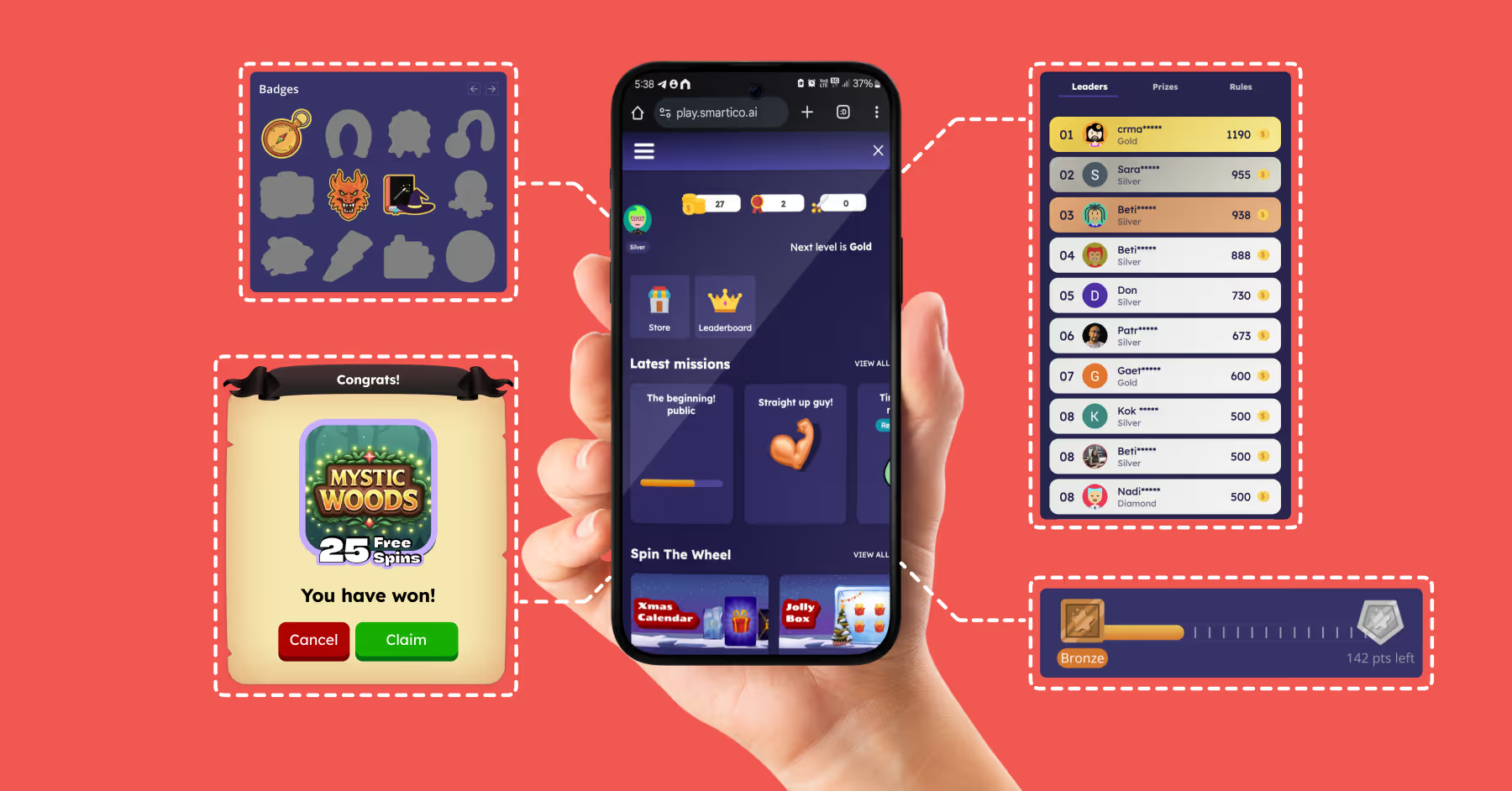
Smartico.ai stands as the industry's first unified Gamification/CRM Automation platform, specifically designed for businesses seeking to combine emotional intelligence with powerful engagement tools. Founded in 2018 and headquartered in Sofia, Bulgaria, Smartico has revolutionized how companies approach customer retention and engagement in the iGaming industry and beyond.
The software integrates advanced emotional AI capabilities with comprehensive gamification features, creating a unique ecosystem where businesses can respond to customer emotions while simultaneously driving engagement through personalized gaming experiences. Smartico's CRM automation streamlines every step of the player journey using hyper-personalized messaging and automated workflows that adapt based on detected emotional states and behavioral patterns.
What sets Smartico apart is its combination of real-time sentiment analysis with customizable gamification tools including missions, level-based rewards, loyalty wheels, scratch cards, and daily loot boxes. Its AI models predict customer behaviors and engagement patterns, optimizing message delivery timing and content based on individual emotional profiles.
Companies using Smartico report significant improvements in player retention and lifetime value, with the platform's emotional intelligence capabilities enabling more nuanced customer relationship management than traditional CRM systems. By unifying gamification and emotional AI in a single platform, Smartico.ai represents the next evolution of customer relationship management technology.
Book your demo of Smartico below to find out how it can help your iGaming business specifically raise loyalty and retention levels like nothing you’ve tried before.
{{cta-banner}}
Frequently Asked Questions

How accurate is emotional AI in detecting customer sentiments?
Modern emotion detection systems achieve astounding accuracy rates, often matching or exceeding human performance in controlled environments. However, accuracy varies based on context, language, and cultural factors. The most effective implementations combine AI analysis with human oversight for complex or ambiguous situations.
What data privacy concerns should businesses consider when implementing emotional AI?
Companies must navigate regulations like GDPR and emerging privacy frameworks by implementing explicit consent mechanisms, data minimization practices, and transparent data usage policies. The key is providing clear value to customers in exchange for emotional data access while maintaining strict security standards.
Can emotional intelligence integration work for small businesses, or is it only for large enterprises?
Emotional intelligence capabilities are increasingly accessible to businesses of all sizes through cloud-based CRM platforms. Many providers offer tiered pricing models that allow small businesses to start with basic sentiment analysis features and scale up as they grow. The technology's benefits aren't limited by company size.
How long does it typically take to see ROI from emotional intelligence CRM investments?
Most companies report seeing measurable improvements in customer satisfaction and engagement within 3-6 months of implementation. Financial ROI typically becomes apparent within 6-12 months, with many businesses achieving 3:1 or better returns on their emotional AI investments through improved retention and increased sales.
What industries benefit most from emotional intelligence in CRM systems?
While all customer-facing industries can benefit, sectors with high-stakes interactions see the most dramatic improvements. iGaming, financial services, healthcare, retail, and telecommunications typically experience the highest ROI due to the direct correlation between customer emotions and business outcomes in these fields.
Conclusion
Emotional intelligence integration in CRM systems represents more than technological advancement. It’s a fundamental shift toward understanding customers as complex human beings rather than data points. Companies embracing this approach build relationships that create lasting competitive advantages. As customer expectations continue evolving, businesses that can read between the lines of customer behavior will find themselves not just surviving, but thriving in an increasingly competitive marketplace.
Did you find this article helpful? If so, consider sharing it with other industry professionals such as yourself.