


Multi-Brand CRM Orchestration: Managing 5+ Casino Brands Without Operational Chaos
Imagine that you're running five casino brands. Each one targets a different market. One's focused on high rollers in Germany. Another caters to casual players in Brazil. You've got a third brand pushing sports betting in the UK.
Now imagine trying to manage player campaigns, bonuses, and reporting across all five properties using separate systems. You're drowning in spreadsheets. Your team is copying the same campaign five times with tiny tweaks. Reports don't match up. And when someone asks for consolidated numbers, you need three days and a prayer to pull them together.
Sound familiar? You're not alone.
The iGaming industry loves multi-brand strategies. Operators launch different brands to capture specific markets, player types, or geographic regions. Multi-brand strategies are accounting for a growing share of the iGaming market expansion, especially in regulated markets. But here's the problem nobody talks about: the operational nightmare that comes with it…
Why Operators Keep Adding Brands (Even When It's Complicated)

Let's start with the obvious question. If managing multiple brands is such a headache, why do operators keep doing it?
The answer is simple: money and market reach.
Different brands let you target different player segments without confusing your messaging. Your premium brand can court VIPs with white-glove service while your budget-friendly brand focuses on volume and accessibility. You can localize each property for specific markets – different languages, currencies, payment methods, and cultural preferences – without compromising your core brand identity.
Operators can localize brands for Germany, India, Brazil, or Nigeria, each with different game mixes, languages, and regulatory policies while still benefiting from the same operational backend. Smart operators see this as an advantage. Your competition is stuck with one brand trying to be everything to everyone. You've got five laser-focused properties, each speaking directly to its audience.
The problem? Most operators build their multi-brand empire first and figure out the infrastructure later.
The Real Cost of Operational Chaos

Here's what actually happens when you scale to multiple brands without proper orchestration.
Your CRM team becomes a copy-paste factory. They spend hours duplicating campaigns across brands, adjusting currencies, translating copy, and hoping they didn't miss anything. One operator we heard about had a team member manually copying the same welcome series across seven brands every Monday morning. That's not strategy work, but data entry.
Reporting becomes a full-time job. When leadership asks about overall portfolio performance, someone has to export data from five different systems, normalize it in Excel, and pray the formulas are correct. By the time you finish the report, the data is already outdated.
{{cta-banner}}
Player data sits in silos. A high-value player might churn from Brand A and immediately sign up at Brand B – your Brand B – and you'd never know. You're treating them like a new customer, wasting acquisition budget, and missing the chance to understand why they left in the first place.
Compliance gets exponentially harder. Different markets have different rules. When you're managing each brand separately, making sure everyone follows the right regulations becomes a coordination nightmare. Miss something in one market, and you're facing fines or worse.
When tracking is inconsistent, affiliates disengage, and regulators notice when reporting is inaccurate. The biggest risk? Complete operational breakdown where nobody really knows what's happening across the portfolio.
What Multi-Brand Orchestration Actually Means

Orchestration isn't just a fancy word for "managing multiple brands," but a specific approach to running a brand portfolio where everything connects.
Think of it like conducting an orchestra. Each instrument plays its own part, but they're all following the same conductor, working from the same sheet music, creating one unified performance. That's what proper multi-brand CRM orchestration does for your casino business.
At its core, orchestration means three things:
Centralized control with brand-level flexibility. You manage everything from one system, but each brand can customize its player experience. Your German brand sends emails in German with Euro pricing. Your Brazilian brand uses Portuguese and local payment methods. But both campaigns run from the same platform, using the same player data and reporting to the same dashboard.
Unified player data across all properties. When a player interacts with any of your brands, that information feeds into a single profile. You see their complete history across your entire portfolio. If they're a whale at Brand A and just signed up at Brand B, you know immediately.
Shared resources without duplication. Build a campaign template once, deploy it across five brands with localized tweaks. Create a retention workflow, then apply it portfolio-wide. Your team focuses on strategy and optimization instead of repetitive manual work.
The Campaign Management Problem (And Solution)

Let's talk about campaigns because this is where most operators feel the pain first.
You're running a summer promotion. All five brands need to participate, but each one needs its own spin. Brand A is offering free spins on specific slots. Brand B is doing a cashback promotion. Brand C has a tournament. Brand D combines everything. Brand E is in a restricted market and can only offer limited bonuses.
In a traditional setup, your team builds five separate campaigns from scratch. Different segments, different triggers, different creative, different everything. If you need to adjust the promotion mid-campaign, you're making changes in five places and hoping they all align.
With proper orchestration, you build the campaign framework once. The core logic, timing, and player segments are defined at the portfolio level. Then each brand customizes its specific elements. Need to pause the promotion across all brands? One click. Want to see which brand is performing best? Single dashboard.
One operator managing more than 200 whitelabel brands for both casino and sports betting covered them all with the same set of campaigns, with each brand maintaining its own style, different currencies and languages.
This isn't theoretical. Operators are doing this right now.
Unified Reporting: Finally Seeing the Full Picture

Remember when we talked about the three-day reporting nightmare? Unified reporting fixes that.
Here's what changes: Instead of exporting data from multiple systems and trying to normalize everything in Excel, you get one report that shows your entire portfolio. Total player count. Consolidated revenue. Retention rates by brand. Everything in one place, updated in real time.
You can drill down to see individual brand performance, or zoom out for portfolio-level insights. Compare Brand A's retention rate to Brand B's. See which markets are growing fastest. Identify which player segments are most valuable across all properties.
The really powerful part? You can track player movement between brands. When someone churns from one property and reappears at another, you see it. This transforms how you think about customer lifetime value because you're measuring it at the portfolio level, not the brand level.
Operators benefit from simplified management as they can consolidate tracking, reporting, and commission structures across multiple gaming products.
Building Your Multi-Brand Framework

So how do you actually set this up? What does a proper multi-brand CRM orchestration framework look like?
Start with your player data foundation. Everything else builds on this. You need a system that captures player behavior across all brands and consolidates it into unified profiles. This means integrating all your gaming platforms, payment systems, and customer databases into one central hub.
Define your brand hierarchy. Some elements should be consistent across your entire portfolio. Others need to vary by brand. Figure out which is which. Responsible gaming policies? Probably portfolio-wide. Bonus structures? Likely brand-specific. Player segmentation logic? Could go either way depending on your strategy.
Create reusable campaign templates. Build your core campaigns once with flexibility built in. Welcome series, reactivation workflows, VIP programs – these follow similar patterns across brands even if the specific details differ. Templates let you maintain that consistency while allowing for necessary customization.
Set up intelligent automation. The whole point of orchestration is reducing manual work. Automate routine tasks like bonus delivery, churn prevention triggers, and compliance reporting. Your team should focus on strategy and optimization, not data entry.
Implement cross-brand intelligence. This is where orchestration really pays off. Use insights from one brand to improve others. If a specific promotion crushes it in Market A, test it in Market B. If certain player segments consistently underperform across multiple brands, adjust your acquisition strategy.
The Technical Requirements Nobody Talks About

Here's the uncomfortable truth: most CRM systems weren't built for this.
Traditional CRM platforms treat each brand as a separate instance. You can technically manage multiple brands, but you're essentially running parallel systems that don't talk to each other. That's not orchestration. That's just organized chaos.
What you actually need is a system designed from the ground up for multi-brand operations. A multi-tenant architecture unifies content flows, session management, and payments under one secure umbrella. This means shared infrastructure with brand-level customization.
The system needs to handle multiple currencies, languages, and regulatory requirements simultaneously. It should support brand-specific bonus logic while using centralized player data. And it needs to generate both brand-level and portfolio-level reporting without manual data wrangling.
Integration capabilities matter too. Your CRM orchestration platform needs to connect with all your gaming platforms, payment processors, and analytics tools. A platform should manage consistent tracking across multiple brands and products.
Common Mistakes That Kill Multi-Brand Operations

Even operators with the right intentions mess this up. Here are the biggest mistakes.
Mistake one: Building brand-specific systems and bolting them together later. This seems logical at first. Start with Brand A, build everything custom, then repeat for Brand B. By the time you get to Brand C, you realize nothing connects properly. Now you're stuck with three separate systems and the "integration project" that never quite gets finished.
Mistake two: Over-centralizing everything. The opposite problem. You build one rigid system and force all brands to work exactly the same way. Your German high-roller brand runs the same campaigns as your Brazilian casual-player brand because "that's how the system works." Your brands lose their identity and your conversion rates tank.
Mistake three: Ignoring the compliance complexity. Different markets have different rules about bonus structures, communication frequency, and responsible gaming features. Managing complex, multi-jurisdiction operations with varying regulatory requirements requires systems that can enforce different rules for different brands automatically.
Mistake four: Treating reports as an afterthought. You focus on campaign management and player engagement, assuming reporting will "just work." Then leadership asks for portfolio performance metrics and you realize you can't easily answer basic questions about cross-brand player behavior or consolidated lifetime value.
Mistake five: Underestimating the team training required. New systems mean new workflows. If your team doesn't understand how to use the orchestration tools properly, they'll fall back to old habits. Before you know it, they're exporting data to Excel and building campaigns manually again.
When Multi-Brand Orchestration Makes Sense (And When It Doesn't)

Not every operator needs this level of sophistication. If you're running one or two brands with similar target audiences in the same market, basic CRM tools probably work fine.
But if any of these apply to you, orchestration becomes essential:
1. You're managing three or more brands.
The operational overhead crosses a threshold around three brands. Below that, manual workarounds are annoying but manageable. Above that, they become business-limiting.
2. Your brands target different geographic markets.
Each market has its own regulations, currencies, languages, and player preferences. Managing this complexity without orchestration is asking for trouble.
3. You're planning to expand.
If you're launching new brands or entering new markets, build the orchestration infrastructure now. It's exponentially harder to retrofit later.
4. You need consolidated reporting.
If stakeholders, investors, or regulators need portfolio-level insights, you need unified reporting. Excel gymnastics don't scale.
5. Your team spends more time on execution than strategy.
If your CRM managers are drowning in manual tasks instead of optimizing campaigns and analyzing player behavior, that's a sign your infrastructure can't keep up with your portfolio.
Key Features Your Orchestration Platform Needs

Not all systems are created equal. When evaluating multi-brand CRM orchestration platforms, these features separate the contenders from the pretenders:
- Multi-tenant architecture with brand isolation. Each brand should feel like its own system from the operator's perspective, while actually running on shared infrastructure.
- Unified player profiles across brands. See complete player history across your entire portfolio in one place.
- Campaign templates with brand-level customization. Build once, deploy everywhere, customize as needed.
- Real-time cross-brand analytics. Track player movement, compare brand performance, and spot trends across your portfolio.
- Centralized bonus management with brand-specific rules. Control costs at the portfolio level while allowing brand teams to run their own promotions.
- Automated compliance workflows. Different rules for different markets, enforced automatically.
- API flexibility for custom integrations. Connect with your existing tech stack without rebuilding everything.
The ROI of Getting This Right

Let's talk about what actually happens when you implement proper multi-brand orchestration.
First, your team gets time back. Hours spent on manual campaign duplication disappear. Reporting time drops from days to minutes. Your CRM managers can finally focus on strategy instead of data entry.
Second, your campaigns improve. When you can easily test approaches across brands and apply learnings portfolio-wide, your optimization velocity increases. Best practices spread faster. Underperforming brands catch up to leaders.
Third, player lifetime value increases. You're no longer losing track of players who move between brands. You can identify cross-sell opportunities. You understand true customer value at the portfolio level and make better acquisition decisions.
Fourth, operational costs drop. Teams don't need to triple just because brand portfolios do, thanks to shared tools and automation. You're doing more with the same resources.
Fifth, expansion becomes easier. Adding Brand Six isn't a massive project anymore. You're plugging into existing infrastructure, not building from scratch. Once a base platform is live, deploying a new casino brand becomes a matter of days not months.
Making the Transition

Here's the hard part: getting from where you are to where you need to be.
Most operators can't just shut down everything and rebuild. You're running live businesses generating real revenue. The transition needs to happen without disrupting operations.
Start by mapping your current state. Document all your brands, markets, campaigns, and systems. Understand how everything currently connects and where the pain points are.
Prioritize your biggest problems. Maybe cross-brand reporting is killing you. Or campaign duplication is eating your team's time. Or compliance tracking is a constant source of stress. Pick the problem that's causing the most pain and solve that first.
Phase your implementation. You don't need to move all brands at once. Start with one or two brands on the new platform. Prove it works. Then migrate others gradually.
Plan for data migration carefully. Player data, campaign history, and performance metrics need to move cleanly. This is where a lot of transitions go wrong. Take the time to get it right.
Train your team thoroughly. New systems mean new workflows. Invest in proper training so your team can actually use the new capabilities.
Smartico.ai: Purpose-Built for Multi-Brand Operations
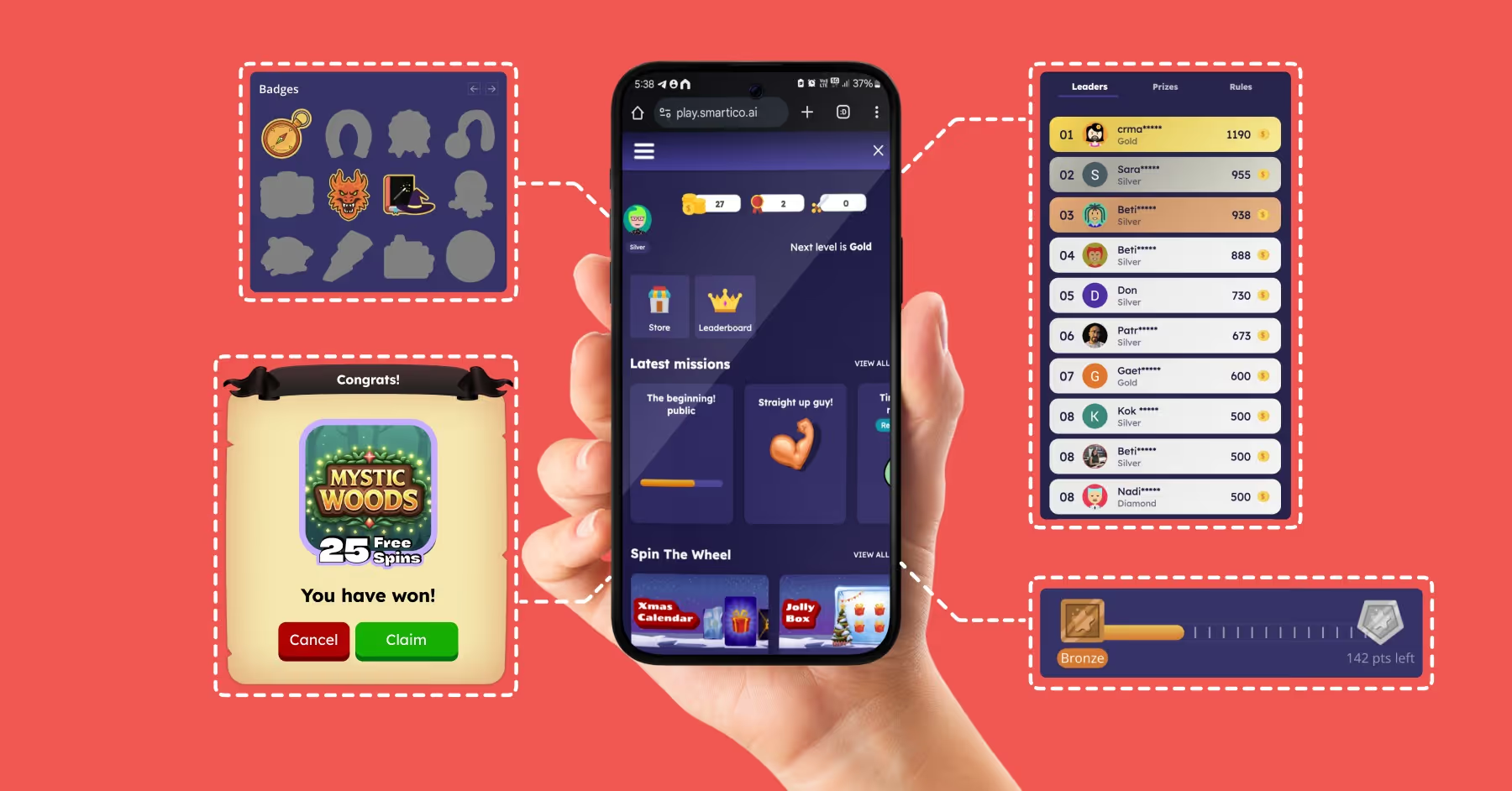
Smartico.ai pioneered the unified CRM and Gamification approach for iGaming. Founded in 2019, Smartico was born as the first unified CRM automation and gamification platform.
The platform was designed specifically for multi-brand operators. Each brand maintains its own campaigns, gamification settings, and bonus configurations while benefiting from centralized control and unified reporting. This means you get portfolio-level efficiency without sacrificing brand-level flexibility.
Smartico combines CRM automation, gamification tools, bonus management, and AI-powered insights in one system. Real-time player data flows across all brands, enabling true orchestration. Campaign templates let you build once and deploy everywhere with brand-specific customization.
The platform integrates with all major gaming platforms and supports multiple currencies, languages, and regulatory frameworks. Operators using Smartico report significant improvements across key metrics, with retention rates increasing exponentially thanks to personalized gamified experiences.
To find out how Smartico can help you catapult revenue via the unified power of CRM and Gamification, book your free, in-depth demo below.
{{cta-banner}}
Conclusion
Running multiple casino brands doesn't have to mean operational chaos. With proper CRM orchestration, you can maintain brand-specific player experiences while gaining portfolio-level efficiency and insights.
The operators winning in today's competitive iGaming market aren't just launching more brands. They're building infrastructure that lets them manage those brands intelligently. They're using unified player data to understand true customer value. They're automating routine work so teams can focus on strategy.
If you're managing multiple brands with separate systems, you're fighting with one hand tied behind your back. The competition isn't. They've moved to orchestrated operations, and they're capturing the efficiency gains and strategic advantages that come with it.
FAQ
What's the difference between multi-brand CRM and regular CRM?
Multi-brand CRM orchestration is specifically designed to manage multiple casino properties from one system. Regular CRM treats each brand as separate, requiring duplicate work and offering no portfolio-level visibility. Orchestration provides centralized control with brand-level customization, unified reporting, and shared player intelligence.
How many brands do you need before orchestration makes sense?
The threshold is typically three brands. Below that, manual workarounds are manageable. At three or more brands, especially if they target different markets or player segments, the operational complexity justifies investing in proper orchestration infrastructure.
Can you implement orchestration without disrupting current operations?
Yes, through phased implementation. Start by migrating one or two brands to the new platform while others continue on existing systems. Once you've proven the approach works, gradually migrate remaining brands. This reduces risk and maintains business continuity.
What happens to historical player data during migration?
Historical data migrates to the new platform as part of the transition process. This includes player profiles, campaign history, and performance metrics. Proper data migration planning ensures you maintain continuity and don't lose valuable insights.
How does orchestration impact brand identity?
Done correctly, orchestration strengthens brand identity rather than compromising it. Each brand maintains its unique player experience, visual identity, and market positioning. The difference is that operations and infrastructure are shared behind the scenes, making everything more efficient without affecting what players see.
Did you find this article helpful? If so, consider sharing it with other industry professionals such as yourself.