


The Compliance-First CRM Architecture: Built-In GDPR, Responsible iGaming & Multi-Jurisdictional Rules
It’s the email every iGaming operator dreads.
It lands in your inbox at 8:00 AM on a Tuesday. It’s from a regulator – maybe the UKGC, maybe the KSA in the Netherlands, or perhaps a state board in the US. They aren't saying "hello." They’re asking for an audit trail on a specific high-roller who self-excluded three months ago but somehow received a "Welcome Back" bonus email yesterday.
If your stomach dropped just reading that, you aren't alone.
In 2025, the iGaming landscape isn't the Wild West anymore, but a highly structured, heavily scrutinized environment where "oops" doesn't cut it. The fines are massive, but the reputational damage is worse.
For a long time, CRM and compliance were treated like oil and water. Marketing teams wanted to send emails; compliance teams wanted to stop them. The tech stack usually reflected this: a flashy CRM for the marketers, and a clunky, separate database for the legal team.
That architecture is officially obsolete.
To survive the current regulatory pressure, you need a compliance-ready CRM casino solution. You need a system where the rules aren't just a weak fence around the perimeter, but the foundation of the house. Here is why the "bolt-on" era is over, and how a compliance-first architecture actually helps you sleep better at night.
The "Bolt-On" Problem: Why Legacy CRMs Fail in 2025

Let’s be honest about how most older setups work. You have your Player Account Management (PAM) system, your email provider, a separate gamification tool, and maybe a spreadsheet for VIPs.
When a player hits a responsible gaming trigger – say, they spend too much too quickly – that data sits in the PAM. Ideally, it should instantly tell the marketing system to "stop." But in legacy setups, that data sync happens via a batch process. Maybe every four hours. Maybe once a day.
{{cta-banner}}
In that four-hour gap, your automated CRM might trigger a "Deposit Now for 50 Free Spins" push notification.
Technically, your systems are working. But functionally, you just broke the law.
This is the danger of "bolt-on" compliance. When you try to force a generic marketing platform to understand complex iGaming regulations, you end up with latency. And in 2025, latency is liability.
Anatomy of a Compliance-First Framework

So, what does a regulatory CRM framework actually look like? It’s not about hiring more people to check lists manually. It’s about architecture.
A compliance-first system doesn’t ask "Can we send this message?" after the campaign is built. It asks that question before the audience is even selected.
1. Real-Time Data Ingestion (The "Kill Switch")
We aren't talking about "fast" data. We are talking about real-time. If a player hits a "Cool Off" button on their profile, that tag needs to hit your CRM automation engine instantly.
The architecture must support event-driven triggers. If Event: Self_Exclusion occurs, the system should immediately:
- Remove the player from all active journeys.
- Invalidate any unclaimed bonuses in their digital wallet.
- Add a suppression tag to their profile.
If your current system takes 15 minutes to process that tag, you have a 15-minute window of vulnerability.
2. Granular Consent Management (The GDPR Shield)
GDPR isn't new, but enforcement is getting sharper. The "Right to be Forgotten" is a nightmare for fragmented systems. If a player asks to be deleted, can you guarantee their data is wiped from your email vendor, your SMS gateway, and your gamification engine simultaneously?
A unified architecture handles this centrally. You press the button once, and the data cascades through the entire ecosystem. It ensures that GDPR gamification automation isn't an oxymoron – you can have fun, engaging mechanics that respect privacy boundaries automatically.
3. The Multi-Jurisdictional toggle
Running a brand in Ontario, the UK, and Malta? You know the pain.
- Ontario: Strict rules on inducing play.
- UK: Heavy focus on affordability checks.
- Malta/Curacao: Different sets of marketing freedoms.
A compliance-first CRM allows you to segment not just by player value, but by jurisdiction. You should be able to build one master campaign and apply "Regional Filters."
Example: You want to run a "Friday Feelin'" promotion.
- Filter A (UK): Excludes anyone who hasn't passed an affordability check.
- Filter B (Ontario): Strips out the "Bonus" language and focuses on the game art (compliant with local advertising standards).
- Filter C (ROW): Sends the standard offer.
If your team has to clone campaigns manually for every region, human error is inevitable. Automation solves this.
5 Ways Automation Saves Your Compliance Officer’s Sanity

We often think of iGaming software automation as a way to make money, but it’s actually your best defense mechanism. Here is how smart workflows keep you safe.
- The Bonus Blocker
You can set logic rules that prevent bonuses from triggering if specific risk markers are present. If a player’s risk score goes from Low to Medium, the system automatically creates a "hard stop" on all bonus issuance, no matter what the VIP manager tries to do manually. - The KYC Nudge
Instead of blocking a player abruptly when they hit a withdrawal threshold, use gamification. Create a "mission" called "Verify Your Identity." When they upload their documents, reward them with loyalty points (where regulation allows). It turns a bureaucratic friction point into a part of the player journey. - The Affordability Audit Trail
Regulators love logs. A unified CRM logs every interaction. If you are asked, "Why did you send this offer?" you can pull a log showing: At 10:02 AM, Player X was marked 'Safe'. The email went out at 10:03 AM. Player X self-excluded at 10:45 AM. You have proof you acted correctly based on the data you had at the second of sending. - The Dormant Player Wake-Up (Carefully)
Reactivating churned players is high-risk. Are they dormant because they are bored, or because they are broke? Automated logic can check their last known deposits and interactions. If the pattern looks like "chasing losses" before they churned, the system suppresses the reactivation email. - Marketing Fatigue Prevention
Bombarding players isn't just annoying; in some jurisdictions, it's viewed as predatory. CRM automation allows you to set global caps. "No more than 3 messages per week across all channels." The system enforces this rigorously, protecting the player and your license.
Beyond Fines: How Compliance Actually Builds Trust
It’s easy to look at compliance as the "Department of No." But let's flip the script. A safe environment is a sticky environment.
- Players stay longer: When players feel you are looking out for them (e.g., nudging them to take a break rather than draining their wallet), their lifetime value (LTV) extends.
- Payments happen faster: Clean data and verified accounts mean fewer hiccups with payment processors.
- The "White Hat" Premium: In regulated markets, being the "safe" brand is a marketing asset. You attract the casual, recreational players who play for fun, rather than the high-risk problem gamblers who bring regulatory heat.
Smartico.ai: The Unified Engine Under the Hood
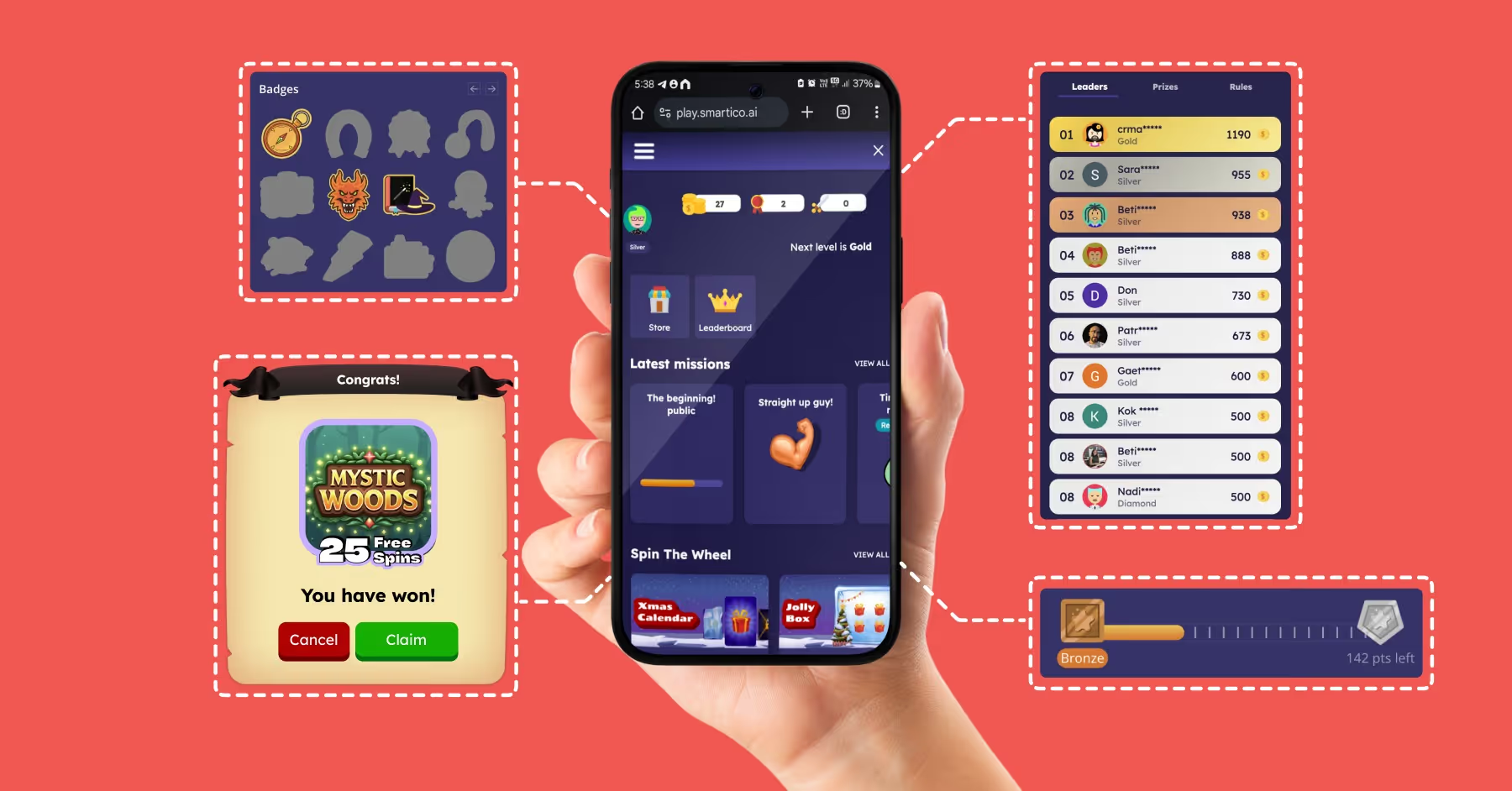
If you are trying to piece together this level of safety using three different vendors, you are fighting a losing battle. This is where Smartico.ai changes the conversation.
Founded in 2019, Smartico.ai is the industry’s leading unified Gamification and CRM Automation software. It wasn't built as an email tool that later decided to add casino features. It was architected specifically for the iGaming vertical.
It combines real-time gamification mechanics (missions, tournaments, levels) with a robust CRM automation suite. Because these two sit on the same codebase, they talk to each other instantly.
When a player hits a Responsible Gaming trigger in your PAM, Smartico.ai knows immediately. It can lock the gamification widget, pause the loyalty progress, and reset the marketing journey – all in milliseconds. Smartico provides the personalization in loyalty programs that players love, wrapped in the safety net that Compliance Officers demand.
Want to see how it works? Book your free, in-depth demo below.
{{cta-banner}}
Frequently Asked Questions
Can a CRM really handle different legal ages for different countries?
Yes. A robust system allows you to use "Age" and "Country" as variable filters. You can set a global rule that blocks any communication to users under 18 (or 21 in some US states/regions) automatically, pulling data directly from the registration fields.
Does gamification encourage addictive behavior?
It depends on how you design it. Responsible gamification focuses on entertainment (missions, avatars, regulated tournaments) rather than pure expenditure. Smartico.ai’s tools allow you to set limits on how much time or money can contribute to a mission, preventing "grinding" behaviors that lead to harm.
How does the "Right to be Forgotten" work in a unified system?
In a unified unified gamification CRM, the request is processed at the user ID level. Once that ID is flagged for deletion, the system anonymizes their data across the loyalty engine, email logs, and behavioral tracking history simultaneously, ensuring full GDPR compliance without manual scrubbing.
Can we automate Anti-Money Laundering (AML) checks via CRM?
Indirectly, yes. While the CRM doesn't replace your AML software, it can receive triggers. If a player deposits a large sum that flags an AML alert, the CRM can automatically suspend all "Withdrawal Success" messages or bonuses until the AML team clears the flag.
Stop "Patching" Your Compliance
The regulatory walls are closing in, but that doesn't mean your business has to shrink. It just means your tech needs to grow up.
Trying to run a regulated iGaming brand in 2025 with 2015 technology is a gamble you will eventually lose. You need a system where compliance is the skeleton, not the coat of paint.
You need architecture that moves as fast as your players do.
Ready to see what a compliance-first engine looks like?
Request a Demo of Smartico.ai today and stop worrying about the 8:00 AM email.
Did you find this article helpful? If so, consider sharing it with other industry professionals such as yourself.
Ready to use Smartico?
Join hundreds of businesses worldwide engaging players with Smartico.