


What Can AI Agents Do in iGaming? A Practical Guide for Operators
.avif)
AI agents are now part of nearly every iGaming platform conversation, but the term gets used so loosely that it has lost a lot of meaning. For an operator trying to decide where AI fits into a casino or sportsbook, the real question is simpler: what can these agents do today, and which of those things move the numbers that matter. This guide breaks down the practical use cases for AI agents in iGaming, with a focus on what operators are running in production rather than what sounds good in a pitch deck.
What is an AI agent in iGaming (and how it differs from a chatbot or automation rule)
An AI agent is a system that can take in a goal, work through the steps to reach it, and act with some degree of independence. That is the line between an agent and the tools operators have used for years.
A scripted chatbot follows a fixed decision tree. It answers the questions it was built to answer and stops at the edge of its script. A traditional automation rule fires when a condition is met: if a player deposits, send this message. Useful, but rigid. It does exactly what it was told and nothing more.
An AI agent sits a level above both. Ask it to pull last month's churn figures for a player segment and it can interpret the request, query the data, and return a plain answer without a human writing the query. Point it at a promotional campaign and it can generate the creative, adjust to the brief, and produce variations. The agent handles the path to the goal, not just a single pre-set step.
For operators, the practical takeaway is this: chatbots and rules handle known, repeatable tasks. Agents handle tasks where the steps vary and judgment is involved. Knowing which problems fall into which bucket is most of the work in deciding where AI agents belong in your stack.
Core use cases for AI agents in online casinos
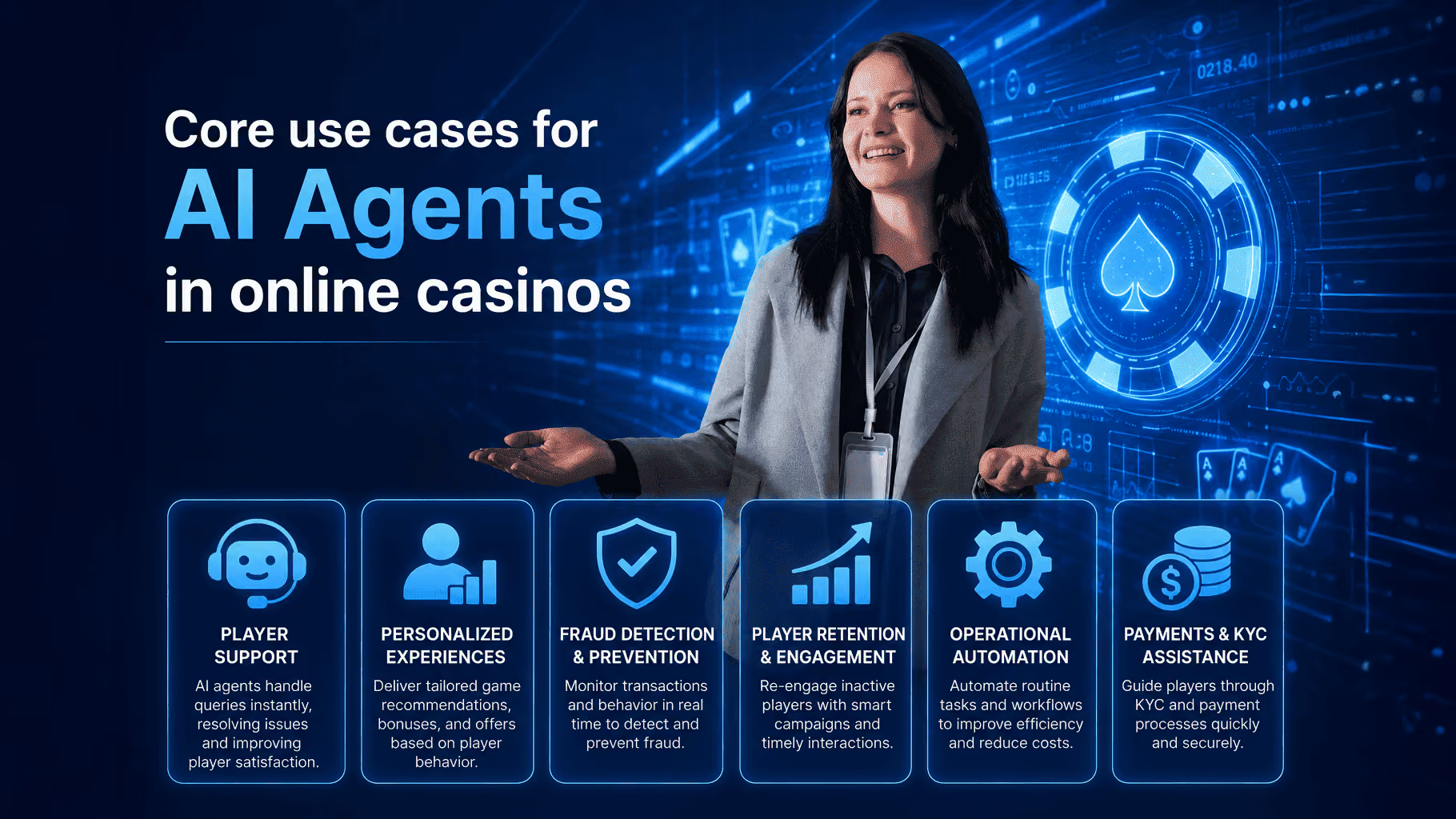
The strongest case for AI agents in online casinos is not one big breakthrough feature. It is a set of focused jobs, each one removing friction from a workflow that used to need manual effort or a support ticket. Here are the use cases operators are getting real value from.
Player support and 24/7 query handling
Support is the most mature use case. AI agents handle the high volume of routine questions that arrive at all hours: account access, deposit and withdrawal queries, bonus terms, basic troubleshooting. The agent resolves what it can and escalates the genuinely complex or sensitive cases to a human team.
The value is twofold. Players get instant answers instead of waiting in a queue, and support staff stop spending their day on repetitive questions and focus on the cases that need a person. For a global operator running across time zones, this is the difference between round-the-clock coverage and a backlog every morning.
CRM automation and campaign triggers
This is where AI agents start to compound. Instead of a CRM manager manually building every segment and timing every send, an agent can read player behavior, identify the right moment to act, and trigger the appropriate campaign. Churn signals, deposit patterns, and engagement drops all become inputs the agent can respond to in close to real time.
The result is retention work that does not depend on a person catching every signal manually. A lean CRM team can maintain consistent, personalized outreach across thousands of players without adding headcount, which is often the practical barrier that stops smaller operators from running sophisticated lifecycle programs.
Bonus personalization
Generic bonuses are easy to ignore. The more an offer matches what a specific player does, the more likely it is to land. AI agents can analyze individual behavior and shape the offer accordingly: which bonus, through which channel, at what time, for each player rather than each segment.
Done well, this reduces wasted bonus spend on players who would not have responded anyway and improves the relevance of every offer that does go out. The agent does the per-player calculation that no team could do by hand at scale.
Fraud and anomaly detection
Fraud detection is a natural fit for AI agents because the work is pattern recognition at speed. An agent monitoring player activity can flag anomalies the moment they appear: unusual deposit behavior, multi-accounting signals, patterns that suggest bonus abuse. The faster a problem is caught, the less damage it does.
The practical benefit operators notice most is the reduction in false positives. A well-tuned agent reduces the manual review burden and stops legitimate players from being caught up in blunt rule-based checks, which protects both the bottom line and the player experience.
VIP management and escalation
High-value players need attention that does not scale through automation alone. AI agents help by handling the monitoring layer: tracking VIP activity, surfacing the players who need a human touch, and escalating at the right moment. The agent does the watching so the VIP team can do the relationship work.
This keeps the human effort focused where it earns its return. Instead of manually scanning dashboards to spot which VIPs are cooling off, the team gets pointed at the accounts that matter, when they matter.
Creative and content generation for promotions
Producing promotional assets is slow when every popup, banner, and gamification mechanic needs to be designed from scratch. AI agents built for this generate creative to spec in minutes: custom Spin the Wheel designs, popups, mini-game art, branded imagery. The CRM team describes what they need and the agent produces it.
The gain here is speed and volume. Campaigns that used to wait on a design queue can go live faster, and teams can test more variations because the cost of producing each one drops sharply.
What makes an AI agent useful versus a marketing label
.avif)
Not everything described as an AI agent earns the name. A few signals separate working product from slideware, and they are worth knowing before any vendor conversation.
The first is whether the agents are focused or vague. A platform that ships several purpose-built agents, each solving a specific operator workflow, tends to be describing real capability. A single general-purpose assistant that supposedly does everything usually does very little of it well.
The second is release cadence. Platforms with working AI agents ship updates regularly, adding capabilities and refining guardrails over time. A platform still pitching tends to have launched one AI feature a long time ago that has not moved since.
The third is honest scoping. Vendors with deployed AI talk openly about what their agents cannot do and where human oversight stays in the loop. Vendors selling vibes claim everything works perfectly. The first group is describing a product. The second is describing a hope. For a fuller treatment of this distinction, our breakdown of AI agents in iGaming CRM: deployed reality versus marketing hype digs into how to tell them apart.
What to ask when evaluating AI agents for your iGaming platform
.avif)
If you are weighing AI agents for a casino or sportsbook, a short list of questions cuts through most of the noise.
Ask which specific workflows each agent handles, and request to see it running on a live operator scenario rather than a demo environment. A vendor with real product will show you; a vendor with slideware will deflect.
Ask how the agents handle regulated markets and where human oversight remains mandatory. Operator-facing agents that help teams configure campaigns or query data are generally low-risk. Player-facing agents that touch real-money interactions in regulated jurisdictions are a sensitive area, and any serious platform keeps a human in the loop there.
Ask about realistic deployment timelines. Basic features like agent-assisted setup help can go live quickly. Agents that need tuning on your specific player data take longer. Any vendor promising same-day deployment of fully tuned predictive agents is overselling.
Ask how the AI layer connects to the rest of the platform. An agent that operates on the same data as your CRM, gamification, and loyalty tools is far more useful than one bolted on as a separate product, because the data from each interaction feeds back and sharpens the rest.
Finally, ask what happens when an agent gets something wrong. The answer tells you how seriously the vendor takes the parts of this that are still hard.
How Smartico approaches AI agents in iGaming
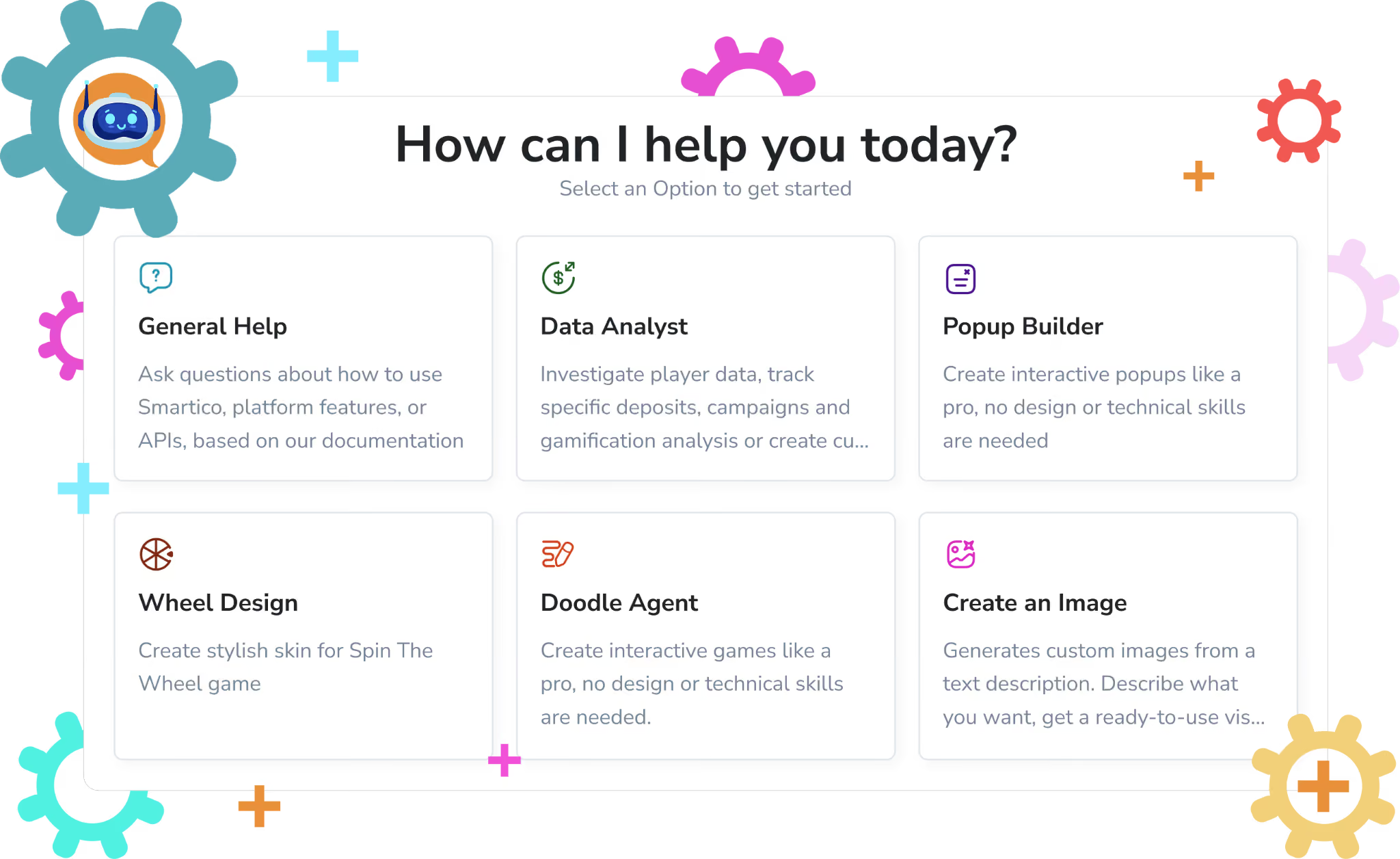
Smartico is a unified gamification and CRM automation platform built for iGaming, and its approach to AI follows the focused-agent model described above. The platform ships several AI agents in production, each built for a specific operator workflow rather than as a single catch-all assistant. They cover support and configuration help, natural-language data queries, and creative generation for promotions and gamification mechanics, among other jobs.
Because the agents operate inside the broader platform, alongside real-time gamification, CRM automation, loyalty management, and personalization, the data from each interaction feeds back into the system rather than sitting in a silo. You can see how each agent maps to the use cases covered in this guide on the Smartico AI Agents page.
If you want to judge the agents on live operator scenarios rather than descriptions, the practical next step is to request a demo below and see them run.
{{cta-banner}}
Frequently asked questions
1. What is the difference between an AI agent and an automation rule in iGaming?
An automation rule fires a fixed action when a set condition is met, such as sending a message after a deposit. An AI agent interprets a goal and works through the steps to reach it, handling tasks where the path varies rather than executing one pre-set step. Rules handle known, repeatable tasks; agents handle tasks that involve judgment.
2. AI agents safe to use in regulated iGaming markets?
Operator-facing agents that help teams configure campaigns, query data, or generate internal content are generally low-risk and widely used. Player-facing agents that handle real-money interactions in regulated jurisdictions remain sensitive, and reputable platforms keep human oversight in the loop. Always confirm with your compliance team before enabling player-facing AI features.
3. How long does it take to deploy AI agents in an existing iGaming platform?
It depends on the agent. Basic features like agent-assisted setup help can go live in a few days. Agents that need to be tuned on operator-specific player data can take several weeks. A vendor promising same-day deployment of fully tuned predictive agents is overselling the timeline.
4. Can smaller operators benefit from AI agents, or are they only for large platforms?
Smaller operators often benefit more, because lean teams cannot manually manage player communication, segmentation, and support at scale. AI agents let a small team maintain consistent, personalized work across thousands of players without adding headcount.
5. Do AI agents replace human teams in iGaming?
No. The practical model is agents handling the high-volume, repetitive layer and escalating complex or sensitive cases to people. Support agents resolve routine queries and pass the hard ones to humans; VIP agents surface the accounts that need attention so the team can do the relationship work. The human effort gets focused, not removed.
For a simple breakdown of how AI Agents work, check out IBM’s tutorial below.
Did you find this article helpful? If so, consider sharing it with other industry professionals such as yourself.
Ready to use Smartico?
Join hundreds of businesses worldwide engaging players with Smartico.