


Safer Gambling at the CRM Layer: How Player Protection Integrates with Retention
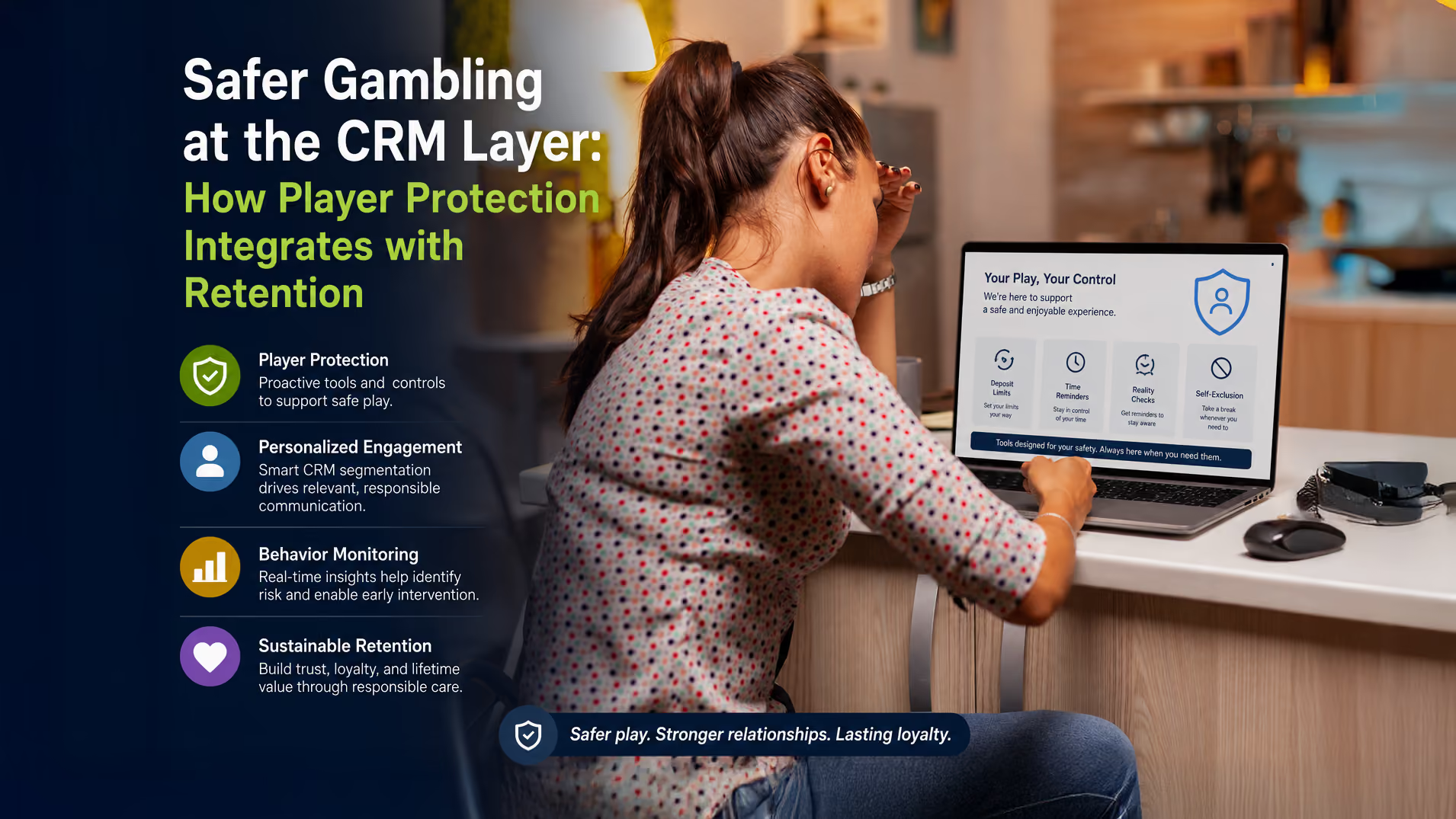
For most of the last decade, the industry has filed player protection and retention into different drawers. Retention sits with marketing and commercial teams, measured in reactivation rates, lifetime value and churn. Protection sits with compliance, measured in interventions logged and regulatory boxes ticked. The two functions rarely share a roadmap, and often do not share a system.
That separation made sense when safer gambling meant a self-exclusion link in the footer and a monthly report to the regulator. It makes far less sense now. Affordability checks, real-time monitoring and the expectation of timely intervention have turned player protection into an operational, data-driven discipline that draws on exactly the same behavioral signals, segmentation logic and messaging infrastructure that power retention. The question operators should be asking is no longer whether the two can coexist, but why they are still being run from separate engines.
The plumbing is already shared
Strip both functions back to their mechanics and they look remarkably similar. Retention depends on understanding how a player behaves, including deposit frequency, session length, game mix, time of play and response to a message, and acting on that understanding at the right moment. Player protection depends on precisely the same inputs. A sharp change in deposit velocity, chasing behavior after losses, sessions creeping into the small hours, a sudden migration to higher-volatility products: these are the markers a risk model watches for, and they live in the same event stream a CRM platform already ingests to decide who gets a free spin on Saturday morning.
When protection is run as a parallel silo, that shared plumbing becomes a liability. Data arrives in the compliance system late or in batch, so an intervention that should have fired during a session is logged the next day. Worse, the two systems can contradict each other. There are few faster ways to lose a regulator's confidence, or a player's trust, than to send a personalized "we've missed you, here's a bonus" message to someone whose behavior has already tripped a harm marker elsewhere in the stack. The campaign engine simply did not know what the risk engine knew.
Why the CRM layer is the right home
Putting protection logic where the behavioral data and the orchestration already live solves the timing and the contradiction problems at once. If a risk signal is just another attribute in the same player profile that drives segmentation, then a safer gambling intervention can fire with the same immediacy as a cross-sell: in-session, triggered by the event itself, rather than after an overnight job.
It also means the two sets of rules can talk to each other. A journey builder that can launch a reactivation flow can equally be configured to suppress or pause that flow when a protection threshold is crossed, redirecting the player toward a deposit-limit prompt or a cool-off suggestion instead of a deposit incentive. Personalization cuts both ways: the same models that tailor an offer can tailor an intervention, replacing the generic pop-up that players have learned to dismiss with a message that reflects their actual pattern of play. Tools built for this, including unified CRM, gamification and AI-driven player monitoring on a single platform, as we have argued at Smartico, are most useful precisely because retention and protection stop competing for the same player at cross purposes.
{{cta-banner}}
Gamification is the clearest test of whether an operator has genuinely integrated the two. Missions, loyalty wheels, tournaments and reward ladders are powerful engagement mechanics, and they are also exactly the mechanics most likely to be read as encouraging chasing if they are deployed without guardrails. Integrated at the CRM layer, the same risk attributes that govern messaging can govern gamification: rewards that do not escalate in response to loss-chasing, mechanics that throttle for at-risk segments, and engagement that builds habit without manufacturing pressure. Run separately, gamification is the first thing a regulator points to. Run together, it becomes evidence that engagement and welfare were designed in the same room.
The commercial argument, made honestly
None of this is charity. The commercial case for moving protection into the retention engine is straightforward: a player who is steered away from harm early is a player who is still active, still trusted and still valuable in eighteen months, rather than a remediation case, a complaint, or a headline. Sustainable lifetime value and effective player protection are not in tension; the short-term extraction model is simply the wrong way to read the data, and increasingly the wrong way to read the regulatory weather.
That weather is hardening on every front. Affordability and intervention expectations continue to tighten across European markets; Australia has announced its most sweeping gambling advertising overhaul to date, including a ban on advertising during live sport and on celebrity and athlete endorsements, expected to take effect from January 2027; and AI-driven player monitoring increasingly sits within data-protection obligations on profiling and automated decision-making, with the governance and oversight that brings. An operator that can demonstrate protection logic embedded in its core player-management system, with a clear audit trail of who was flagged and what action followed, is in a far stronger position than one presenting a compliance bolt-on to a skeptical regulator.
It would be dishonest to pretend the technology settles the matter on its own. Thresholds have to be set by people who understand both the behavioral science and the local regulatory expectation. Models need monitoring for bias and drift, intervention strategies need testing against real outcomes rather than assumed ones, and human oversight has to sit over automated decisions, especially where money and welfare intersect. Integration removes the technical excuses; it does not remove the governance work.
One discipline, not two
The operators likely to come out ahead over the next few years will be the ones that stop running player protection and retention as rival projects with separate budgets, separate systems and separate definitions of success. They depend on the same data, they act through the same channels, and at their best they pursue the same goal: a player who stays because the experience is fair, well-paced and worth coming back to. The CRM layer is where that convergence becomes operational. The sooner it is treated as one discipline rather than two, the better the outcome for players, operators and regulators alike.
Looking for a proven unified CRM & Gamification solution for your iGaming operation? Book your free, in-depth demo of Smartico below and learn how it can help you raise loyalty and retention like nothing you've tried before.