


Agentes de IA em CRM de iGaming: Realidade Implementada Versus Hype de Marketing
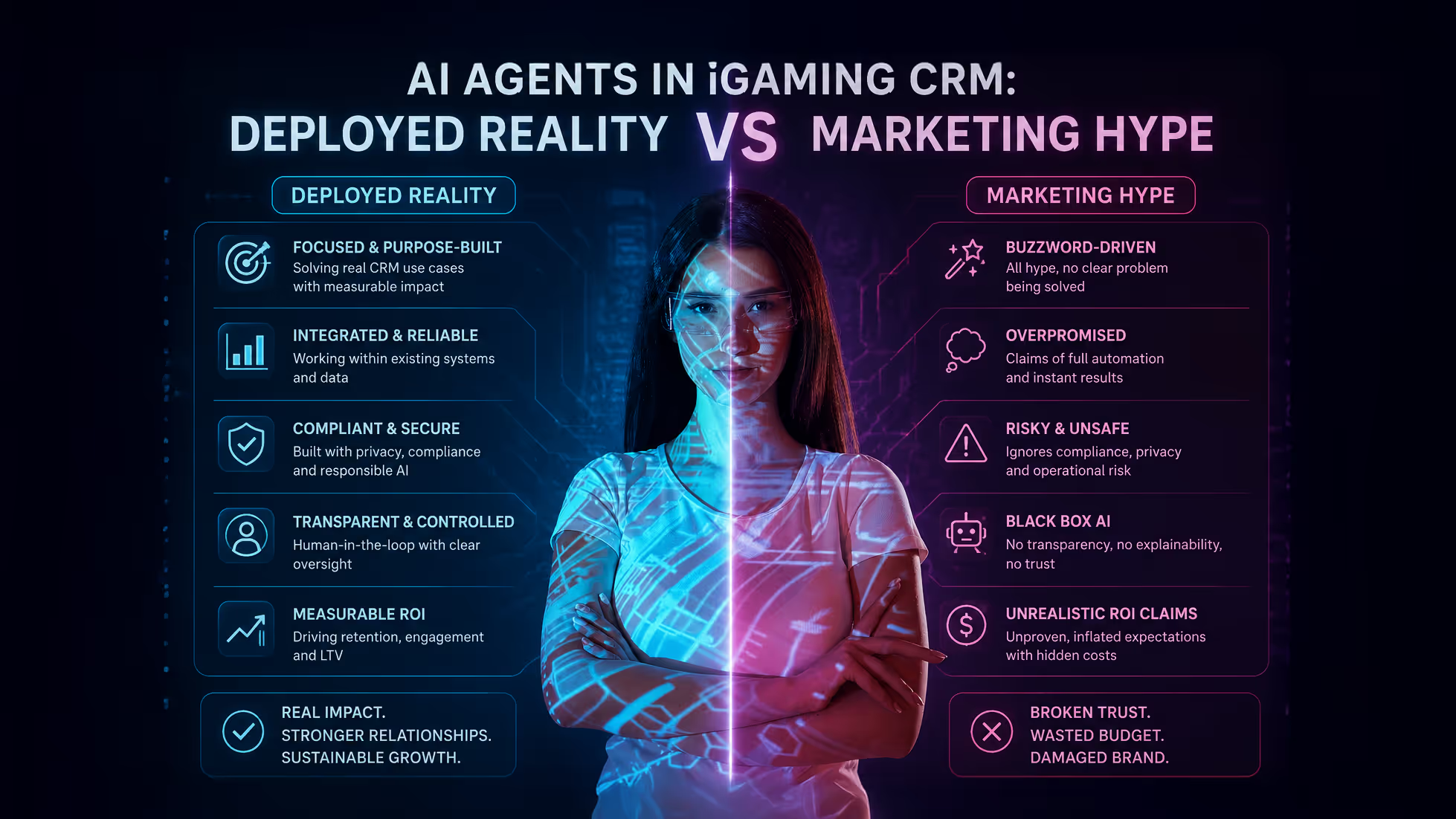
Walk into any iGaming conference in 2026 and look at the booth signage. Roughly half of it says some version of the same word: AI. AI-powered. AI-first. AI-native. AI-enabled. It's become the industry's favourite wallpaper.
And if you're an operator trying to actually buy a CRM platform that uses AI in any meaningful way, the marketing fog gets thick fast. Every vendor claims it. Few can show it running. Fewer still can point to customers using it in production without a sales engineer holding the keyboard.
So let's cut through. This is a practical look at what AI agents in iGaming CRM actually do today, what they don't (despite the slideware), and how to tell the difference when a vendor is pitching you. If you've been to a single demo this year, you'll recognise the pattern.
What an AI agent actually is (and what it isn't)
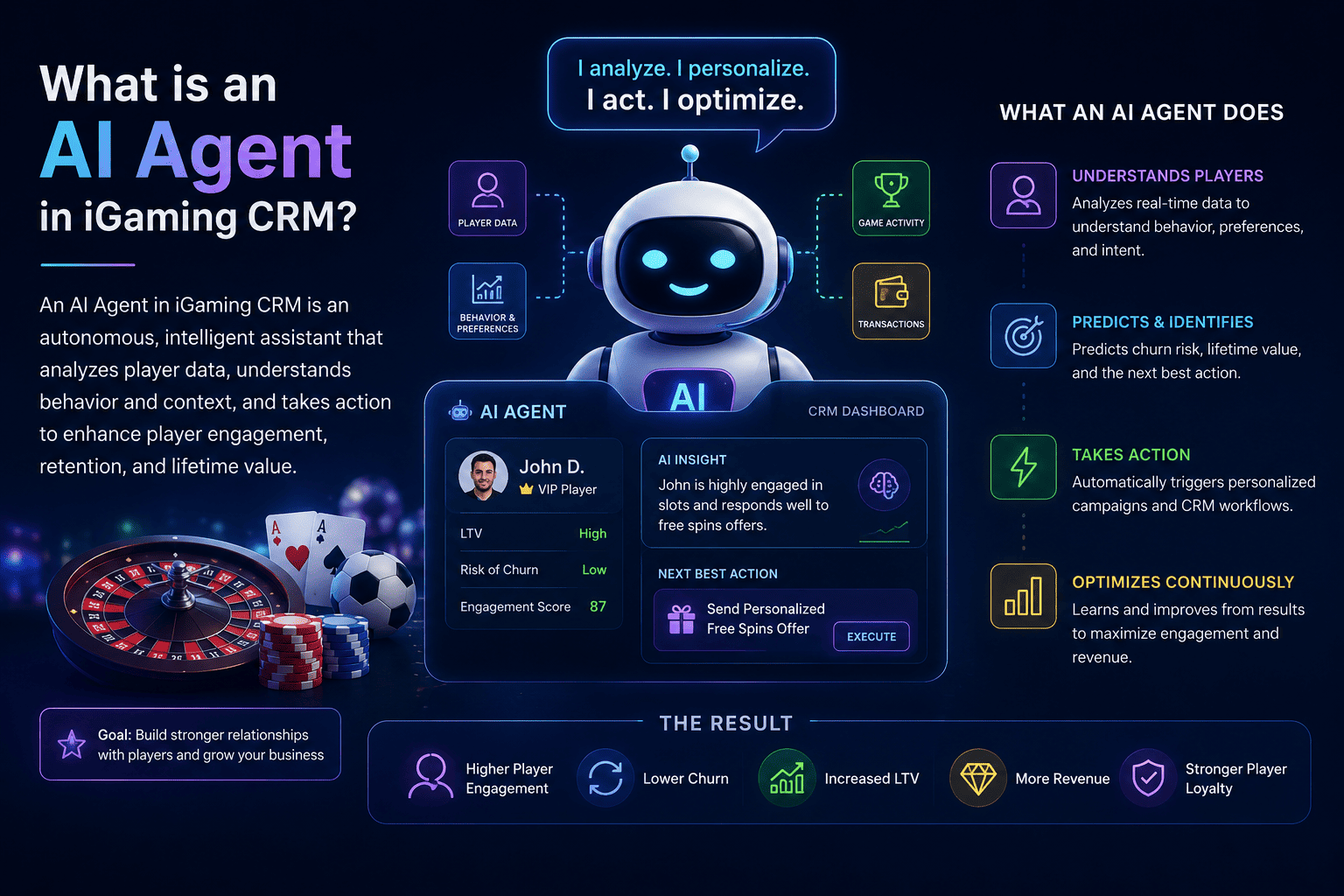
In strict technical terms, an AI agent is software that takes in a goal, makes decisions, and acts on a user's behalf, usually with some level of autonomy. In a CRM for iGaming context, that means tasks like answering operator questions about platform setup, running player-data queries in plain language, generating campaign creatives, or surfacing anomalies before anyone notices them.
The problem is that "AI" now gets stamped on basically anything. A rules-based segmentation engine from 2014 with a fresh coat of paint. A simple logistic regression scoring churn. A genuine large language model wired into a production database. These are wildly different products. Operators are paying for the third and often getting the first.
Worth knowing before any demo: ask what's actually under the hood. If a vendor can't answer that without checking with engineering, that's your answer.
What AI agents actually do inside deployed iGaming CRM platforms today
A few categories have moved from slideware to production over the last 18 months. Not every vendor has all of them. Some have none. Here's where the technology has genuinely landed.
Plain-language data queries
A small group of CRM platforms now let you ask questions like "show me last month's churn rate for Brazilian deposit players under 30" and get an answer back in seconds. No SQL. No data team ticket. No three-day wait. The agent translates the question, runs the query, and returns a readable answer.
This is one of the cases where deployed AI agents genuinely earn their cost. The time savings for CRM managers, who used to spend half their week chasing data, is real and measurable.
Campaign and journey configuration help
Setting up a complex CRM workflow used to require either deep platform expertise or a support ticket and a waiting period. Agents that walk a user through configuration, explain why a journey isn't firing, or spot a broken trigger condition are now shipping in production. Not glamorous, but it shortens the typical learning curve from weeks to days.
Creative generation
Banners, popups, mini-game artwork, branded doodles, promotional imagery. The underlying image models from the big AI labs got genuinely good in 2025, and CRM platforms have started wiring them in. A marketing manager who needs a tournament banner can generate ten usable options in two minutes instead of waiting four days for design.
Anomaly detection and pattern surfacing
Less visible, arguably more valuable. Agents that watch player behaviour and flag unusual patterns (bonus abuse clusters, sudden VIP churn signals, a segment that's quietly underperforming) reduce the gap between something going wrong and someone noticing. The best implementations don't just flag the anomaly. They suggest a corrective action.
{{cta-banner}}
Where AI agents still fall short
Here's the honest version of what doesn't work yet, no matter how confidently the marketing says otherwise:
- Regulatory judgment calls. An agent doesn't reliably know whether a specific bonus structure is compliant in a specific jurisdiction. It will happily suggest things that get you fined. Compliance still belongs to humans who read the regulations.
- Cross-system coordination. Most agents work inside one platform. They don't talk to your PAM, your payment gateway, your KYC provider, your sportsbook engine. Operators still stitch this together manually with engineering work.
- Novel situations. Agents are good at recognising patterns. When something genuinely new happens (a regulatory shift, an unexpected market event, a new player behaviour the model hasn't seen), they default to confident but mediocre suggestions.
- Genuinely strategic decisions. Agents are useful for execution and querying. They are not yet good at telling you "stop running this acquisition channel, the player quality is bad and you're burning budget."
- Unsupervised player-facing interactions. Operator-facing agents are reasonably safe. Player-facing chatbots that handle real-money interactions in regulated markets are still a serious risk surface. Most platforms keep humans in that loop, and the ones that don't usually shouldn't.
If a vendor claims they've solved any of the above without caveat, that's the moment to push harder.
10 questions to tell deployed AI agents from marketing slideware

If you're evaluating a platform, ask these. The answers will tell you more than any deck:
- Can you demo the AI agent live, in a test environment, right now? Not a recorded video, not a controlled scenario, but live.
- How many of your customers are actually using the AI features in production today? Names, please.
- What does the AI cost beyond the base platform fee? Is it metered per query, per agent, or bundled?
- Can the agent be turned off if it misbehaves, without breaking the rest of the platform?
- What guardrails kick in when the agent produces a wrong or risky answer?
- Is the AI working off our data, or off generic industry data we'd need to supplement?
- How does the agent handle queries from team members who don't write in English?
- What happens to our prompts and outputs? Are they used to train models that other operators benefit from?
- Can we see an audit log of what the agent did last week, or is it a black box?
- Does your roadmap show new agent capabilities shipping every quarter, or was the AI launched once and forgotten?
A vendor that answers all ten directly is unusual. A vendor that dodges three or more is telling you what you need to know.
Hype versus reality at a glance
Of course, none of this means the technology isn't valuable, but that the value is real and bounded, and the operators getting the most out of it are the ones who went in with realistic expectations.
What separates the platforms that ship from the ones that pitch
Three patterns show up repeatedly in CRM platforms that have actually deployed working AI agents (as opposed to those still demoing them).
The first is narrow, focused agents instead of one giant assistant. A single agent that tries to do everything ends up doing nothing well. Platforms that have shipped tend to break the work into specific agents: one for data queries, one for creative generation, one for setup help, one for analysis. Each one does its job and stops.
The second is release cadence. Platforms with working AI agents ship updates frequently. New capabilities, new guardrails, new use cases every few weeks. Platforms still pitching tend to have launched a single AI feature 14 months ago that hasn't changed since.
The third is honest scoping. Vendors with deployed AI talk openly about what their agents can't do. Vendors selling slideware tend to claim everything works. The first group is selling product. The second group is selling vibes.
How Smartico approaches AI agents in iGaming CRM
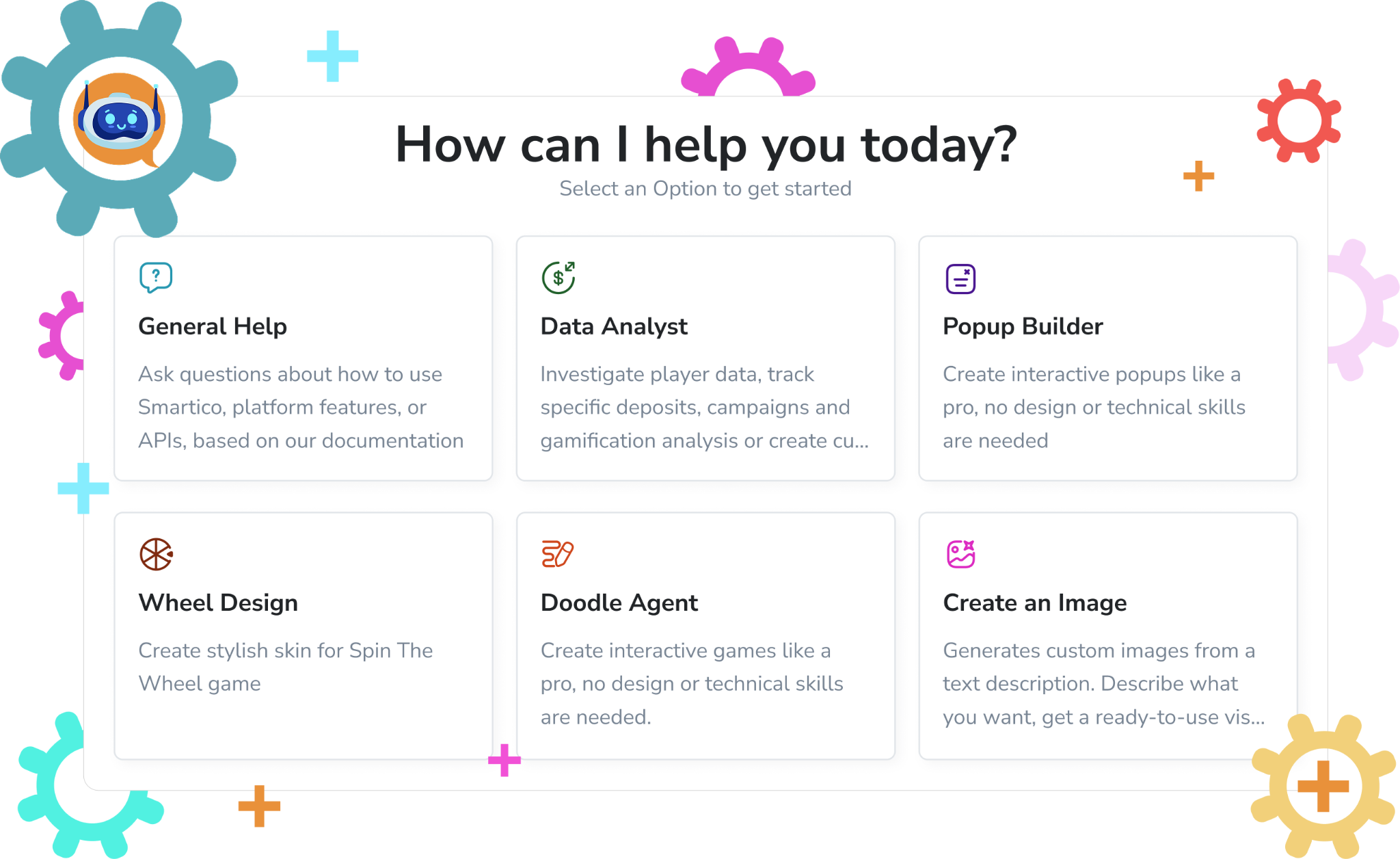
Smartico is the first and leading unified Gamification and CRM automation platform built for iGaming, founded in 2019. The platform now ships six AI agents, each one built for a specific operator workflow rather than as a single general-purpose assistant.
The General Help Agent answers setup and configuration questions 24/7, so CRM teams stop waiting on support tickets to unblock simple work. The Data Analyst Agent runs natural-language queries against player data and returns plain-English answers, no SQL or BI ticket needed. Other agents handle creative generation for promotions and gamification mechanics, including custom Spin the Wheel designs, popups, doodle games, and branded imagery, generated to spec in minutes.
The design choice behind this lineup was deliberate. Six focused agents that solve real operator pain points beat one chatbot that claims to do everything and actually does very little. That's the practical line between AI as a marketing label and AI as a shipping product.
Beyond the AI layer, the broader Smartico platform combines real-time gamification mechanics, CRM automation, loyalty program management, personalisation engines, and player retention solutions, currently used by 1,000+ brands worldwide.
If you want to see the agents running on live operator scenarios rather than reading about them, the easiest way is to book a free, in-depth demo a demo below and judge for yourself.
{{cta-banner}}
Frequently asked questions
Are AI agents in iGaming CRM safe to use in regulated markets? Operator-facing agents (those that help CRM teams configure campaigns, query data, or generate internal content) are generally low-risk and widely deployed. Player-facing agents that handle real-money interactions in regulated jurisdictions remain a sensitive area, and most reputable platforms keep human oversight in the loop. Always confirm with your compliance team before enabling player-facing AI features.
How long does it take to deploy AI agents inside an existing CRM stack? Realistic timelines range from a few days for basic features like agent-assisted setup help, to several weeks for agents that need to be tuned on operator-specific player data. Any vendor promising same-day deployment of fully tuned predictive agents is overselling the timeline.
Do AI agents replace CRM managers? No, and they aren't designed to. The deployed reality is that AI agents handle repetitive, low-judgement tasks (data pulls, creative variants, configuration help) so CRM managers can spend more time on strategy and player relationships. Headcount usually stays the same. Output goes up.
What data do AI agents in iGaming CRM actually need to work well? At minimum, clean player transaction data, session-level behaviour data, segmentation history, and campaign performance data. Agents trained on incomplete or messy data give weak answers. The cleanup work is unglamorous but determines whether the AI actually helps.
How do you measure the ROI of AI agentes em uma plataforma de CRM? Acompanhe três coisas: tempo economizado por gerente de CRM por semana (a métrica mais concreta), aumento no desempenho da campanha a partir de otimizações sugeridas por IA e redução no tempo de lançamento para novas campanhas. A maioria dos operadores com agentes de IA implementados relata ganhos significativos nos três aspectos em um trimestre.
Os agentes de IA em CRM de iGaming continuarão a melhorar, ou a tecnologia estagnou? As melhorias ainda chegam regularmente, particularmente na qualidade do raciocínio, no tratamento de tarefas multi-etapas e na profundidade da integração. O ritmo varia por fornecedor. Plataformas que lançam atualizações frequentemente tendem a continuar ganhando capacidade. Plataformas que foram lançadas uma vez e depois ficaram em silêncio geralmente são um sinal de que a IA era mais uma demonstração do que um produto.
Conclusão
O burburinho em torno dos agentes de IA em CRM de iGaming tem se adiantado muito ao que a maioria das plataformas realmente entregou. A boa notícia: agentes de IA reais e úteis realmente existem, e a lacuna entre fornecedores que os têm em produção e fornecedores que os têm apenas em slides está aumentando a cada trimestre. Faça as dez perguntas. Assista à demonstração ao vivo. Converse com clientes reais. Se você quiser ver agentes de IA implementados em CRM de iGaming funcionando com dados reais de operadores, solicite uma demonstração da Smartico e decida por si mesmo o que é real.

