


Automating the VIP Player Journey: Human Touch vs. Game Mechanics
.png)
Many iGaming operators burn out their VIP teams by treating every frequent player like a whale. A host managing 300 accounts via text message and email creates an operational bottleneck. Responses slow down. Bonuses become generic. Players eventually leave for competitors.
The fix requires separating your top 1% from your top 20%. Human relationships drive the former. Game mechanics scale the latter.
The Scaling Problem in Player Retention
Manual VIP management breaks down as user acquisition scales. Operators typically assign account managers based on deposit frequency or total wagers. This floods the VIP queue with mid-tier players who play regularly but do not generate the Net Gaming Revenue (NGR) required to justify one-on-one attention.
Human managers end up acting as data entry clerks. They check spreadsheets, calculate manual loss rebates, and credit standard free spins. Every minute spent calculating a $50 bonus for a mid-tier player is time taken away from a true high-roller.
Using Game Mechanics for Mid-Tier Players
Gamification replaces manual check-ins with automated, behavior-driven rewards. It shifts player motivation from waiting for a host's handout to actively earning rewards through gameplay.
Status Tiers and Visible Progress: Players want instant feedback on their standing. A visible progress bar tied to their wagering activity shows exactly how close they are to the next tier. They do not need to message support to ask about their VIP status. The platform updates their rank and unlocks perks in real time.
Behavioral Triggers and Loot Boxes: Instead of a manager sending a standard Friday deposit match, automate the interaction based on player behavior. Set up daily missions requiring specific actions, like placing bets on three different live dealer tables. Completion triggers a loot box drop. Variable rewards create stronger behavioral hooks than a predictable flat bonus.
Player Tournaments: Tournaments generate deep engagement without requiring continuous operator-funded bonuses. Mid-tier VIPs compete against each other for leaderboard positions. The CRM handles the scoring and automated payout distribution, removing the administrative burden from your staff.
The ROI of Gamification: Variable Rewards vs. Flat Bonuses
When you transition mid-tier players to automated gamification, the type of reward matters just as much as the delivery method. Flat deposit bonuses are expensive acquisition tools, but variable rewards (like loot boxes and prize wheels) are long-term retention engines.
When you offer a flat 100% deposit match, you are fronting a calculated cost to get a player in the door. The problem is that flat bonuses attract bonus hunters who satisfy the wagering requirements and immediately churn.
The fundamental difference in Return on Investment (ROI) comes down to how liability is distributed:
- Cost Predictability: Flat bonuses have a fixed liability per user. Variable rewards are controlled via probability algorithms.
- Average Cost Per User: Flat bonuses are high cost. Variable rewards are low cost.
- Bonus Abuse Risk: Flat bonuses are targeted by advantage players. With variable rewards, the math prevents guaranteed profit.
- Player Emotion: Flat bonuses create entitlement ("I am owed this match"). Variable rewards create anticipation ("I might win big this time").
With variable rewards, operators control the Expected Value (EV) through probability distributions. You can offer players a loot box that advertises a "Chance to win up to $500." The vast majority of players might win 10 free spins or a $2 bonus, while only one player hits the grand prize. The psychological excitement remains identical for every player opening the box, but the average cost per user drops to a fraction of the flat bonus.
{{cta-banner}}
The Psychology of Retention
The reason players respond better to loot boxes than to guaranteed cash is rooted in behavioral science. Flat bonuses operate on a fixed schedule. Players know exactly what they get and when they get it. This creates a transactional relationship. Once the transaction is over, the motivation to log in disappears.
Variable rewards utilize a variable ratio schedule of reinforcement. The reward is delivered after an unpredictable number of actions, and the size of the reward is unknown. This unpredictability creates massive retention benefits:
- Dopamine Spikes: The brain releases more dopamine in anticipation of a reward than upon receiving a known reward.
- Resistance to Extinction: Because rewards are unpredictable, players will continue logging in much longer during a dry spell because they believe the next attempt will be the winner.
- Daily Active Users (DAU): Because the average cost of a loot box is low, operators can afford to give them away daily just for logging in. You cannot afford to give a $20 flat bonus every day, but you can afford to give a daily spin on a wheel where the most common prize is 5 free spins.
When to Keep the Human Touch
While game mechanics handle the bulk of your active base, human VIP managers should exclusively handle players where relationship building directly impacts your bottom line.
Game mechanics cannot replace empathy or luxury. An automated system cannot arrange tickets to a Champions League match, send a physical holiday gift, or negotiate a complex withdrawal limit increase.
For your top players, the value lies in exclusivity and friction removal. They expect direct communication, immediate payouts, and bespoke deals. A human host recognizes nuances in behavior. A good manager notices when a player is frustrated with a bad run and steps in to cool the situation down with a personalized offer before the player logs off permanently.
The Automated Handoff
The most profitable VIP journeys combine both approaches through automated qualification.
Start all players on a gamified track. Let them engage with loyalty wheels, store purchases, and automated tier progression. Track their Lifetime Value (LTV) and velocity of deposits behind the scenes.
Configure your system to flag accounts that cross specific monetary thresholds within a set timeframe. When a player hits that mark, the software triggers an internal alert. The human manager then steps in, introduces themselves, and takes over the primary relationship.
This structure keeps operational costs low. Game mechanics handle retention for the majority. Human hosts focus their time entirely on players who move the needle for your business.
Automate Your VIP Journey with Smartico
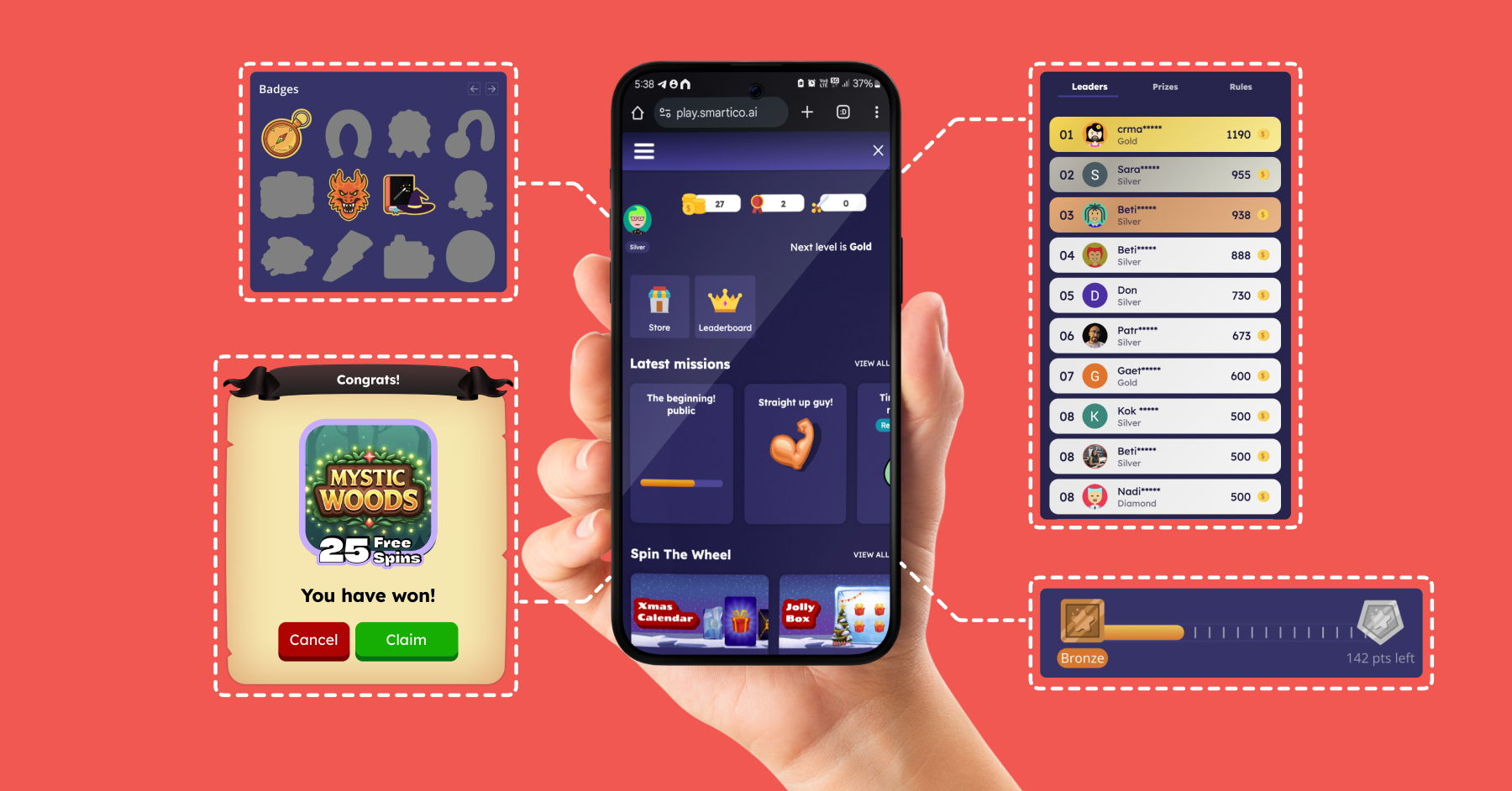
Transitioning from manual spreadsheets to an automated, gamified CRM does not have to be a massive internal development project. Smartico provides an all-in-one platform built specifically for iGaming that handles the heavy lifting of VIP segmentation and variable reward distribution.
Instead of burning out your VIP hosts with manual bonus calculations, Smartico's real-time AI engine automatically tracks player behavior, updates tier progression, and triggers variable rewards like Daily Loot Boxes and Loyalty Wheels the exact moment a player completes a milestone. You can deploy custom tournaments, point marketplaces, and automated retention loops out of the box. This drastically lowers your promotional liability while keeping mid-tier players actively engaged in your ecosystem.
By automating the mechanical parts of retention, Smartico leaves your human account managers free to do what they do best: build deep, highly profitable relationships with the top 1% of your high-rollers.
Ready to stop wasting budget on flat deposit bonuses? Book a demo with Smartico today and find out how our gamified CRM can lower your customer acquisition cost while extending player lifetime value.
Frequently Asked Questions
1. What is the difference between traditional VIP management and gamified retention?
Traditional VIP management relies on manual tracking and human outreach to issue bonuses, which creates operational bottlenecks as your user base grows. Gamified retention uses software to automate this process. It delivers instant rewards based on specific player actions using mechanics like visible progress bars, tournaments, and prize wheels, keeping players engaged without requiring human intervention.
2. Why are variable rewards better for retention than flat deposit bonuses?
Flat bonuses carry a fixed, high cost per user and frequently attract bonus hunters who churn once the funds are spent. Variable rewards operate on a variable ratio schedule, similar to slot machine mechanics. They cost the operator less on average while generating higher anticipation and dopamine spikes. This unpredictability builds a habit loop that encourages daily logins.
3. When should a human VIP host take over an account?
Human managers should step in only when a player crosses specific, high-value monetary thresholds or deposit velocities. Game mechanics are highly effective for mid-tier players, but human hosts are essential for true high-rollers who expect bespoke services, custom withdrawal limits, and personalized relationship building.
4. How do operators handle the transition from gamified to human VIP management?
The most efficient method is automated qualification. Your CRM should track player lifetime value in the background. When a user hits a designated financial threshold, the system triggers an internal alert. A human host then introduces themselves and takes over the primary relationship, seamlessly moving the player from automated rewards to personalized care.
5. Will automating the VIP journey frustrate my current players?
No, as long as the transition is transparent. Most mid-tier players actually prefer instant, automated rewards over waiting hours for a customer support agent to manually credit a bonus. Gamification gives players clear goals, visible status tracking, and immediate gratification, which significantly improves the overall user experience.
Did you find this article helpful? If so, consider sharing it with other industry professionals such as yourself.
Ready to use Smartico?
Join hundreds of businesses worldwide engaging players with Smartico.