A Faster Way to Build iGaming Promotions
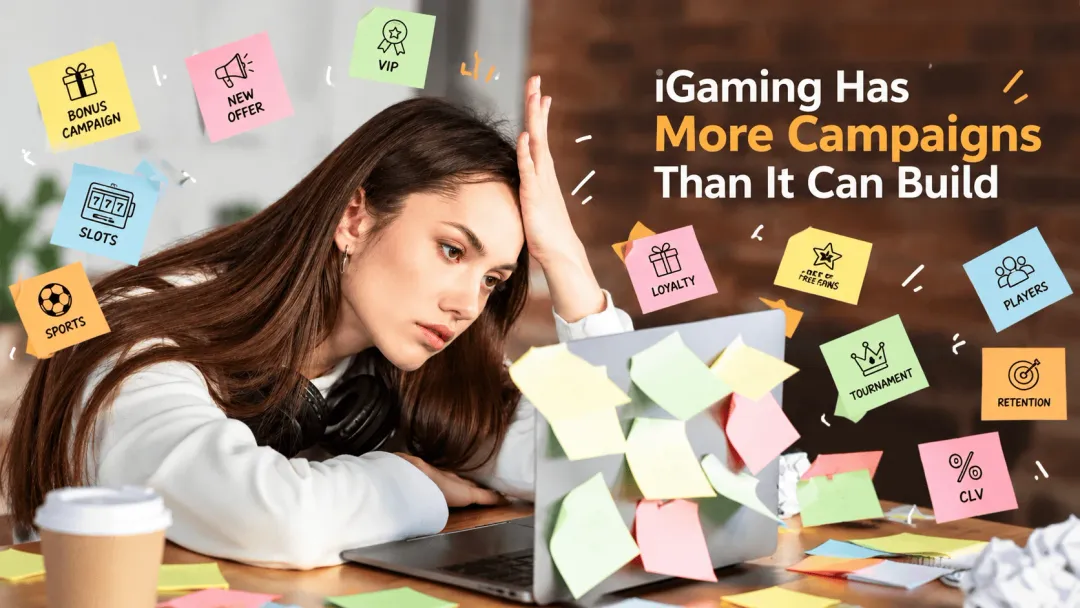
An operator's promotional calendar is relentless. A tournament goes live this week, a seasonal campaign the next, a reaction to a big match or a jackpot somewhere in between, and each one wants its own branded page, its own widget on the site, often its own version per brand and per market. Across a year that adds up to hundreds of player-facing pages, all on-brand, all tied to something time-sensitive.
Almost no operator can produce at that pace. So the calendar quietly shrinks to fit what the team can build, and the plan on the whiteboard turns into a shorter plan that ships.
The ceiling was production, not planning
Ask a CRM or marketing team what holds them back and they will rarely point to a shortage of ideas. The ideas are there: the campaign, the tournament concept, the landing page for a new market, the seasonal game someone sketched in a meeting. What runs short is the capacity to turn all of it into live pages.
The reason is the path every page has to travel. A design ticket goes into a queue. A front-end developer picks it up when the sprint allows. The first version comes back close but not quite right, so it goes around again. Multiply that by a weekly promo cadence, several brands, and a handful of languages, and the pipeline becomes the thing that decides what the business can run.
The effects are familiar to anyone who has worked an operator's calendar. The same generic prize wheel gets reused because a custom one costs too much time. A localized landing page gets skipped because the market is not big enough to justify the build. A promotion built around last night's match lands three days later, after the moment has passed. Each of those is the production limit showing through, dressed up as a strategy call.
What changes when the marketer can build
AI-assisted building changes who sits at that bottleneck. When the person who owns the campaign can describe a page in plain language and get a working, on-brand version back the same afternoon, the queue turns into a conversation, and the calendar is limited by ideas again rather than by capacity.
For an iGaming team that shows up in concrete ways.
Reactions keep pace with events. A promo page for a big fixture or a jackpot run can go live while the moment is still live, not after it.
Every market gets its own page. Localized landings and promotions stop being a luxury reserved for the biggest markets when each one takes an hour instead of a sprint.
Campaigns get their own look. Instead of the same wheel in different colors, a campaign can have the mechanic and the design that fit it, because a bespoke build is no longer expensive.
Small teams run a big calendar. A lean marketing team that no longer waits on a shared developer can ship at a tempo that used to need a department.
None of this removes the specialists; it changes what they spend their time on. The developer who spent a morning on a promo page spends it on the work that genuinely needs an engineer, while the routine building moves to the people who were waiting on it.
The honest part
AI-assisted building rewards patience more than the demos admit. The first result will usually impress you, and the version you would put in front of players takes a few more rounds of prompting and testing. When the assistant says everything works, check it the way you would check anything player-facing, because the model sounds just as confident when it is wrong. The skill that matters most is judgment: knowing what good looks like, testing before you publish, and keeping a person in the loop on anything that touches real players or real money.
The shift has a name
This way of working picked up a label in 2025: vibe coding, describing what you want in plain language and letting AI build it. It started with software engineers and has been moving outward to any job where the idea was always quicker than the build. For operators, the pages that fit that description best are the player-facing ones that fill the calendar.
That is the idea behind Smartico's Vibe Studio. You describe the experience you want, an AI assistant builds it on-brand, a live preview updates as you go, and one click takes it live. It covers the four kinds of work that crowd an operator's calendar: widgets you embed on your site, promotion pages for a single event, public landings for acquisition, and your own branded reward games. The look is yours to design, while the mechanics behind it, the missions, leaderboards, tournaments, and prizes, stay wired to your live Smartico data, so a leaderboard you design still pulls real rankings and a reward game still draws from your actual prize rules.
If you want to see what your team could ship in an afternoon, book a demo and we will show you Vibe Studio in action.
Did you find this article helpful? If so, consider sharing it with other industry professionals such as yourself.