Players Stay for Each Other: Why We Built Clan Tournaments
Why iGaming retention ignores the strongest motive in games, how Clans turn tournaments into team races, and how to add team play without adding pressure.
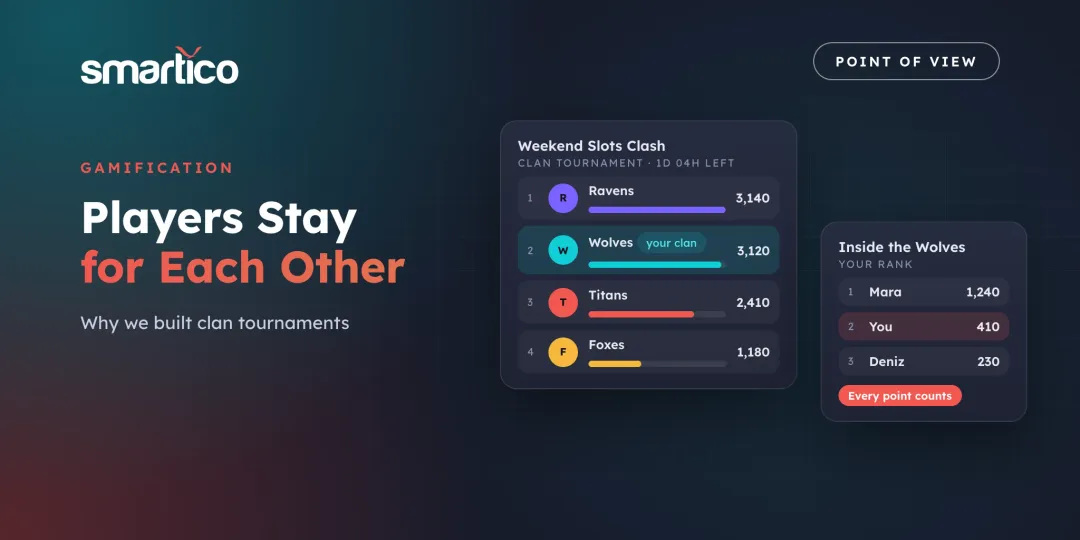
 Kiril Georgiev Product Manager, Gamification at Smartico. A point of view on team play in tournaments.
The games people play for years have a team. Most iGaming retention still has one player climbing alone.
Most of my work comes down to one question: why do players come back? When we looked honestly at how tournaments play out, we saw a gap. Every reason we gave players to return was about the player alone. Clans are our answer to that gap.
This post is the case for team play, the story of what we built, and what we want it to change for operators and their players.
The problem with playing alone
Think of the guild, the squad, the five-a-side team. What keeps people there isn't the loot. It's the people they would let down by not showing up. In iGaming we have become very good at solo motivation: missions, levels, streaks, tournaments. We have mostly ignored the other kind, and our tournaments show it:
- The same names win. Big solo tournaments reward the few who can reach the top. Everyone else can see early that they won't place.
- The middle gives up. After a day or two, most registered players stop trying. They are the players you most want to keep.
- Prize budget goes to regulars. Wider prize tiers help for a week and cost money, and much of it goes to players who would have played anyway.
- No reason to come back but a bonus. Solo mechanics give players nobody to play with or for, so the next bonus is the only pull.
The same 410 points, two different feelings
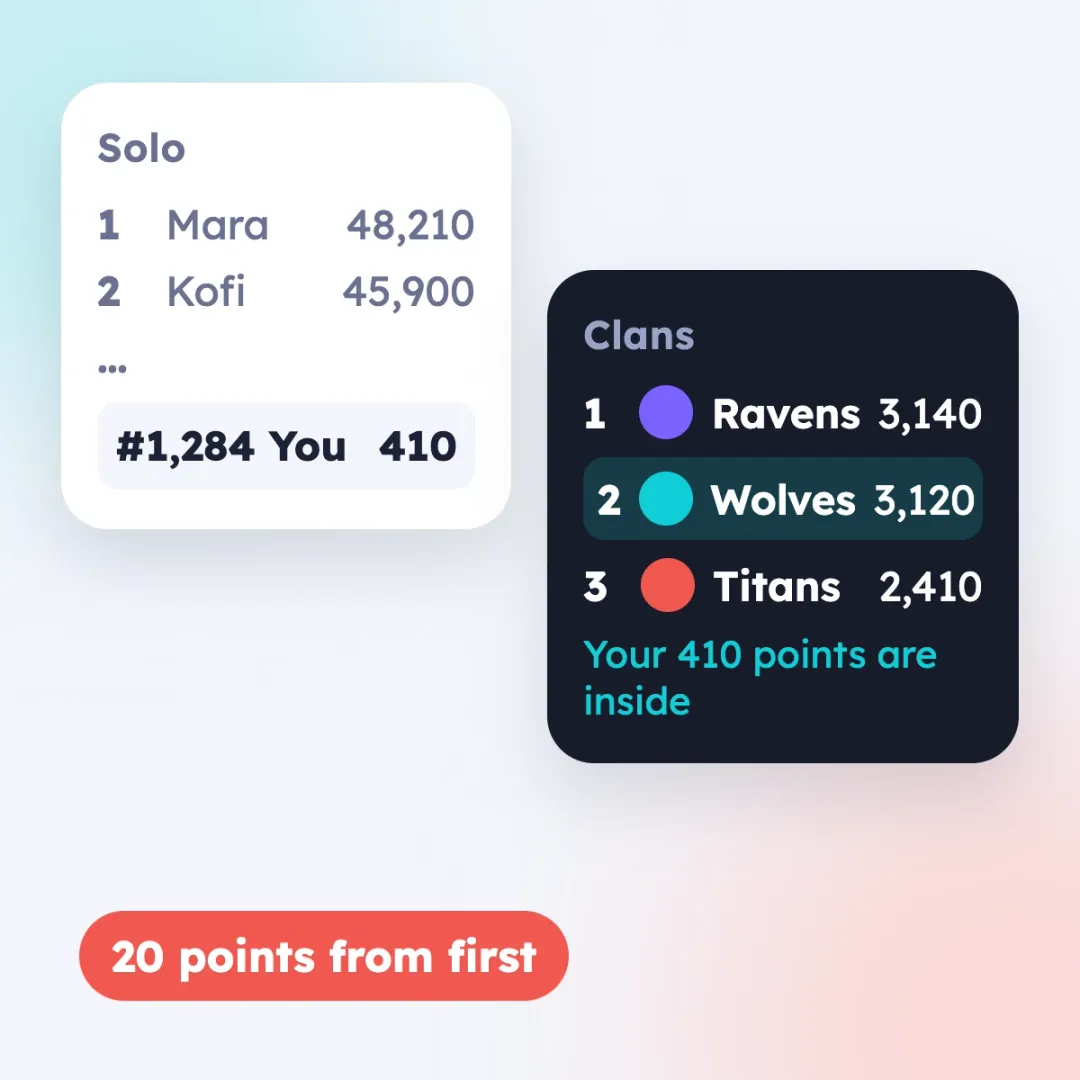 Take a player who scores 410 points this week. In a solo tournament with a few thousand players, 410 points means 1,284th place. Nobody at that place keeps playing for the prize.
Now put the same player in a clan. The same 410 points are part of the Wolves' total, and the Wolves are 20 points behind the Ravens. Nothing about the player changed. The frame did. Every point now counts, and the race looks winnable, because it is.
That is the whole idea of clan tournaments: keep the personal effort, but give it a team to count for.
How we turned that into a product
Clans are yours to shape. Clans are managed by the operator. You create each clan with a name, an image, a status, an entry fee (free, or points, gems or diamonds), a capacity and the segments that can see and join it. Players choose among the clans you offer. A player belongs to one clan at a time.
Tournaments become team races. Set a tournament's Ranking type to Clans and every member's score adds up for the clan. The ranking type can't be changed later, so you decide it when you create the tournament. Everything else works as in any Smartico tournament: duration, games, scoring formulas, Happy Hours. Players see two boards: the clan board, and their own rank inside their clan.
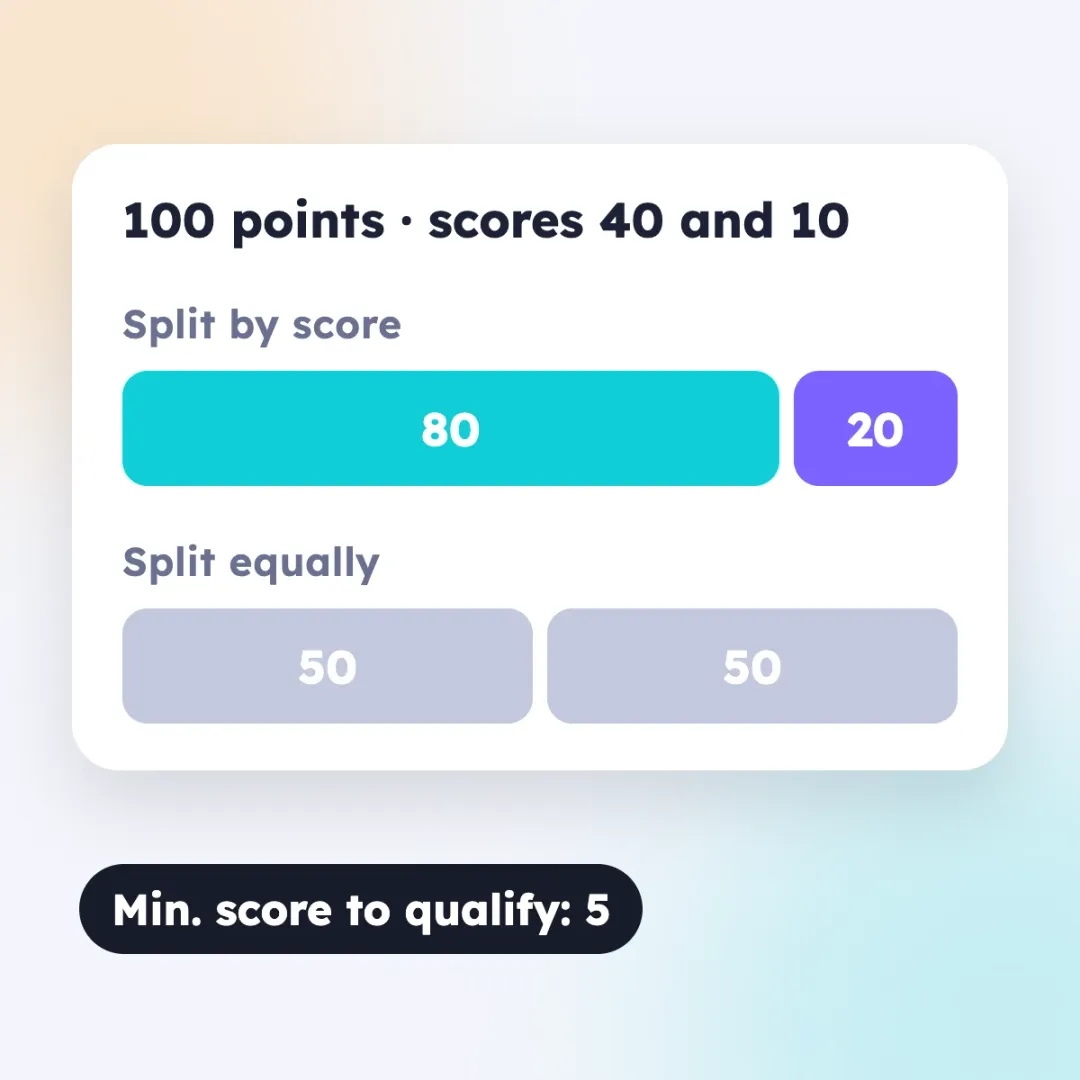 Rewards still follow effort. The top clans win, and each prize is shared inside the clan in one of three ways: a fixed prize per rank, a pool split equally, or a pool split by each member's score. If two members score 40 and 10, a 100-point pool split by score gives them 80 and 20 instead of 50 and 50. A minimum score to qualify keeps passengers out, so nobody wins just by joining the right clan.
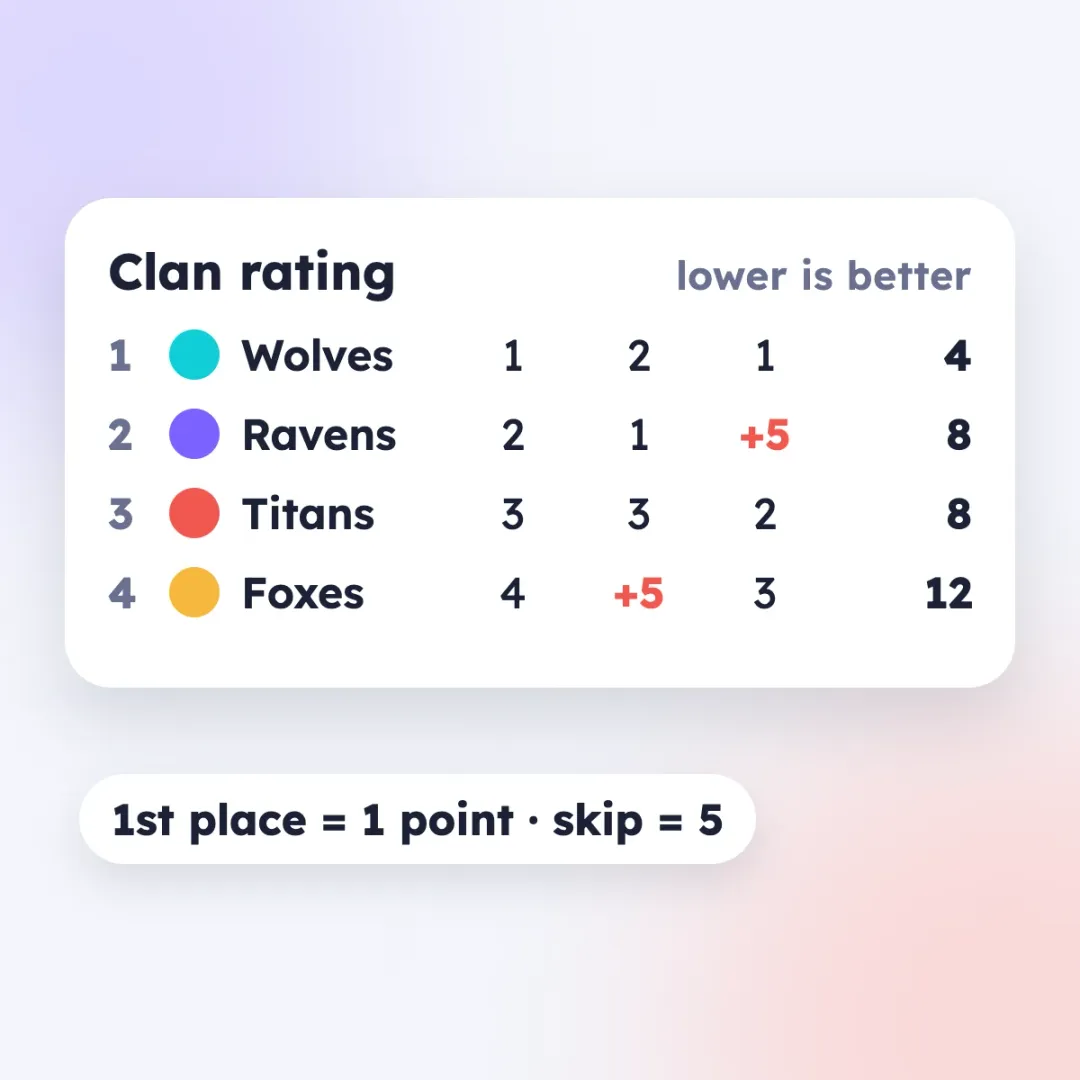 Consistency beats one big win. Clans also compete in a global rating. A clan gets 1 point for first place in a clan tournament, 2 for second, and so on, and 5 points for a tournament it skips. The lowest total leads. The rating counts the last 30 days by default and is recalculated every 10 minutes. So a clan that wins once and disappears falls behind a clan that shows up every week.
Where team play can go wrong
Team pressure is real. It should never become a reason to deposit more, and it should never be gamed. These are the rules I would follow, and most are built in:
- Free entry by default. If you price a clan, use points, gems or diamonds, never money.
- Prizes that reward taking part, not only volume. A score-based split with a sensible minimum score does both.
- No last-minute jumping. A cooldown after a switch, and the run with the old clan ends.
- No leaving into nothing. Players switch to another clan, or you remove them.
- The same responsible-gaming checks as any other campaign: segments, limits and exclusions apply to clans and clan tournaments too.
The switching rules are label settings, so you can tune them to your audience:
| Rule | Default | What it protects |
|---|---|---|
| Players can switch clans in the widget | On | Freedom to choose. Operators can always move players in the back office. |
| Switch cooldown | 1 day | Stops last-minute jumps to the leading clan. |
| Rejoin a running clan tournament after a switch | Off | A switch ends the run with the old clan. When on, players start again from 0. |
| Remove a leaving player's score from the clan | Off | By default the clan keeps the points. Finished tournaments never change. |
| Leaving into no clan | Not possible | Players switch, or an operator removes them. |
Making it run by itself
A team mechanic only matters if it fits into the rest of your CRM. Clans are part of the same platform as your journeys and campaigns, so membership can follow what you know about the player. A new player who loves football can land in a football-themed clan on registration, with a welcome message from the clan.
| Piece | What you can do with it |
|---|---|
| Assign to Clan | Journey activity. Moves a player into a clan, with no entry fee. Join rules, capacity and cooldown still apply. |
| Remove from Clan | Journey activity. Takes a player out of their clan, with no cooldown. |
| core_clan_joined | Event on a first join or a switch, however it happened. Use it to welcome new members. |
| core_clan_kicked_out | Event on a removal, an archived clan or a switch. "Is forced kickout" tells a removal from a player's own switch. |
| MCP Server | An AI assistant can create clans and move members, with the same rights and checks as the back office. |
| Public API | Show clans in your own interface instead of the gamification widget, or build your own clan hub with Vibe Studio. |
Your team can still add, remove and move players by hand, from the clan's Members tab or the player profile.
Knowing whether it works
The Clans dashboard (Reports › Gamification › Clans) shows who joins and switches and where joins come from, the value of each clan's players (Value Score, RFM, product preference), each clan's global rank day by day, and how clans do in tournaments. Watch it for the wrong kind of intensity as much as for growth: a clan that grows fast but plays only at the last minute, or players who switch every time the cooldown ends.
What it gives players and operators
| For your players | For your team |
|---|---|
| Every point counts. A small score still moves the clan up. | Activity across the middle, not only at the top of the leaderboard. |
| A race that looks winnable. Clan gaps are small and visible. | A reason to return every tournament. Skipping costs the clan rating points. |
| Belonging. A name and a crest to play for. | New segments. Clan membership becomes something you can target. |
| Personal reward. Prizes still follow each player's own effort. | Control and insight. You manage the clans, automate membership and see the results. |
The question I'd ask your team
Of everything in your retention calendar, what would a player miss if their friends stopped playing?
If the answer is "nothing", start here:
- Ask your Success Manager to enable Clans for your label.
- Create your clans. Start with three to five, free to join, with the same segments on each.
- Create a clan tournament. Set Ranking type to Clans and use the same segments as the clans.
- Show the Clan section in the gamification widget to test users first, check the prizes, then go live.
Running several brands? Keep the segments of the clans and the clan tournaments the same, or players of one brand may see a race they can't join, or clan names may show across brands. The full reference is the Clans & Clan Tournaments guide in our help center, and you can try a live clan tournament on our clan tournaments page.
FAQ
What is a clan tournament?
A clan tournament is a tournament where players compete as teams. Every member's score adds up for their clan, the clans race on one board, and each player also sees their own rank inside the clan. In Smartico you create one by setting a tournament's Ranking type to Clans.
How are prizes shared inside a winning clan?
You choose which clan places win, then how each prize is shared among the members: a fixed prize per member, a pool split equally, or a pool split by each member's score. A minimum score to qualify keeps members who did not play out of the prize.
Can players switch clans during a tournament?
Yes, within the rules you set. After a switch there is a cooldown (1 day by default) before the next one, and the player's run in a running clan tournament with the old clan ends. By default the old clan keeps the points the player scored. Players can't leave into no clan.
How is the global clan rating calculated?
Each finished clan tournament gives a clan rating points by its place: 1 for first, 2 for second, and so on. A skipped tournament adds 5 points. The lowest total over the last 30 days (by default) leads, and the rating is recalculated every 10 minutes.
Should clans have an entry fee?
Free entry is the safe default. If you want a fee, use points, gems or diamonds, never real money, so team pressure never turns into a reason to deposit.