

CRM vs Marketing Automation: Understanding the Difference and Integration
.avif)
Imagine that you're running an online casino, and your marketing team keeps sending welcome emails to players who've already deposited three times this week. Meanwhile, your CRM is sitting on a goldmine of player behavior data that nobody's actually using.
The thing is, most people use the terms interchangeably, and that's exactly why operators end up with disconnected tools, frustrated teams, and players who feel like they're being marketed to by a bot from 2014.
So, in this article, we'll break down what each one actually does, where they overlap, and why combining them properly might be the smartest move your online casino makes this year.
What Is a CRM, Really?
A CRM (Customer Relationship Management) system is basically the brain of your customer data. It stores everything you know about your players: their deposits, gameplay patterns, support tickets, preferences, lifetime value, and that weird thing where they only play roulette on Tuesdays.
The original purpose of CRM systems was to give sales and support teams a single source of truth about customers. You could pull up a player's history, see every interaction, and make smarter decisions about how to treat them.
In iGaming, a Casino CRM does more than just store data. It segments players, tracks behavior in real time, and helps operators understand who's about to churn, who's a VIP in the making, and who needs a little nudge to come back.
What a CRM Typically Handles
- Player profiles and contact info
- Deposit and withdrawal history
- Gameplay behavior and preferences
- Customer support interactions
- Segmentation based on player value
- Lifetime value tracking
- Churn risk indicators
A CRM tells you who your players are and what they've done. That's its superpower.
What Is Marketing Automation?
Marketing automation is the engine that does the actual work. While your CRM holds the data, marketing automation uses that data to send messages, trigger campaigns, and personalize the player experience without your team manually clicking "send" every five minutes.
Think of it as the action layer. According to HubSpot's research, companies using marketing automation see significantly higher engagement rates because campaigns happen at the right moment, not just when a marketer remembers to set them up.
For online casinos, marketing automation handles things like:
- Welcome series for new players
- Bonus offers triggered by specific behaviors
- Win-back campaigns for inactive players
- Birthday rewards and milestone celebrations
- Cross-channel messaging (email, SMS, push, in-app)
- A/B testing for offers and creatives
If CRM is the brain, marketing automation is the hands. It actually does stuff.
{{cta-banner}}
Why iGaming Operators Need Both (and Why They Need Them Connected)
Online casino players move fast. They sign up, deposit, play, win, lose, and either come back or vanish forever. The window to influence behavior is tiny, sometimes measured in minutes.
If your CRM and marketing automation tools live in separate silos, you're already behind. A player makes their first deposit, and your automation system fires off a generic welcome email three hours later because nobody told it the deposit happened. Meanwhile, a VIP loses interest because the system didn't know to trigger a personalized retention offer.
According to a Boston Consulting Group report on personalization, brands that get personalization right see revenue lifts of 6% to 10%, two to three times faster than those that don't. In iGaming, where retention is everything, that gap is massive.
The fix is integration. When your CRM data flows directly into your automation engine, every campaign becomes smarter. Every message lands at the right moment. And your players stop feeling like they're being spammed by a system that doesn't know them.
10 Signs Your CRM and Marketing Automation Aren't Properly Integrated

If any of these sound familiar, you've got a problem worth fixing:
- Your players receive welcome emails after they've already deposited.
- VIPs get the same generic offers as casual players.
- Your team manually exports CSVs to run campaigns.
- Churned players keep getting promotional emails for weeks.
- Real-time triggers feel anything but real-time.
- Campaign performance reports take days to compile.
- Your support team doesn't know which campaigns a player received.
- Personalization is limited to using the player's first name.
- Different teams work from different versions of the data.
- You can't tell which channel actually drove a conversion.
If you nodded along to even three of these, your stack needs a serious rethink.
How Unified Gamification CRM Changes the Game
This is where things have shifted in the last few years. Traditional CRM and marketing automation tools were built for ecommerce, banking, and SaaS. They weren't designed for the speed and complexity of iGaming.
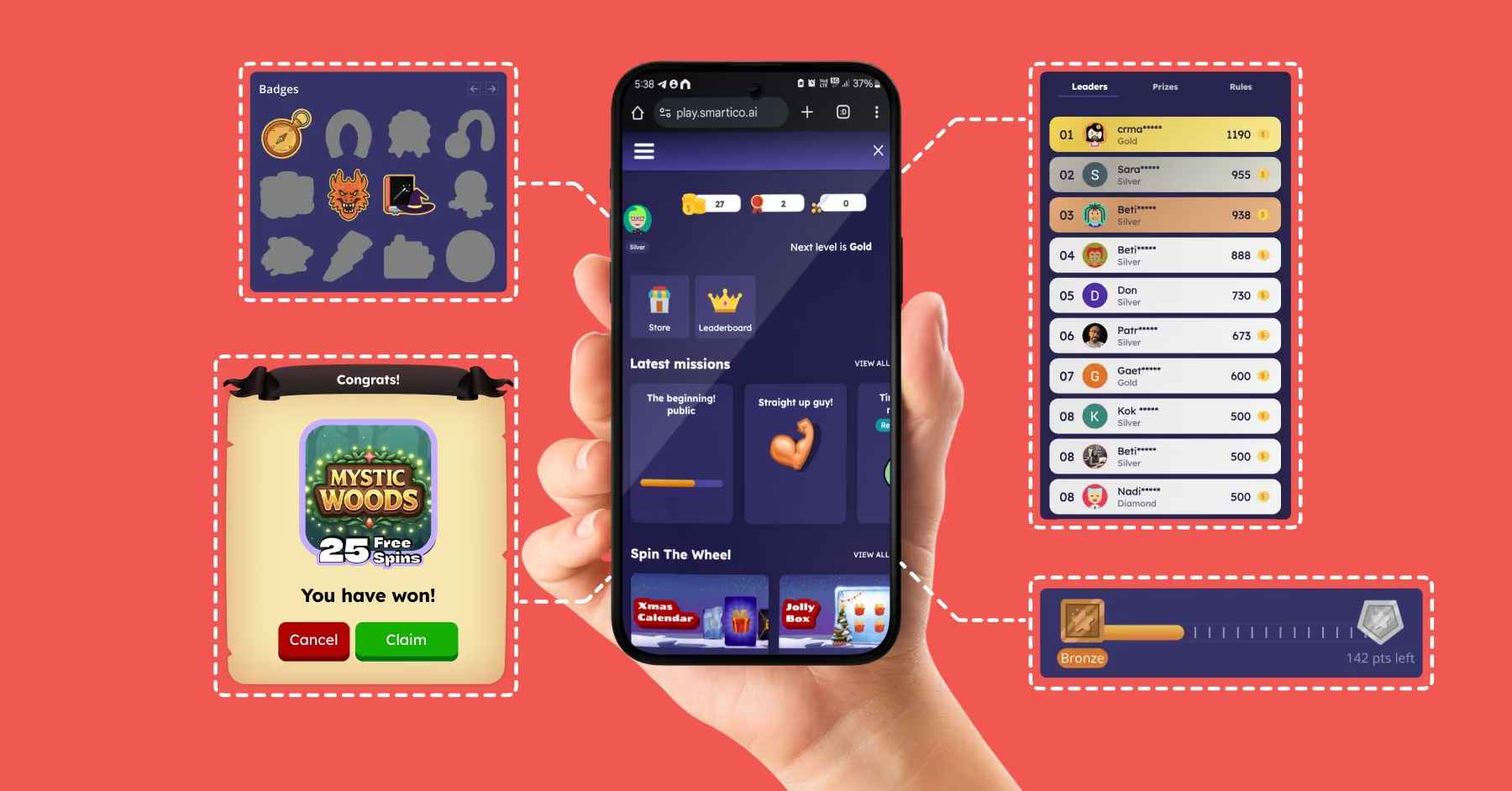
That's why unified gamification CRM platforms have become so popular with operators. Instead of running a CRM, a marketing automation tool, and a separate gamification system, you get everything in one place. Player data, campaigns, missions, tournaments, loyalty programs, all connected, all talking to each other.
The benefit? When a player completes a mission, the system instantly knows. When their behavior shifts, campaigns adapt. When they're about to churn, the right offer goes out automatically, often before the player even realizes they were losing interest.
Smartico.ai: Built for iGaming, Not Retrofitted for It
Smartico.ai is the first and leading unified Gamification and CRM Automation platform built specifically for iGaming operators. Founded in 2019, the platform was designed from day one to solve the exact problem we've been discussing: CRM and marketing automation that actually work together, in real time, for online casinos and sportsbooks.
What makes it different is the combination. Real-time gamification mechanics like missions, tournaments, and loyalty programs sit alongside full CRM automation, personalization engines, and player retention tools. Operators don't need to glue together three or four different systems and hope they sync properly.
Players get experiences that feel personal because the platform knows what they've done, what they like, and what they're likely to do next. Operators get campaigns that fire at the right second, segments that update in real time, and a clear view of every player's journey across every channel.
If you want to see how it works in practice, you can request a demo of Smartico.ai and watch a unified gamification CRM run in real time.
{{cta-banner}}
Key Benefits of Integrating CRM and Marketing Automation
When these two systems work as one, the results are pretty obvious:
- Faster campaign execution because data flows automatically
- Better segmentation thanks to real-time behavioral updates
- Higher conversion rates from personalized messaging
- Improved player retention through timely interventions
- Reduced manual work for marketing and CRM teams
- Cleaner reporting with one source of truth
- Stronger compliance through unified data tracking
- More accurate lifetime value predictions
- Smarter bonus distribution based on actual player value
- Better cross-channel consistency for every player
These aren't theoretical benefits. They're what operators see when they stop running disconnected systems and start running a unified one.
The Role of Machine Learning in Modern CRM Automation
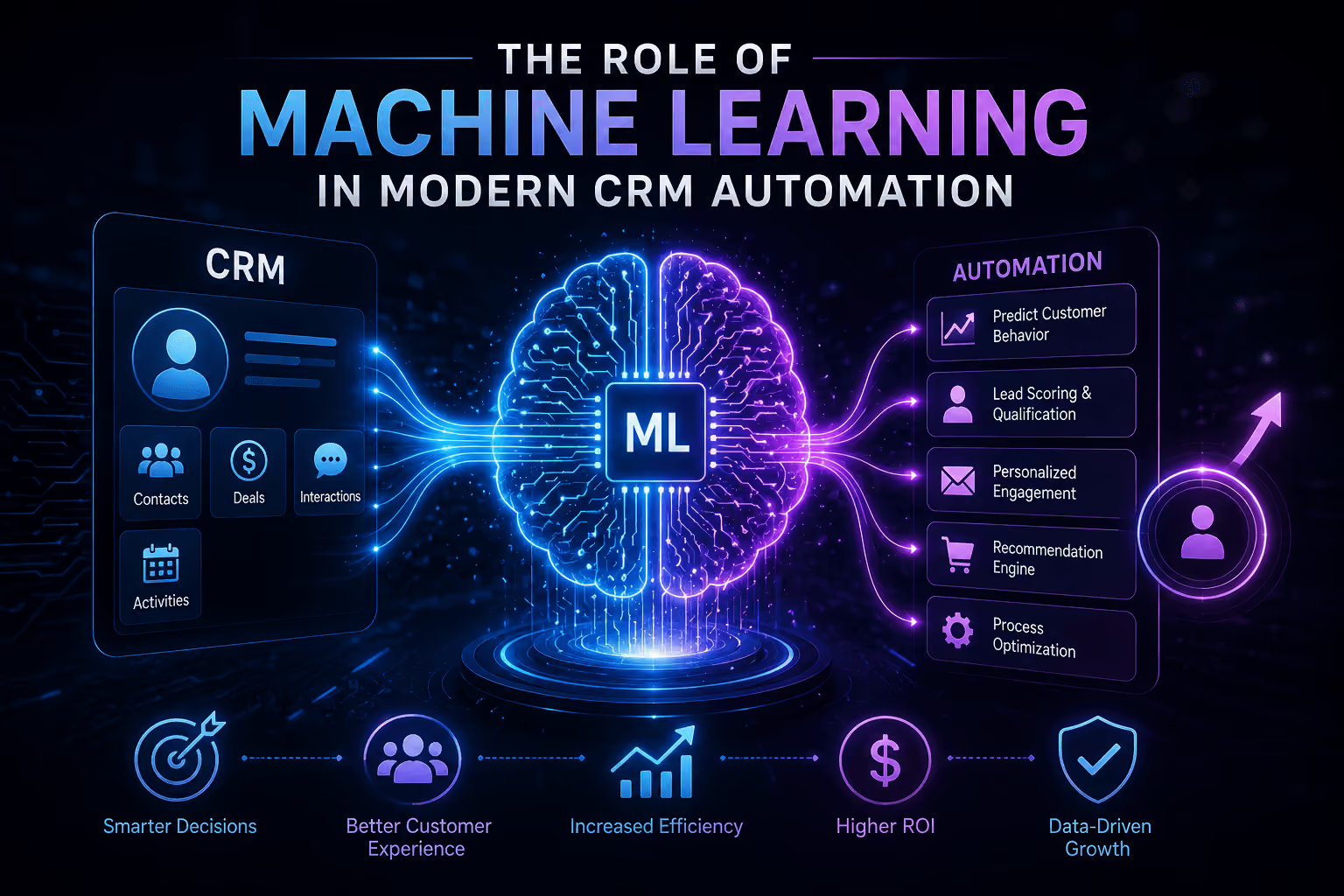
Machine learning has quietly become the secret weapon of modern CRM automation. Instead of building rule-based campaigns ("if player deposits $100, send offer X"), machine learning models predict what each player is likely to do next and personalize accordingly.
Companies using AI-driven personalization at scale generate much more revenue than slower-moving competitors. For iGaming, where every player interaction is a data point, this matters even more.
In practice, machine learning helps with:
- Predicting churn before it happens
- Identifying high-value players early
- Choosing the best offer for each player
- Optimizing send times automatically
- Detecting unusual behavior patterns
- Personalizing game recommendations
The operators who lean into this aren't replacing their teams. They're giving them better tools.
Common Mistakes Operators Make With CRM and Marketing Automation
A few patterns come up over and over again. If you're planning a new setup or fixing an existing one, watch out for these:
Treating them as separate tools. They're not. Buy them or build them with integration as the priority, not an afterthought.
Over-relying on email. Players live across channels. Push, SMS, in-app, and even WhatsApp matter just as much.
Ignoring real-time data. A campaign based on yesterday's data is already stale. Real-time is the standard now.
Spamming inactive players. If someone hasn't logged in for 60 days, sending them daily emails won't bring them back. It'll get you flagged.
Skipping personalization in loyalty programs. Generic loyalty rewards are barely better than no loyalty program at all. Personalization in loyalty programs is what makes them stick.
Not measuring what matters. Open rates are fine, but lifetime value, retention rate, and revenue per player are what actually pay the bills.
FAQ
Can a CRM replace a marketing automation tool?
No, and trying to make it do so usually ends badly. CRMs are built for data management and customer insights, not for executing complex, multi-channel campaigns at scale. You can use a CRM to send basic messages, but you'll quickly hit limits around timing, personalization, and automation logic.
Is marketing automation only for big operators?
Not at all. Smaller operators often see bigger relative gains because automation lets them compete with larger brands without scaling their team. A small operator with smart automation can outperform a bigger one stuck on manual workflows.
How long does it take to integrate CRM and marketing automation?
It depends on your current stack. If you're starting fresh with a unified platform, you can be live in weeks. If you're stitching together legacy systems, it can take months. The faster route is almost always picking a platform built for integration from the start.
What's the difference between CRM automation and marketing automation?
CRM automation focuses on streamlining customer-facing workflows like onboarding, support follow-ups, and retention triggers. Marketing automation focuses on outbound campaigns and engagement at scale. They overlap, but CRM automation is broader and more behavior-driven.
Does gamification belong in CRM or marketing automation?
Honestly, it belongs in both, which is why unified platforms have become the preferred option. Gamification mechanics need real-time CRM data to work properly, and they need marketing automation to deliver rewards and notifications at the right moment.
How does machine learning improve iGaming CRM?
Machine learning takes the guesswork out of player engagement. Instead of marketers setting rules manually, models analyze player behavior continuously and decide what each player should see, when, and through which channel. The result is better timing, better offers, and better retention.
Wrapping It Up
CRM and marketing automation are two halves of the same job. One understands your players, the other talks to them, and when they're properly integrated, the difference shows up fast in retention, engagement, and revenue.
For iGaming operators, the smartest move is picking a unified gamification CRM that handles both natively instead of duct-taping systems together. If you want to see what that looks like in action, book your free, in-depth demo of Smartico.ai below and watch a fully integrated CRM and marketing automation platform run live.