


RFM Modeling: An In-Depth Guide
Updated on July 3, 2026
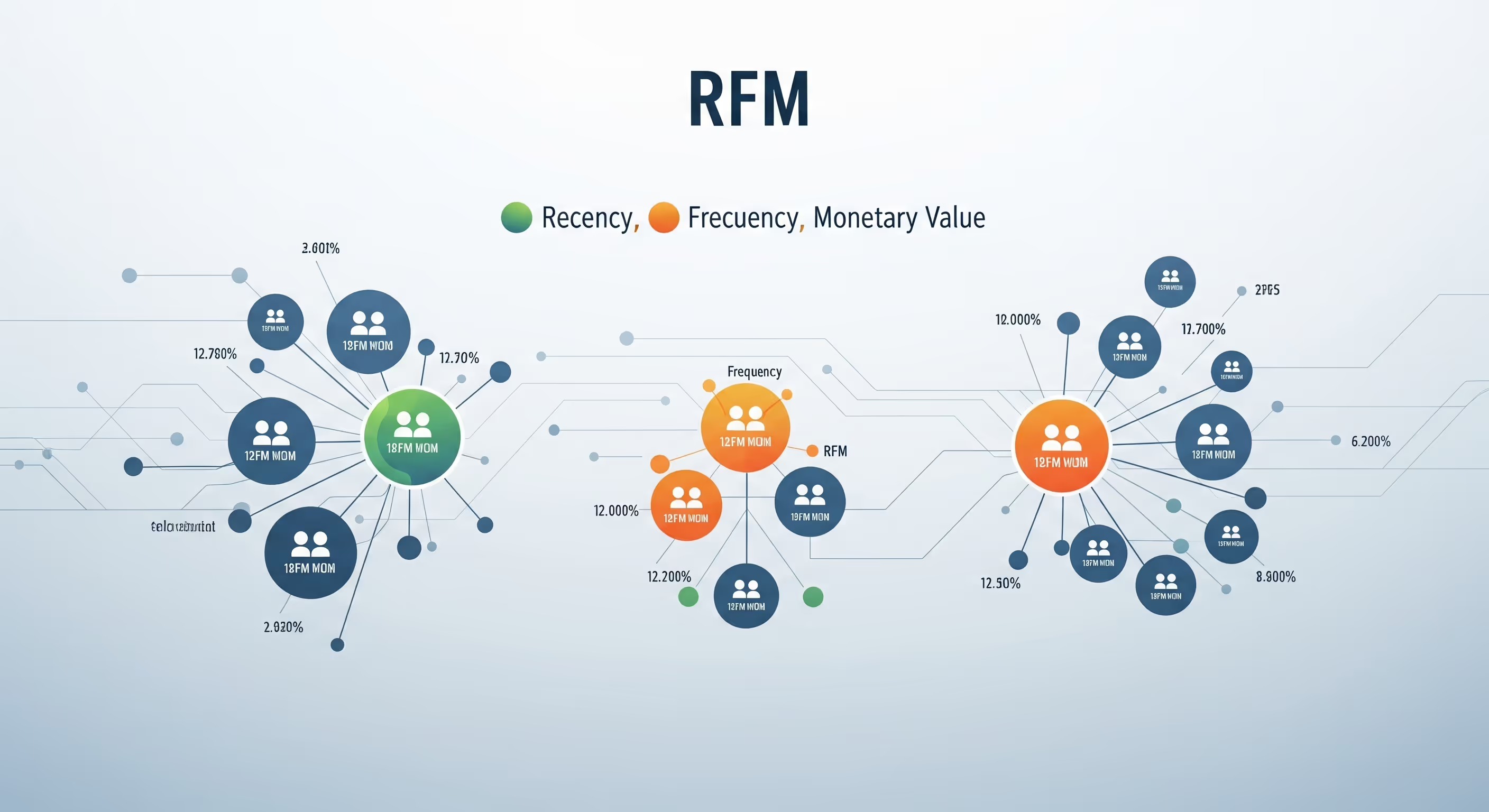
RFM modeling is one of the most popular customer segmentation models used by data-driven marketers. RFM has been around for about half a century, and it is still used to predict customer behavior and measure customer value.
What makes RFM compelling today is how far it has moved beyond manual calculation. Businesses increasingly pair RFM with machine learning to build more precise segments, and modern AI-powered versions process large datasets in real time, surfacing patterns that manual analysis would miss. Despite its age, RFM is still researched, refined, and widely used, yet many marketers still don't know how it works or what it is good for. This guide covers everything you need to start using it.
RFM ranks and segments your customers by value over a set period using three criteria:
- Recency: how recently someone bought. Recent buyers are more likely to respond to a new offer or message.
- Frequency: how often they buy. More purchases signal higher engagement.
- Monetary: how much they spend. This shows which customers spend more and which spend less.
Together these give you a clear view of your most valuable customers and everyone else, all from data you already have: historical transaction data.
What Are the Key Advantages of RFM?
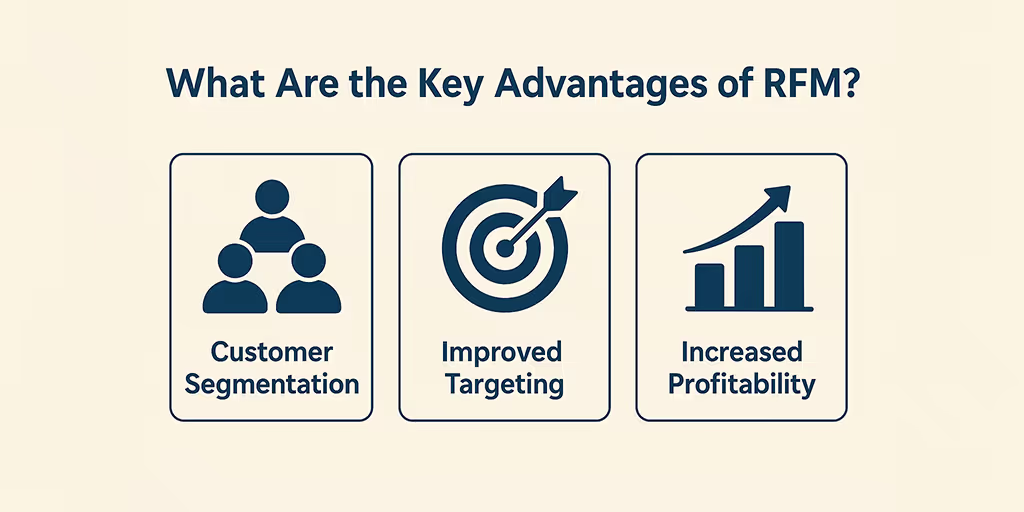
- It gives you a deeper understanding of customer behavior.
- It shows how customers are distributed across segments.
- It highlights which segments to prioritize.
- It sharpens the messaging in your campaigns.
- It supports better custom and lookalike audiences.
Automatic RFM segmentation makes it easy to keep one clear model that every team can understand and use. If you want both segmentation and traceability, RFM is a strong choice.
Acquisition drives growth in a business's early stages, when visibility and awareness matter most. Once you have enough customers to sustain the business, the focus shifts to retention and segmentation through personalized journeys. RFM helps you lift retention by giving you customer insight you would not otherwise have.
RFM is also straightforward to calculate. You can buy a paid RFM tool, but doing it yourself is simple. Here are four steps.
Step 1: Compile the data
Gather your raw transaction data. Pull every customer's purchase history and line it up with the three RFM values: recency, frequency, and monetary. If you are starting out, you can do this in Excel. With more experience, you can use Python or connect the data to other tools for reporting.
Step 2: Separate customers into tiers
Calculate each customer's RFM score by sorting the three categories and creating tiers. Four tiers is the sweet spot for manual work, though you can use five for large datasets or three for smaller ones.
Sort each value so the most desirable behavior ranks first. For recency, recent purchases rank at the top. The four tiers are:
- T-1: top score
- T-2: upper-middle score
- T-3: lower-middle score
- T-4: bottom score
Do this for recency, frequency, and monetary. When you finish, every customer has all three values tiered on their profile. Place the tiered values side by side to get the combined RFM score.
Step 3: Identify your target audience
With scores in place, group customers into named segments so your strategy is easy to act on. Common examples:
- Champions (1-1-1): your most active customers, who spend more and buy often.
- Loyals (1-1-3): not always big spenders, but active and loyal over a long time.
- Potential champions (1-4-2): often new, already spending, and worth nurturing toward Champion status.
- At risk (4-1-1): once-active big spenders who have gone quiet, so you risk losing them.
- Lost (4-4-4): barely active or gone, with no real loyalty to the business.
How you name segments is up to you. Use whatever fits your needs.
Step 4: Set up your messaging campaign
Now send messages that match each segment:
- Reward your big spenders. Give regulars a loyalty program, special offers, or early access to new products. If they invest in you, reward them for it.
- Win back customers who are slipping. Find out what pushed them away, then send strong offers to bring them back.
- Clean up the truly lost. If long-inactive customers ignore every attempt, consider removing them from your list so they stop skewing your data. An exit survey can tell you why they left.
Beyond Basic RFM: Advanced Implementation Strategies
The four-tier approach works well for most businesses, but data-driven teams push it further. Rather than building manual tables, use a CRM or analytics system that exports the data for you. Advanced teams combine RFM with machine-learning clustering like K-means to find micro-segments.
Real-time processing helps too. Instead of monthly or quarterly analyses, you can update segments daily or hourly, which suits fast-moving businesses where behavior shifts quickly.
RFM Scoring Variations for Different Business Models
The standard 1-to-5 scoring is not right for every business. SaaS companies may weight frequency around subscription renewals, while retailers may weight monetary value differently in peak seasons. Consider dynamic scoring that adapts to your industry's customer lifecycle.
Advanced Customer Segment Strategies
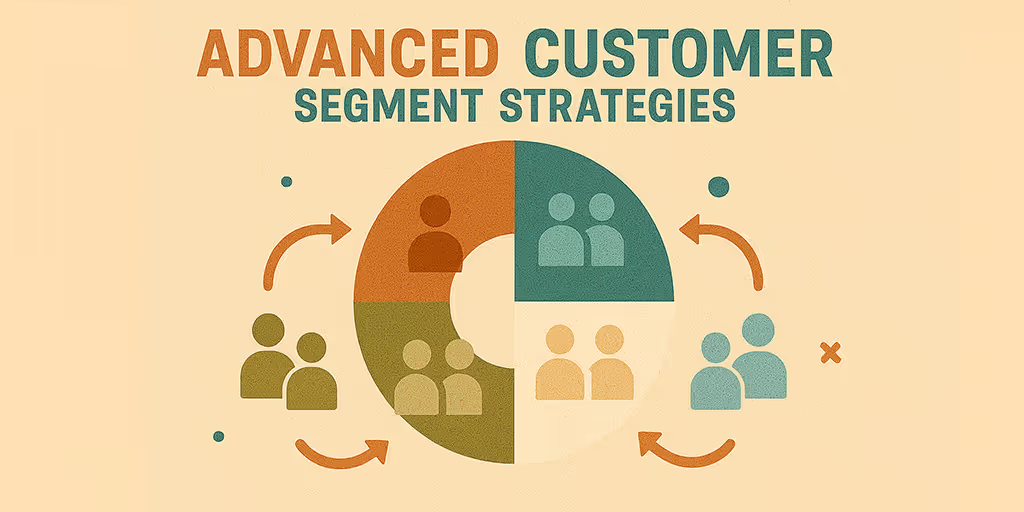
Beyond Champions, Loyals, and At-Risk, careful RFM analysis surfaces subtler segments. "Hibernating" customers were once active but have slowly disengaged. They are not quite Lost, and they need a different approach than At-Risk customers. "New customers with high potential" are recent buyers whose spending looks like your Champions; win them over with a clear value proposition rather than discounts. "Seasonal loyals" buy on predictable cycles through the year and reward well-timed campaigns.
RFM began in catalog marketing. Catalogs were expensive to design, print, and mail, so direct marketers needed a way to reach the most promising customers and stop wasting print on people who would not buy. Analysts scored each customer, studied how scores correlated with the likelihood of purchase, and built mailing lists around the best scores. By focusing on high-scoring customers, they drove profit by cutting waste, which is still the core idea today.
RFM works for almost any business. Good segmentation helps you target promotions, build loyalty and retention, and strengthen marketing overall. Used well, it is highly profitable. Like any model, though, it has weak points, which we cover below.
Integrating RFM With Modern Marketing Technology
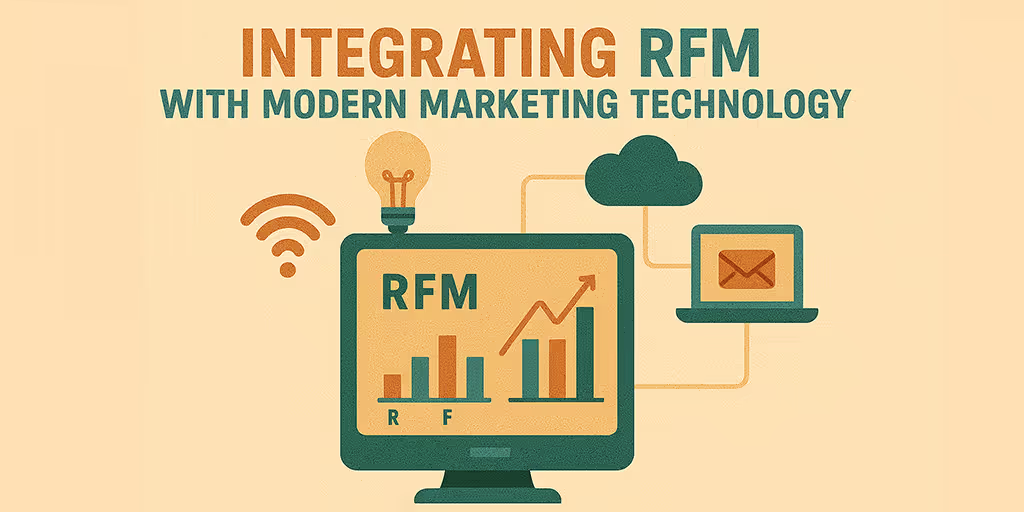
RFM works best alongside other tools. The strongest setups connect it to customer data platforms, marketing automation, and predictive analytics. Combining RFM with customer lifetime value, cohort analysis, and predictive models builds a fuller picture of your customers.
Machine learning also helps RFM find patterns that are hard to spot by hand. Pairing RFM with machine learning on transactional data improves churn prediction, so you can step in with retention campaigns before customers leave. Real-time engines can even use RFM scores to adjust website content, recommendations, and offers on the spot, which makes the experience more relevant and lifts conversion.
{{cta-banner}}
Pros of the RFM Model
1. It is measured objectively
RFM is backed by hard data, so the analysis is quantitative and free of human bias. Other segmentation methods can skew toward variables like demographics, and sampling can pick people who do not represent your base well.
2. It powers personalized marketing
RFM lets you send large-scale messaging that is still tailored to each group, rather than one generic blast. That focus tells customers you understand what they want, which brings lapsed customers back and encourages your best ones to buy again.
3. It is affordable and simple
Market research can be complex and costly. RFM keeps it simple and low-cost. Paid tools exist and some are genuinely useful, but with practice the calculation is straightforward, so businesses of any size can adopt it.
4. It raises customer lifetime value
Keeping customers matters more than winning new ones, especially in a crowded market. RFM shows you who your most valuable customers are so you can reward them, and people who feel appreciated are far more likely to stay.
Cons of the RFM Model
Used on its own, RFM can be inaccurate. Watch for three limits.
1. It can be simplistic
RFM leans on three pillars, so it can miss useful data like location and demographics. You can strengthen it with additional research into spending habits, or by asking customers directly for feedback.
2. It looks backward, not forward
RFM analyzes past behavior, which is not always a reliable guide to the future. Pair it with predictive tools to close that gap.
3. It can mislead
RFM results can distort for some business models. Seasonal patterns can throw off recency and frequency, with Black Friday a classic example. And if your product is trusted but expensive, loyal customers simply won't buy often, so frequency and recency matter less.
How Smartico Applies RFM in iGaming
When it comes to customer behavior segmentation, Smartico is a globally recognized leader in the iGaming, casino, and sports betting industry.
In practice, Smartico's RFM Analysis is built for how operators actually work. Recency and frequency are based on real player activity, either deposits or bets, over the last 30 days, and each operator chooses the methodology that fits their setup. Businesses running several brands under one label can calculate RFM "By Brand" for sharper, more relevant segments, or "By Label" across the whole operation. Ineligible users are excluded automatically.
Each player carries their RFM segment as a property on their profile, and that property does real work. Campaigns can trigger on an "RFM segment update," so when a player moves from "Loyal Customers" to "At Risk," a tailored re-engagement journey can fire on its own. From the RFM Analysis view, you can see the full population distribution, inspect any segment, and build targeted campaigns, tournaments, or offers straight from those insights. Smartico also added Value Score segmentation, which ranks each player's relative contribution to the business so you can focus marketing spend where it returns the most.
Smartico Behavioral Segments
Alongside RFM, Smartico offers behavioral segments that combine a player's profile state with their real behavior. An example is players who wagered more than €100 on slots in the last 30 days. You set these up by choosing the activity and time window (up to 90 days), the event attributes, the total conditions (a count, total, minimum, or maximum, such as total bets above €1,000), and an update schedule, for instance once a day at 5 PM. You can refine further with state conditions like brand, registration country, or language.
Like any segment, behavioral segments can be exported on a schedule and used anywhere in the platform: to limit real-time and scheduled campaigns, to gate automation rules, or to control the visibility of tournaments, store items, and mini-games.
This is where RFM stops being a spreadsheet exercise and becomes a working retention loop. Smartico pairs player analytics with machine learning through CRM Automation, AI Models, and Gamification, so the segments you build turn into timely, personalized action across every channel. To see it on your own data, book a demo below.
{{cta-banner}}
RFM Applications Across Industries
RFM started in catalog marketing, but it now reaches almost every industry. E-commerce uses it to power recommendations and pricing. Subscription services adapt it to account for tenure and usage rather than just purchase frequency. Financial services apply it to account activity and transaction volume to spot cross-selling opportunities and flag likely closures. Healthcare uses RFM-style models around appointment frequency and care costs. And the gaming industry has built sophisticated variations around player engagement, in-game purchases, and social activity to improve retention and monetization.
The Future of RFM Analysis
As customer data grows richer, RFM keeps evolving. Some teams add a "lifetime" dimension (RFML) or an "engagement" dimension (RFME) drawn from digital touchpoints. AI is making RFM more predictive than descriptive, so instead of only sorting customers by past behavior, models forecast future actions and recommend proactive steps. Privacy rules like GDPR and CCPA are also shaping the field, pushing better consent management and data anonymization so segmentation stays effective and compliant.
RFM is old, but for understanding your customers it should not be underestimated. With a little tuning, it delivers a personalized, results-focused approach to your base. Just remember that promotions, seasons, and holidays shape the data. If a loyal customer with a strong history skips a month, do not move them to another segment right away. The reason is often seasonal, and they will usually return to their normal pattern.
Did you enjoy this article? If so, why not share it with other like-minded professionals like yourself?
Want to find out how our event triggered campaigns can raise your customer engagement through the roof? Contact one of our experts for a free demo.