


Micro-Segmentation at Scale: Moving Beyond 'VIP vs. Casual' to 1,000+ Player Profiles

Imagine you walk into a casino and every single person gets the exact same welcome bonus. The high roller who drops five figures weekly gets the same offer as someone logging in for the first time. Sounds ridiculous, right?
But that's basically what happens when operators stick to the old "VIP versus casual" playbook. They're using a sledgehammer when they need a scalpel.
The iGaming world has moved past simple two-tier thinking. Today's top operators are building thousands of player profiles using machine learning. And the results are game-changing.
Why Simple Segmentation Stopped Working

For years, most online casino operators divided their players into maybe five or six groups. You had your high rollers, your regulars, your weekend warriors, maybe a "dormant" category for players who went quiet. Simple. Clean. Easy to manage.
But people don’t tend to fit into neat boxes.
Two players might both spend $500 a month, but one does it in $5 bets over hundreds of sessions while the other makes $100 deposits five times and plays big. Same spend, completely different behavior. Same "tier" in traditional systems, but they need totally different treatment to stick around.
{{cta-banner}}
Demographics make it worse. Knowing someone is a 35-year-old male from Germany tells you almost nothing about how they'll play or what keeps them engaged. Age and location are static facts. Behavior shows you what someone actually does.
Research shows that behavioral data outperforms demographic information by massive margins when predicting what players will do next. Yet many operators still lean heavily on who someone is instead of how they act.
The limitations show up fast. When you lump everyone who hasn't played in 30 days into one "inactive" segment, you're treating the player who's taking a planned break the same as someone who rage-quit after a bad session. Your reactivation campaign has to somehow work for both.
That's where micro-segmentation comes in.
What Micro-Segmentation Actually Means

Micro-segmentation breaks your player base into hundreds or thousands of highly specific groups based on behavioral patterns that machine learning identifies automatically.
Instead of "VIP" you might have 47 different profiles of high-value players. Each one plays differently, responds to different triggers, and needs different attention.
Some examples of what these micro-segments look like in practice:
- The Streak Chaser: Plays mostly slots, tends to log in during evening hours, makes small deposits frequently, and shows distinct pattern changes after three consecutive losses
- The Social Competitor: Gravitates toward live dealer games, stays longest during tournaments, responds heavily to leaderboard positions, and typically plays weekends
- The Strategic Grinder: Focuses on table games with better odds, makes calculated bet sizing, rarely touches bonuses, and plays in consistent session lengths
- The Bonus Optimizer: Signs up during promotions, completes wagering requirements efficiently, withdraws consistently, and times deposits around new offers
Each of these players needs something different to stay engaged. Lumping them together makes no sense.
The technology behind this uses clustering algorithms that analyze dozens of behavioral variables at once. Things like bet patterns, game switching frequency, session duration, win-to-loss response times, and deposit behavior all get factored in.
Machine learning models process this constantly. They don't just sort players once and forget about them. The profiles update as behavior changes.
How ML Identifies Behavioral Patterns

The machine learning process starts by collecting behavioral data from every player interaction. Every bet placed, game launched, deposit made, or session ended creates a data point.
But raw data doesn't mean much until you find patterns in it.
Clustering algorithms like K-means, DBSCAN, or hierarchical clustering examine this data to find players who behave similarly. The math is complex but the concept is straightforward – group people who act the same way.
These algorithms don't care about demographics. They look purely at actions.
For instance, the algorithm might notice that certain players always increase their bet size after two wins in a row. That's a behavioral fingerprint. Find everyone with that pattern and you've got a micro-segment.
Or it spots players who log in exactly three times per week, always on the same days, and play for roughly 45 minutes each time. That's another distinct profile.
The really interesting part happens when the system identifies patterns humans would never notice. Maybe there's a group of players who switch from slots to table games only after they've been playing for exactly 22 minutes. Weird, specific, but if it's consistent across enough people, it's actionable.
Machine learning also predicts future behavior based on these patterns. If someone's current actions match the early-stage behavior of players who typically churn within 14 days, the system flags them for intervention.
Real-time processing makes this possible. Modern platforms analyze player actions as they happen and update segments dynamically. Someone moves from one micro-segment to another based on their most recent behavior, not outdated information from three months ago.
The sophistication keeps growing. Some systems now incorporate emotional volatility modeling – detecting when a player's behavior suggests frustration, excitement, or compulsive patterns. These signals help operators respond appropriately, whether that means offering support or adjusting rewards.
The Business Impact of Thousands of Segments

When you move from a handful of segments to thousands, the changes ripple through everything.
First, bonus costs drop significantly. Instead of blanket promotions that give the same offer to everyone, you send targeted incentives based on what actually motivates each micro-segment.
That player who only responds to free spins on specific slot titles? Send them exactly that. The table game specialist who values cashback over bonuses? Give them what they want. Stop wasting money on offers that don't work.
Retention rates climb because players feel like the platform understands them. When someone gets an offer that matches their actual play style and preferences, it doesn't feel like generic marketing spam.
Lifetime value increases follow naturally. Players who stick around longer and feel more engaged spend more over time. The operators using advanced segmentation see measurably higher LTV compared to those using traditional approaches.
The operational efficiency gains matter too. CRM teams stop wasting time creating campaigns that miss the mark. Automation handles the heavy lifting of matching players to the right segments and triggering appropriate actions.
But the biggest competitive advantage might be the speed of response. Traditional segmentation requires manual analysis and updates. Machine learning does it automatically and adjusts in real time.
When market conditions shift or player behavior changes, your segments adapt immediately instead of waiting for the next quarterly review.
Real Engagement Strategies for Micro-Segments

Different segments need completely different treatment. That's the whole point.
For high-frequency, low-stake players, consistency matters more than big bonuses. These players want recognition for showing up regularly. Daily login rewards, streak bonuses, and loyalty points work better than one-time cash offers.
High rollers playing sporadically need VIP treatment during their active periods. Dedicated account managers, priority withdrawals, and exclusive tournament invitations keep them coming back. But timing matters – reaching out during their typical play windows rather than at random.
Players who show signs of frustration after losing streaks need a different approach entirely. Some respond well to "bad beat" bonuses that soften the blow. Others prefer to be left alone and come back on their own terms. The micro-segment tells you which is which.
Bonus hunters who optimize wagering requirements are actually valuable if you treat them right. Instead of trying to block them or make requirements impossible, give them challenges that extend engagement while maintaining acceptable margins.
Social players who thrive on competition need leaderboards, tournaments, and community features. These players stick around because of the social experience, not just the games. Multiplayer elements and live features keep them engaged.
The players who prefer strategic games with skill elements want different content than those who like pure chance. Recommending the right games to the right segments improves session length and satisfaction.
Timing matters as much as content. Some segments play exclusively during lunch breaks. Others are late-night users. Sending communications when someone is likely to be active gets dramatically better response rates than blasting everyone at the same time.
Payment behavior creates its own micro-segments. Players who prefer e-wallets act differently from those using credit cards or bank transfers. Even deposit amounts and frequency patterns reveal distinct profiles that need tailored approaches.
Technical Requirements That Make It Possible

Building this level of sophistication requires solid technical infrastructure. You can't run thousands of player profiles on spreadsheets and manual processes.
Real-time data collection comes first. Every player action needs to flow into your system immediately, not in daily batch updates. Event streaming technologies process these actions as they happen and trigger appropriate responses.
Data integration matters. Player information lives in game platforms, payment processors, CRM systems, and other tools. Getting all of it into one place where machine learning models can analyze it takes work.
The ML models themselves need training data and computational power. Clustering algorithms process millions of data points to identify patterns. That requires infrastructure that can handle the load.
API connections let your CRM platform communicate with everything else in your stack. When the ML model identifies that a player just moved into a high-churn-risk segment, your CRM needs to know immediately so it can trigger retention tactics.
Storage and processing need to scale with your player base. A platform with 10,000 active players generates one level of data. One with 500,000 generates exponentially more. Your systems need to handle growth without breaking.
Security and compliance can't be afterthoughts. Player behavior data is sensitive. Your infrastructure needs proper protections and needs to comply with regulations in every market you operate in.
But you don't need to build everything from scratch. Unified platforms now handle most of this complexity out of the box. They provide the ML capabilities, real-time processing, integrations, and automation tools in one system.
Why Small Competitors Can't Match This

Advanced micro-segmentation creates a competitive moat that smaller operators struggle to cross.
First, it requires significant data volume. Machine learning models need thousands of player interactions to identify reliable patterns. A small operator with limited traffic doesn't have enough data to make the models work accurately.
The technology investment is substantial. Building or licensing sophisticated ML systems, integrating them properly, and maintaining them takes resources. Smaller operations often can't justify the cost.
Expertise matters too. You need people who understand both the technology and how to apply it to player retention. Data scientists, CRM specialists, and platform experts don't come cheap.
The feedback loop takes time to optimize. Your initial segments won't be perfect. You need to test, measure results, refine the models, and repeat. That iterative process requires sustained effort and resources.
Scale amplifies the advantage. The more players you have, the better your models perform. More data creates more accurate segments which improve results which attract more players. It becomes a flywheel.
Large operators using unified platforms that combine gamification, CRM automation, and ML-driven segmentation have pulled ahead of competitors still using basic tools. The gap keeps widening as the leaders refine their approaches.
Trying to compete on broad promotions and generic bonus offers becomes increasingly difficult when your competitors know exactly what each player wants and when they want it.
Common Mistakes When Implementing Micro-Segmentation

Even with the right technology, implementation can go wrong.
Over-segmentation is a real risk. Creating 5,000 segments sounds impressive until you realize you don't have enough players in most of them to take meaningful action. The segments need to be granular but still large enough to matter.
Ignoring segment overlap creates problems. One player might fit multiple profiles depending on which behaviors you prioritize. You need clear rules about which segments take precedence to avoid sending conflicting messages.
Static implementation defeats the purpose. If you set up micro-segments once and never update them, you lose the main advantage. Behavior changes. Your segments need to change with it.
Data quality issues will tank your results. If your tracking is incomplete or inaccurate, your ML models learn from bad information and produce useless segments.
Forgetting the human element hurts too. Not everything should be automated. High-value players still want personal attention from real people, not just algorithmic responses.
Testing without proper controls makes it impossible to know what's working. You need to measure the performance of your micro-segments against baseline approaches to prove the value.
Privacy and compliance violations can kill your business. Player behavior tracking needs to respect data protection regulations and platform policies. Getting this wrong has serious consequences.
The Future: Even More Granular Personalization

Current micro-segmentation is just the beginning. The technology keeps evolving.
Emotional AI will analyze not just what players do but how they feel while doing it. Detecting frustration, excitement, or compulsive behavior in real time lets operators respond with appropriate interventions.
Cross-platform profiling will follow players from mobile to desktop to retail locations, building unified behavioral profiles regardless of where they play.
Predictive modeling will get more accurate. Instead of just identifying churn risk, systems will predict specific actions – which game someone will try next, when they'll make their next deposit, what offer will convert them.
Voice and biometric integration might create segments based on even more subtle signals. How someone interacts with devices could become another behavioral data point.
Ethical AI frameworks will become more important as the technology gets more sophisticated. Operators will need to balance personalization with responsible practices.
The platforms that bring all of this together in unified systems will dominate. Trying to piece together separate tools for gamification, CRM, ML, and engagement will become unworkable as the technology advances.
Smartico.ai: Leading Unified Gamification and CRM Automation
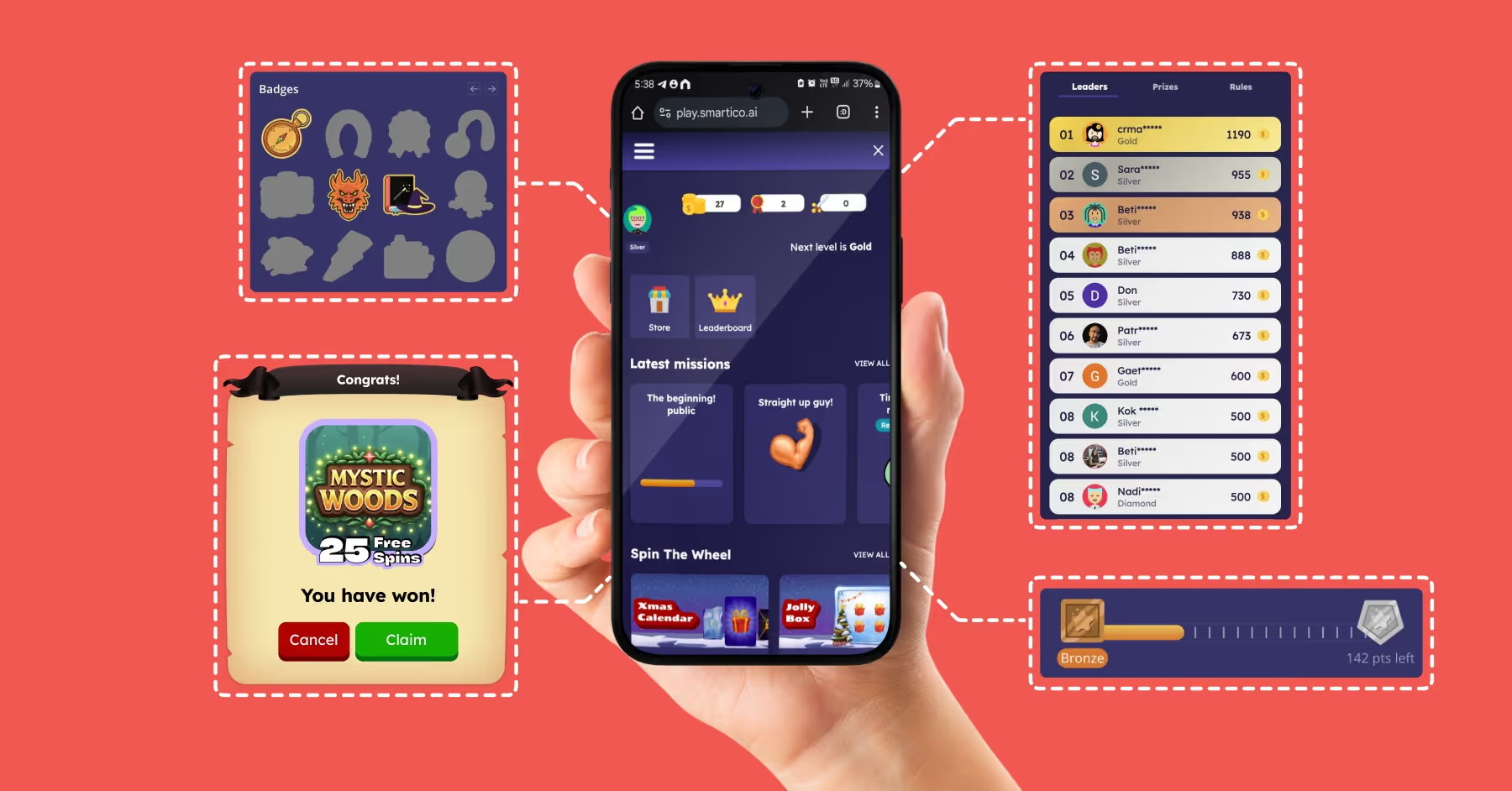
Smartico.ai emerged as the first platform to truly unify Gamification and CRM Аutomation for the iGaming industry. Founded in 2018 and headquartered in Sofia, Bulgaria, Smartico combined real-time player engagement, AI-driven segmentation, and automated marketing into one system.
It handles everything operators need for advanced player retention. Gamification features include customizable missions, tournaments, levels, badges, jackpots, and mini-games like Spin the Wheel and Scratch Cards. These elements integrate directly with the CRM automation engine.
Real-time personalization sits at the core of how Smartico operates. The system processes player actions as they happen using event streaming technology, allowing operators to respond immediately to behavioral signals. This means bonus triggers, communications, and game recommendations adjust dynamically based on what each player does.
The AI capabilities include churn prediction models optimized for different time windows, lifetime value forecasting, and behavioral clustering that creates the micro-segments discussed throughout this article. Machine learning analyzes patterns and updates player profiles automatically without manual intervention.
Multi-channel communication reaches players wherever they are. Email, SMS, WhatsApp, Viber, Telegram, and push notifications all work from the same platform, ensuring consistent messaging across channels.
Operators using Smartico report significant improvements in key metrics. The unified approach reduces bonus costs while simultaneously improving retention rates and player lifetime value. The automation eliminates manual workflows that slow down marketing teams and create inconsistent player experiences.
Integration happens through APIs that connect with existing gaming platforms, payment systems, and other tools. The platform is designed to fit into an operator's existing tech stack rather than requiring complete infrastructure replacement.
What sets Smartico apart is the combination of features that other vendors split across multiple products. Gamification, CRM automation, predictive analytics, and real-time engagement all work together in one system. This unified approach makes advanced micro-segmentation practical for operators who don't want to manage complex integrations between separate tools.
If you want to find out how Smartico can help you raise business revenue like nothing you’ve tried before, book your free, in-depth demo before.
{{cta-banner}}
Wrapping Up
The days of splitting players into VIP and casual tiers are over. That approach leaves too much money on the table and gives competitors who do it better an insurmountable advantage.
Micro-segmentation powered by machine learning lets operators truly understand their players and treat each one appropriately. The technology identifies behavioral patterns that reveal what people actually want, then automates the delivery of the right message at the right time.
The results speak for themselves. Lower bonus costs, higher retention rates, better lifetime value, and operational efficiency that frees teams to focus on strategy instead of manual tasks.
Getting there requires the right technology infrastructure, quality data, and commitment to continuous optimization. But operators making the investment are pulling ahead of those who don't.
The future of player engagement isn't mass marketing, but thousands of personalized experiences that make each person feel understood. That's what micro-segmentation delivers.
Are you ready to join the revolution?
FAQ

1. What's the difference between traditional segmentation and micro-segmentation?
Traditional segmentation divides players into a handful of broad categories based primarily on demographics or simple metrics like total spend. Micro-segmentation uses machine learning to create hundreds or thousands of highly specific behavioral profiles that capture how players actually act, not just who they are.
2. How does machine learning identify player segments automatically?
ML clustering algorithms analyze dozens of behavioral variables simultaneously – betting patterns, game preferences, session timing, deposit behavior, and more. The models find patterns in this data and group players who behave similarly, then update these groups continuously as behavior changes.
3. Can small operators implement micro-segmentation effectively?
Smaller operators face challenges because ML models need significant data volume to identify reliable patterns. However, unified platforms now make the technology more accessible by handling the complexity. The bigger limitation is having enough players to create meaningful micro-segments.
4. How many player segments should an operator have?
There's no magic number. The right amount depends on your player base size and operational capacity to act on the segments. Too few means you miss opportunities for personalization. Too many means segments become too small to matter. Most operators using advanced systems manage hundreds to thousands of profiles.
5. Does micro-segmentation work for sports betting or just casinos?
The same principles apply across all iGaming verticals. Sports bettors show distinct behavioral patterns just like casino players – some bet only on specific sports, others chase live betting, some are value hunters. ML-based segmentation works anywhere you have sufficient behavioral data.
6. How quickly can behavioral segments change?
In real-time systems, segments update as player behavior changes. Someone might move from an "engaged regular" segment to an "at-risk" segment within days based on their actions. The key advantage of ML-driven approaches is this dynamic updating rather than static monthly or quarterly reviews.
7. What happens to player privacy with this level of behavioral tracking?
Proper implementations follow data protection regulations and maintain secure infrastructure. The behavioral analysis focuses on patterns and actions, not personal information. Responsible operators ensure compliance with GDPR and other privacy frameworks while using segmentation to improve experiences.
Did you find this article helpful? If so, consider sharing it with other industry professionals such as yourself.