


Predicting Customer Lifetime Value: Using AI and Machine Learning
.avif)
What if you could look at a brand-new player on your online casino platform and predict, with surprising accuracy, how much revenue they'll bring in over the next two years? That's exactly what Customer Lifetime Value (CLV) prediction does. And with AI and machine learning now doing the heavy math, iGaming operators don't have to guess anymore.
The ability to forecast what a player is worth over time changes everything: how you spend your marketing budget, who gets VIP treatment, and which players are about to quietly slip away. According to a Harvard Business Review study, increasing customer retention by just 5% can boost profits by 25% to 95%. For online casino operators, that kind of insight isn't optional. It's survival.
Let's break down how predictive analytics actually works for CLV, the machine learning models behind it, and how you can turn all of this into a real strategy.
What Is Customer Lifetime Value (And Why Does It Matter So Much in iGaming)?

Customer Lifetime Value is the total net profit a business can expect from a single customer over their entire relationship. In the context of an online casino, CLV accounts for deposits, wagers, bonuses redeemed, withdrawal behavior, and how long a player stays active.
Here's why CLV sits at the center of smart iGaming operations: acquiring new players is expensive. It costs five times more to attract a new customer than to keep an existing one. If you're pouring money into acquiring players who churn after a week, your return on ad spend craters. CLV gives you the lens to see which players deserve more attention and which acquisition channels actually deliver long-term value.
Without CLV, you're flying blind. With it, your CRM, your loyalty programs, and your entire retention strategy get sharper.
The Traditional CLV Formula vs. Predictive CLV
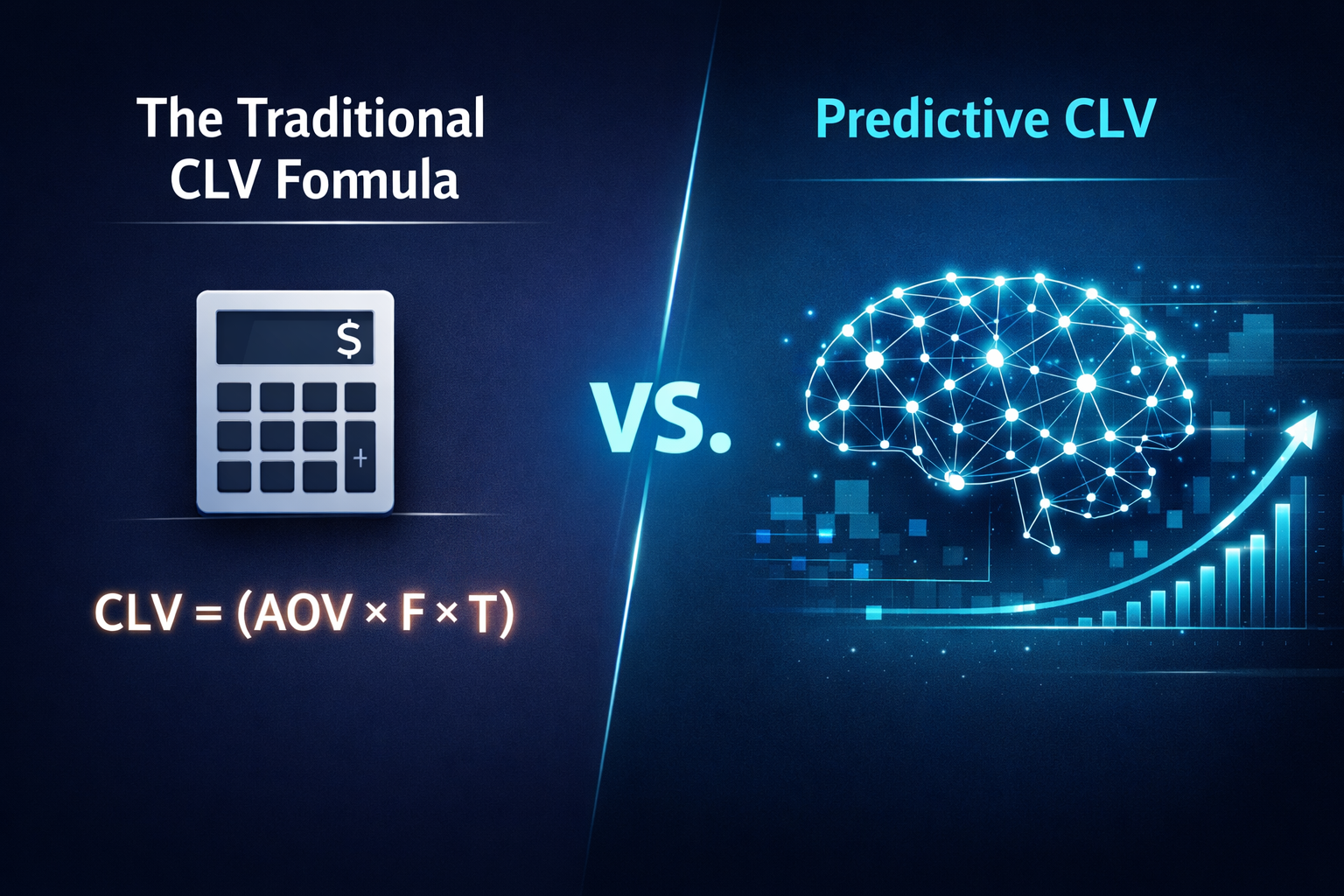
Historically, operators calculated CLV with a straightforward formula:
CLV = Average Revenue Per User × Average Customer Lifespan
That works fine on a spreadsheet, but it has limitations. It treats every player like an average, ignores behavioral patterns, and can't adapt in real time. A player who deposits $500 in their first week looks identical to one who deposits $500 spread over six months, even though their future behavior will likely be very different.
Predictive CLV flips this approach. Instead of looking backward at averages, machine learning models look at individual player data and forecast future behavior. They factor in recency of play, frequency of deposits, game preferences, bonus response rates, session lengths, and dozens of other signals.
Predictive CLV models outperform traditional methods by 15% to 25% when it comes to accurately identifying high-value customers. For an industry where margins matter this much, that improvement pays for itself quickly.
How Machine Learning Models Predict Player Value

So what's actually happening under the hood? Machine learning models for CLV prediction typically fall into a few categories. Each has strengths depending on your data maturity and goals.
Probabilistic Models (BG/NBD and Gamma-Gamma)
These are the workhorses of CLV prediction. The BG/NBD (Beta-Geometric/Negative Binomial Distribution) model, originally described by Fader, Hardie, and Lee, predicts how many future transactions a customer will make and the probability they're still "alive" (active). The Gamma-Gamma model then estimates the monetary value of those transactions.
They're popular because they work well even with limited data and don't require a massive engineering team to implement.
{{cta-banner}}
Supervised Learning Models
These include regression techniques (linear, logistic), decision trees, random forests, and gradient boosting machines like XGBoost. You train them on historical data where you already know the actual lifetime value of past players, and they learn the patterns.
Companies using advanced analytics for personalization (which relies on CLV prediction) generate a much higher revenue from those activities than average players.
Deep Learning and Neural Networks
For operators with massive datasets, deep learning models like LSTMs (Long Short-Term Memory networks) can capture complex sequential patterns in player behavior. These models excel at spotting non-obvious correlations, like how a shift in game preference might signal upcoming churn weeks before it happens.
Here's How These Models Compare:
The choice depends on where you are as an operator. Probabilistic models get you 80% of the way. Deep learning and ensemble approaches are worth the investment.
7 Ways AI Improves CLV Optimization in Online Casino Operations
Predicting CLV is only half the equation. The real payoff comes when you act on those predictions. Here's how AI-driven CLV insights translate into concrete operational improvements:
- Smarter Player Segmentation. Instead of grouping players by deposit size alone, AI segments them by predicted future value. A low-depositor with high engagement frequency might be far more valuable long-term than a high-roller who's about to leave. Most customers expect companies to understand their unique needs.
- Personalized Bonus Allocation. Why offer the same bonus to everyone? AI matches bonus types and amounts to individual player profiles. Players predicted to have high CLV get retention-focused offers. Those on the edge of churning receive reactivation incentives calibrated to their history.
- Dynamic Loyalty Program Tiers. Machine learning can automatically adjust loyalty tiers based on predicted future value, not just past spend. This keeps high-potential players engaged before they hit traditional thresholds.
- Optimized Acquisition Spend. When you know which player profiles lead to high CLV, you can feed that data back into your acquisition campaigns. Lookalike audiences built from high-CLV player profiles consistently outperform generic targeting. CLV is a primary input for ad bidding strategies.
- Early Churn Detection. AI models don't just predict value. They also flag when that value is at risk. A drop in login frequency, smaller deposit amounts, or reduced session times can trigger automated CRM workflows days or weeks before a player actually leaves.
- Revenue Forecasting. Aggregating individual CLV predictions gives you a bottom-up revenue forecast that's more reliable than top-down estimates. Finance teams and investors appreciate this kind of granularity.
- Responsible Play Monitoring. Interestingly, CLV models also help identify problematic play patterns. Sudden spikes in deposit frequency or wager size that deviate from a player's predicted profile can flag potential issues, supporting responsible gaming initiatives.
Key Data Points That Feed CLV Prediction Models
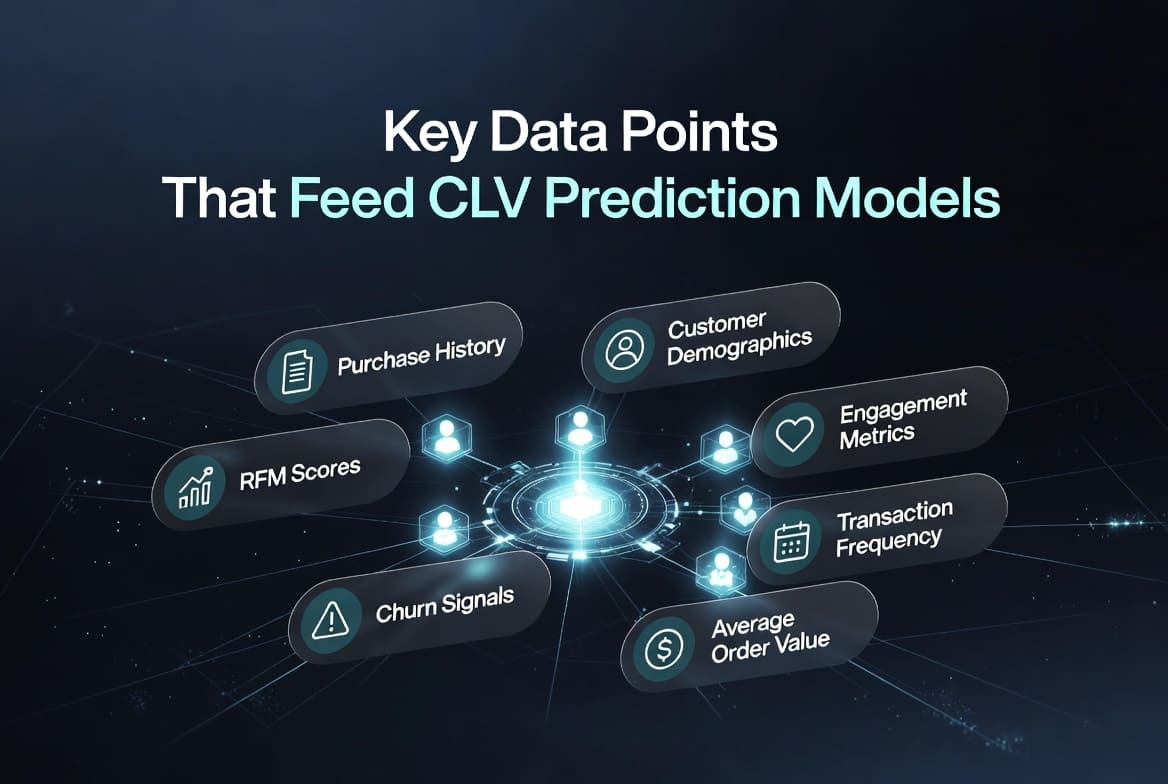
Not all data is equally useful. The best CLV models in iGaming draw from specific behavioral and transactional signals. Here are the ones that matter most:
- Deposit frequency and amounts over the first 7, 14, and 30 days (early behavior is highly predictive)
- Game type preferences and shifts in those preferences over time
- Session duration and frequency, including time-of-day patterns
- Bonus redemption rates and how players respond to different offer types
- Withdrawal behavior, including timing and frequency relative to deposits
- Customer support interactions, which often signal satisfaction or frustration
- Device and channel data (mobile vs. desktop, app vs. browser)
- Referral activity, since players who refer others tend to have higher CLV themselves
- Loyalty program participation and progression velocity
The quality of input data is the single biggest factor in predictive model accuracy. Garbage in, garbage out still applies, even with the fanciest AI.
Building a CLV Prediction Strategy: Where to Start
If you're an iGaming operator looking to implement CLV prediction, here's a practical roadmap.
Step 1: Audit Your Data
Before touching any model, take stock of what data you actually have. Is your CRM capturing behavioral signals beyond basic transactions? Are your data pipelines clean and consistent? Most operators find gaps here, and filling them is the highest-leverage first move.
Step 2: Start Simple
You don't need a data science team of 20 to get started. Probabilistic models like BG/NBD can run on relatively modest datasets and still produce actionable insights. Peter Fader's work at Wharton has shown repeatedly that these models punch above their weight for their simplicity.
Step 3: Integrate CLV Into Your CRM
A prediction sitting in a spreadsheet doesn't help anyone. The real value comes when CLV scores feed directly into your CRM automation. That means triggering personalized campaigns, adjusting loyalty tiers, and flagging at-risk players automatically, all based on predicted value.
Step 4: Test, Learn, Iterate
No model is perfect on day one. Run A/B tests comparing CLV-driven campaigns against your existing approach. Measure not just short-term metrics (open rates, click-throughs) but actual long-term revenue per player. Organizations that continuously iterate on their AI models see much better results than those that deploy and forget.
Step 5: Scale With More Sophisticated Models
Once your data infrastructure is solid and your team has experience with basic models, graduate to ensemble methods or deep learning. The incremental accuracy gains become significant at scale.
Common Pitfalls to Avoid

Even with great tools, CLV prediction projects can go sideways. Watch out for these:
Overfitting is the big one. If your model is too tightly tuned to historical data, it won't generalize well to new players or changing market conditions. Always validate with holdout sets.
Ignoring the time dimension is another trap. Player behavior in iGaming is seasonal and event-driven. A model trained only on data from a major sports season will underperform during quieter periods.
And don't forget about data privacy. The GDPR and similar regulations require transparency about how you use player data for profiling. Build compliance into your process from the start, not as an afterthought.
How Smartico.ai Supports CLV Prediction and Optimization
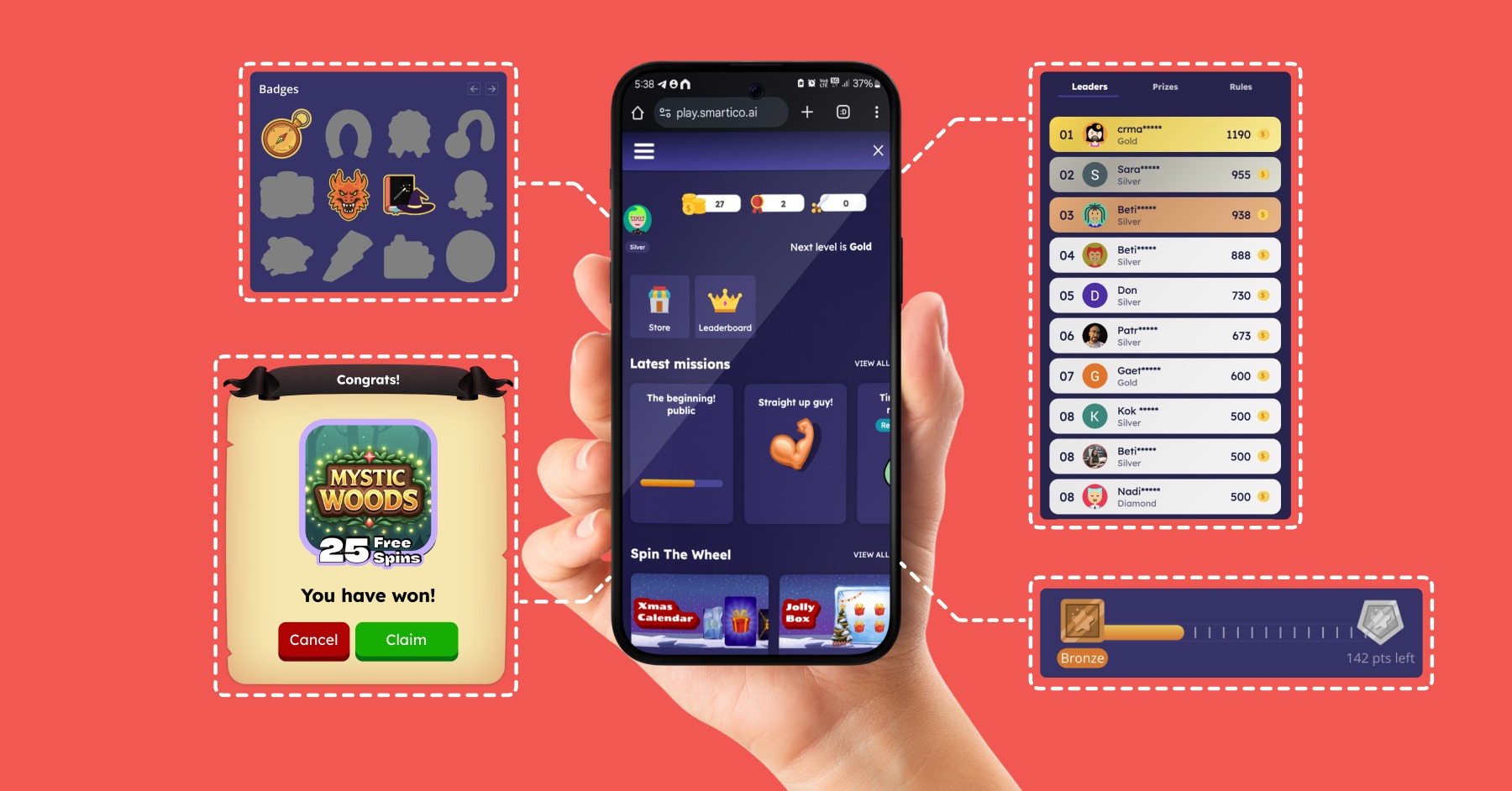
For operators who want CLV prediction connected to real-time action, Smartico.ai offers something distinct. Founded in 2019, Smartico.ai is the first unified Gamification and CRM Automation software built specifically for the iGaming industry.
What makes Smartico.ai relevant here is how it connects the dots between prediction and execution. It combines real-time CRM automation with gamification mechanics, loyalty program management, and personalization engines in a single system. Instead of predicting a player's value in one tool and then manually setting up campaigns in another, Smartico.ai lets operators act on player insights instantly.
Its CRM automation triggers personalized engagement workflows based on player behavior and predicted value. The built-in gamification layer (missions, tournaments, points, levels) gives operators proven tools to boost the engagement signals that drive higher CLV. And its loyalty program management allows dynamic tier adjustments that reflect a player's trajectory, not just their history.
For iGaming operators looking to move from "we know what our players are worth" to "we're actively increasing what they're worth," Smartico.ai bridges that gap. Book your demo below to see how Smartico works wonders with your data.
{{cta-banner}}
Frequently Asked Questions
How accurate are machine learning CLV predictions for online casino players?
Accuracy depends on data quality and model choice, but well-implemented models typically predict within 15-20% of actual values for 6-12 month horizons. Ensemble methods and models trained on rich behavioral data tend to perform best. The key is continuous retraining as player behavior evolves.
How soon after a player signs up can you predict their lifetime value?
Surprisingly early. Research shows that first-week behavior (deposit patterns, game selection, session frequency) provides strong predictive signal. Some models produce useful estimates within 7 to 14 days of a player's first activity, though accuracy improves with more data over the first 30 to 90 days.
What's the difference between historical CLV and predictive CLV?
Historical CLV sums up what a player has already spent. Predictive CLV uses statistical or machine learning models to forecast future spending. Predictive CLV is more useful for strategic decisions because it helps you act before outcomes are locked in, rather than reacting to what already happened.
Can small iGaming operators benefit from CLV prediction, or is it only for large platforms?
Small operators absolutely benefit. Probabilistic models like BG/NBD work with modest datasets, and cloud-based tools have lowered the cost of implementation dramatically. Even basic CLV segmentation (dividing players into high, medium, and low predicted value groups) can improve marketing ROI significantly.
How does CLV prediction relate to responsible gaming?
CLV models can flag anomalous behavior, like sudden spending spikes that deviate from a player's predicted pattern. These signals can trigger responsible gaming interventions such as deposit limit suggestions or cooling-off prompts. Regulators are increasingly encouraging data-driven approaches to player protection.
How often should CLV models be retrained?
Most operators retrain monthly as a baseline, with more frequent updates during high-activity periods like major sporting events or seasonal promotions. The goal is keeping the model responsive to shifting player behavior without overreacting to short-term noise.
Conclusion
Predicting Customer Lifetime Value with AI and machine learning gives online casino operators a genuine competitive advantage. It sharpens every decision, from player acquisition to loyalty programs to responsible gaming. The tools exist, the models are proven, and the operators who adopt them now will be the ones setting the pace in 2026 and beyond.
Ready to connect CLV prediction to real-time player engagement? Request a demo of Smartico.ai below and see how unified CRM automation and gamification can work for your platform.