

Promotional Fatigue in iGaming: Coordinating Gamification and CRM Across the Player Journey
.png)
When every mechanic fires at once, players stop responding to all of them. The fix is coordination at the player level, not another campaign.
On a Tuesday evening, a regular slots player logs in. A supplier free-spins popup lands first. Behind it, a banner pushes this weekend's tournament. Her phone buzzes with a cashback SMS. An email sits in her inbox offering a reload bonus, and a push notification tells her the brand misses her, even though she played yesterday. Five prompts, one session, and none of them aware of the other four.
That is promotional fatigue: the point where a player receives so many overlapping offers and messages that each one stops landing. It is one of the fastest-growing problems in iGaming retention, and it rarely comes from any single campaign being wrong. It comes from good campaigns firing without coordination.
Promotional fatigue is a coordination problem, not a volume problem
Volume is part of it. The deeper issue is that the mechanics do not know about each other. A modern iGaming program runs several engagement systems at once: supplier promotions, operator tournaments, missions, cashback, jackpots, and, layered on top, the iGaming CRM campaigns that send email, SMS, and push. Each was built to work on its own. None was built to check what the others already sent today.
This is where the industry is heading in 2026. According to recent industry reporting, operator attention is shifting from the performance of any single engagement tool toward how several mechanics operate alongside one another without piling up, because a player can now meet a supplier promotion, an operator tournament, cashback, and a CRM campaign inside the same stage of their lifecycle. The question has moved from "is this campaign good" to "what else is this player already getting this week."
Players feel the total pressure from your brand, not from your org chart
Here is the part that is easy to miss from the inside. Your VIP team, your CRM team, your gamification manager, and your supplier integrations each contact the player independently, and each one can be perfectly disciplined on its own. The player does not experience four teams. They experience one brand, and they feel the sum of everything all four sent. Fatigue keeps climbing even while every team believes it is being restrained, because no one is looking at the combined load on a single player.
Over-contacting does specific damage in a mature database. It teaches players to wait, since a better offer usually arrives tomorrow, so they delay deposits they would have made anyway. It lowers response quality across the board, so the messages that matter get ignored alongside the ones that do not. And it pushes players to tune the brand out entirely unless an offer is unusually large, which is an expensive habit to train into your base.
{{cta-banner}}
The cost shows up as bonus dependency, dead channels, and compliance risk
Left alone, promotional fatigue turns into four measurable problems.
Bonus dependency is the most expensive. When players are trained to expect a constant stream of offers, they stop playing on their own money and hold out for the next incentive, which erodes margin and feeds bonus abuse. Bonuses are already the costliest retention tool in iGaming, so a bonus engine that fires without coordination multiplies a cost you can least afford to waste. Tighter targeting, which we covered in our work on personalized bonus systems, does more with less.
Channel burnout comes next. Every unsubscribe and every push opt-out is a channel you do not get back. Once a player mutes your email or disables notifications, even your well-timed, genuinely useful messages never arrive, and you have permanently narrowed how you can reach them.
Desensitization is quieter and just as costly. Players who see too much stop separating your signal from your noise, so a real reactivation offer reads like the fifth banner of the day and earns the same shrug.
Compliance exposure closes the list. Sending promotional prompts to a player showing high-frequency or high-intensity activity is exactly the pattern regulators scrutinize, and it is easy to do by accident when your promotional mechanics cannot see a player's risk signals. Coordination is a responsible-gaming safeguard, not only a marketing nicety.
Coordination happens at the player level, not the campaign level
Fixing fatigue means managing the player rather than the campaigns. Four things make that possible.
It starts with a single player view. Every mechanic, from tournaments to CRM sends to bonuses, has to read and write to the same real-time player profile. If your gamification, bonus, and messaging systems each hold a separate slice of the player, no rule can see the whole load, and coordination is impossible before you even begin.
On top of that view sits a pressure limit that applies across everything at once, not per team and per channel in isolation. The cap is the total a player receives in a day or a week, counting supplier promos, tournaments, cashback, and CRM messages together. A limit that governs email while ignoring the popup and the SMS is not a limit. It is a blind spot.
Then comes sequencing by lifecycle stage. A new registrant needs guidance, an active player wants relevance, and a dormant player usually needs a reason to return rather than another discount. Matching the mechanic to the stage, and holding back the ones that do not fit, does more for retention than adding another campaign.
The fourth piece is prioritization. When several mechanics want the same player in the same moment, something has to decide which one wins and which one waits. That call is far better made by rules and by AI models that weigh timing and predicted response than by whichever team happened to schedule first.
Underneath all four is measurement that looks at the net effect, not the per-mechanic scoreboard. A large volume of campaigns produces a reassuring number of opens, clicks, and attributed deposits, which can hide the fact that the combined pressure is quietly lowering response quality over time. Holdout groups and incremental measurement tell you whether the fifth message adds value or just adds noise.
This is the argument for one system instead of five
Every control above depends on the mechanics sharing a brain. Point tools cannot coordinate what they cannot see, and an operator running gamification in one place, bonuses in another, and messaging in a third has no single layer where the total load on a player is visible, let alone capped. Coordination is a property of running the mechanics on one platform, on one player profile, in real time, rather than a feature you bolt onto a stack of disconnected tools.
How Smartico coordinates the player journey
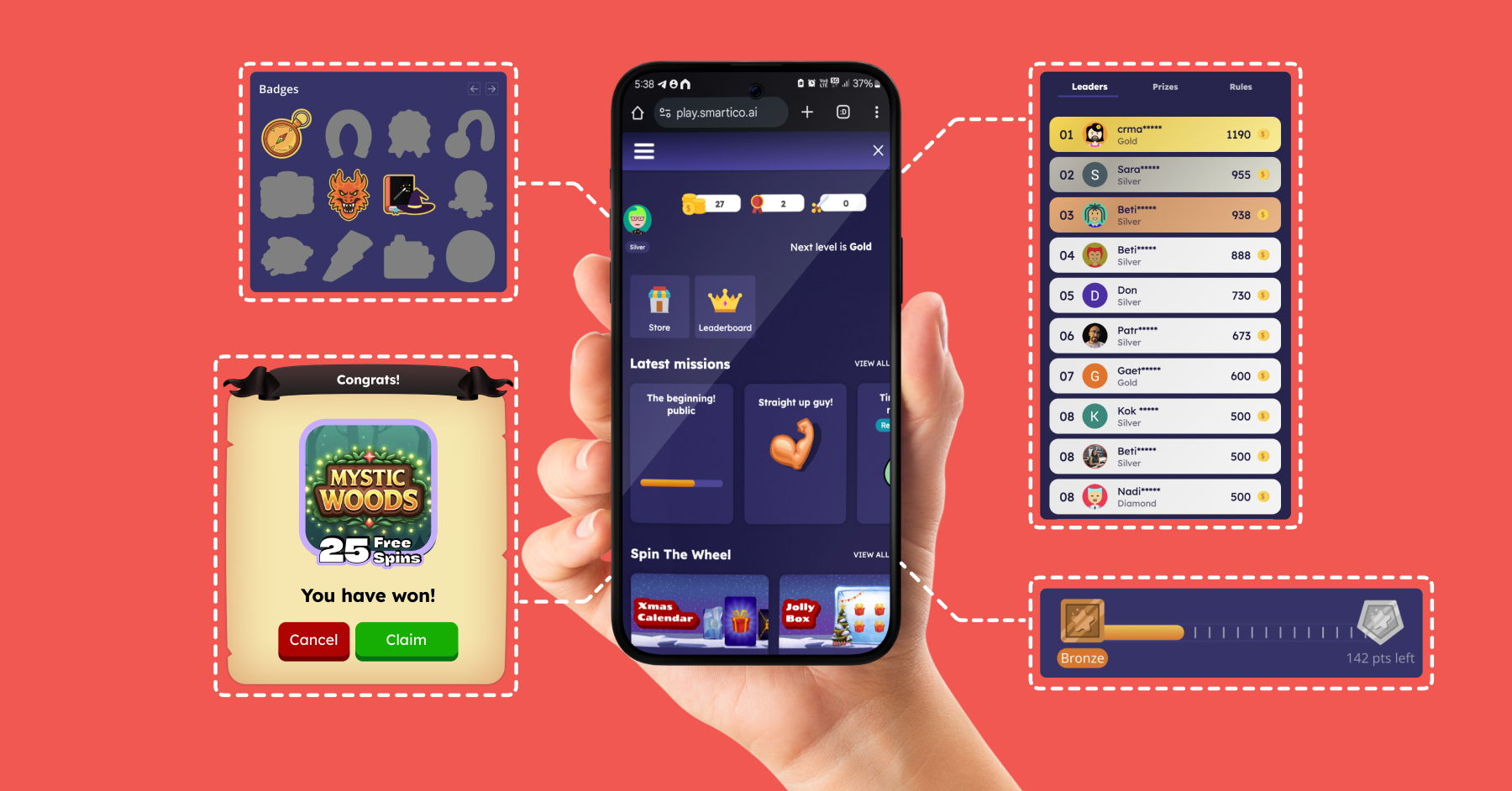
Smartico was built as a single system for this exact reason. Gamification, the bonus engine, and CRM automation run on the same real-time player profile, so tournaments, missions, jackpots, free-to-play games, bonuses, and multichannel messaging all read the same player and can be governed together instead of in separate silos. Because the whole journey lives in one place, you can sequence mechanics by lifecycle stage, apply a pressure limit across every channel and every mechanic at once, and let AI models decide which offer earns the moment based on predicted response and churn risk. The player hears from you when it counts and stays out from under the pile the rest of the time.
If your engagement mechanics are spread across tools that cannot see each other, book your free, in-depth demo below and we will show you what coordinating them on one platform looks like against your current setup.
{{cta-banner}}
Conclusion
Promotional fatigue is a coordination failure, and coordination is the fix: one view of the player, one pressure limit across every mechanic, the right mechanic for each lifecycle stage, and a rule for who wins when they compete. Operators who manage the player instead of the campaigns keep their channels alive, spend bonus budget where it works, and hold the attention everyone else is busy burning out.
FAQ
1. What is promotional fatigue in iGaming?
Promotional fatigue is the point where a player receives so many overlapping offers and messages, across supplier promotions, tournaments, cashback, bonuses, and CRM campaigns, that each one stops landing. It usually comes from good campaigns firing without coordination rather than from any single bad campaign, so the player feels the combined pressure and starts tuning the brand out.
2. How do you prevent message fatigue across channels?
Set a pressure limit that counts everything a player receives together, across email, SMS, push, on-site popups, tournaments, and bonuses, instead of capping each channel or team in isolation. Because players feel the total load from a brand, a cap that governs one channel while ignoring the rest leaves the real problem in place. Pair the limit with sequencing by lifecycle stage, so the messages that do get through are the ones that fit where the player is.
3. Is more communication better for player retention?
Only up to a point. In a mature player base, over-contacting lowers response quality, raises opt-outs, and teaches players to wait for the next offer, which delays deposits and erodes margin. What matters is the net effect on the player, measured with holdout groups, not the raw count of campaigns or opens. Past a certain frequency, another message subtracts value instead of adding it.
Did you find this article helpful? If so, consider sharing it with other industry professionals such as yourself.
Ready to use Smartico?
Join hundreds of businesses worldwide engaging players with Smartico.