


Gestão de Jogadores VIP em iGaming: Um Guia para Operadores (2026)
.png)
A small share of players generates a large share of iGaming revenue. That concentration is consistent across operators and markets: the top few percent of a player base, by deposit volume and lifetime value, carry the program. Managing those players well is one of the highest-return activities in retention, and managing them badly is one of the fastest ways to lose margin you have already earned.
This guide covers what VIP player management actually is in iGaming, how to identify VIP players before they self-select, what a well-structured VIP program looks like, how to retain high-value players over time, and how to prevent the VIP churn that costs the most.
Key takeaways
- VIP players are defined by lifetime value and deposit behavior, not by how long they have been on the platform. Some players reveal VIP potential within days of registration.
- Most operators identify VIPs too late. AI-driven predictive models can flag high-value potential early, before a player has had the chance to be won by a competitor.
- Tiers work when they create genuine progression and meaningful differences between levels. Tiers that look good on paper but deliver the same treatment at every level do not retain.
- The biggest cause of VIP churn is not better offers elsewhere. It is feeling unrecognized, being treated like an ordinary player, or experiencing a service failure without a fast, personal response.
- Responsible gambling sits inside VIP management, not alongside it. High-value players are at elevated risk, and operators that do not build safeguards into their VIP programs carry real regulatory and reputational exposure.
What is VIP player management in iGaming?
VIP player management is the practice of identifying the highest-value players in an operator's player base and giving them a different level of treatment: more personalized offers, faster service, dedicated contacts, and benefits that reflect the relationship they have built with the platform.
In iGaming it spans online casino, sportsbook, and poker, and it covers both the program structure (tiers, benefits, qualification thresholds) and the operational model (who manages VIP relationships, what tools they use, how they intervene when something goes wrong).
It is distinct from a standard loyalty program, which applies to the whole player base. VIP management is the layer above that, focused on the players whose value justifies a fundamentally different level of attention and cost.
Who counts as a VIP player in iGaming?
There is no universal threshold. A VIP player is one whose lifetime value, deposit frequency, and retention probability put them in the top tier of your player base, however you define it. Operators typically use a combination of deposit volume over a rolling period (monthly or quarterly), session frequency, game breadth, and net gaming revenue generated.
The important distinction is between players who spend a lot occasionally and players who are consistently valuable. A player who makes one very large deposit and never returns is not a VIP in the retention sense. A player who deposits regularly, plays across multiple products, and responds well to personalized offers is.
Two practical signals worth tracking early: deposit frequency in the first 30 days (high-frequency early depositors have a better track record of becoming long-term value players) and product breadth (players who engage with casino, sportsbook, and live dealer are harder to replace than single-product players).
AI models built on your player data can score each player's VIP potential continuously, flagging high-value candidates before they have fully matured, which is when winning their loyalty is cheapest.
How do you identify VIP players before it is too late?
Most operators identify VIPs reactively: a player accumulates enough deposits over enough time to cross a threshold, and then gets tagged. The problem with this approach is that the competitor who noticed them first, offered them something personal, and built a relationship earlier has already created switching cost.
The alternative is predictive identification. AI models trained on historical VIP behavior can score new registrations within their first few sessions and flag players whose early behavioral patterns match those of your best long-term customers. A player who makes three deposits in their first week, plays live dealer alongside slots, and responds to a personalized bonus is showing strong VIP signals whether or not they have crossed any formal threshold.
Acting on those signals early, with a welcome that feels personal rather than automated, a relevant offer tied to what they actually played, and optionally a proactive outreach from a VIP manager, is the window where loyalty is built most efficiently. Inside the full player lifecycle, this maps to the conversion-to-retention transition, where most VIPs are either captured or lost to a competitor.
{{cta-banner}}
How should a VIP program be structured?
A VIP program needs tiers, qualification criteria, a defined benefit stack at each level, and a clear path upward. The design decisions that matter most:
Number of tiers. Three to five is the practical range for most operators. Fewer than three and the program does not create enough progression to motivate. More than five and the differences between adjacent tiers become hard to communicate and expensive to deliver.
Qualification criteria. Use a rolling window (90 days is common) rather than lifetime totals, so the program rewards current engagement rather than legacy status. Players who were high-value two years ago but have since reduced activity should not hold VIP status indefinitely.
Benefit stack. The benefits that actually drive retention at the top tier are not primarily financial. Dedicated account contacts, faster withdrawals, priority support, and access to exclusive events or content create the sense of relationship that a bigger bonus cannot. Financial benefits (enhanced cashback, higher bonus percentages, lower wagering requirements) matter most at the lower and mid tiers where players are still deciding whether the program is worth engaging with.
Tier maintenance. Make it clear what players need to do to maintain a tier and communicate it proactively. Players who are close to dropping a tier and know it will often increase activity to stay. Players who drop a tier without warning are at high churn risk.
Exclusivity at the top. The highest tier should feel genuinely rare. If too many players qualify, the exclusivity that makes it meaningful disappears.
What does a VIP player actually want?
The data from retention programs is fairly consistent here. VIP players value recognition above almost everything else. They want to feel that the operator knows who they are, remembers their preferences, and treats them as an individual rather than a segment.
This shows up in practical terms as: a named contact rather than a generic support queue, offers built around their actual game preferences rather than a weekly mass promotion, fast resolution when something goes wrong, and proactive outreach rather than only hearing from the operator when there is a promotion to push.
The financial side matters, but it is the baseline. A VIP who receives genuinely competitive terms but feels unrecognized will leave. A VIP who receives slightly less generous terms but feels valued will stay. That asymmetry is the operational insight that most VIP programs underweight.
How do you retain VIP players over time?
Retention for VIP players runs on the same principles as general churn prevention, but the signals and the responses are different.
Early warning signs of VIP churn are often subtle: a slight reduction in session frequency, a shift to lower-stakes play, fewer product types, shorter sessions, or a bonus claim without a subsequent deposit. These are detectable with the right CRM automation and behavioral monitoring before they become obvious declines.
The response to those signals should be personal and fast. A VIP who gets a generic reactivation email is likely already gone. A VIP who gets a direct message from their account manager, referencing something specific about their recent play and offering something genuinely relevant, has a much better chance of being saved.
Keep-in-touch cadence matters outside of crisis moments too. Regular, personal touchpoints, a call or message ahead of a major sporting event, early access to a new game they are likely to enjoy based on play history, an invitation to an exclusive experience, maintain the relationship and make it harder for a competitor to displace you.
What causes VIP churn and how do you prevent it?
The most common causes of VIP churn, in roughly descending order of frequency:
Feeling unrecognized. Getting a generic mass email or a standard support response when you expect personal treatment is the fastest route to a VIP deciding the relationship is not mutual.
Service failures without recovery. A payment delay, a technical problem, or an unexplained account action is not automatically fatal. How fast and how personally the operator responds to it often matters more than the incident itself.
Competitor offer. A better financial deal from a competitor is the proximate cause in many churn cases, but it is usually preceded by one of the above. A VIP who feels genuinely valued is significantly more resistant to a competing offer than one who already feels the relationship is transactional.
Qualification drop. Dropping a tier without warning or context is a loyalty damage event. Building proactive tier maintenance communication, both near the drop threshold and at the point of drop, recovers a meaningful share of players who would otherwise churn.
Bonus fatigue. VIPs who receive the same type of offer repeatedly, especially volume-based bonuses they have stopped finding interesting, disengage. Rotating offer types and building them around play behavior rather than a calendar reduces this.
The bonus engine should be calibrated to each VIP's behavior and history rather than offering the same structure to all high-value players. What retains a regular live dealer player is not the same as what retains a slots-focused player or a sports bettor.
How do you scale VIP management without losing the personal element?
This is the practical challenge most operators hit when their VIP base grows past what a small team can manage individually. The answer is using automation to handle the routine and reserving human contact for the moments that matter.
CRM automation can handle tier progression, maintenance alerts, routine personalized offers, and early churn signals without manual intervention. Gamification mechanics like missions, tournaments, and leaderboards keep VIPs engaged between personal touchpoints. AI models can score and rank the players most at risk each week, so a small VIP team focuses their calls and messages where they will have the most impact.
The key design principle is to automate the things that would feel impersonal anyway (tier notifications, standard offers, routine check-ins) and keep human contact for interventions, relationship moments, and high-value recovery conversations. For a deeper look at how to do this at scale, the VIP automation playbook covers the operational model in detail.
On segmentation: moving beyond a simple VIP versus casual split to granular player profiles makes both automation and human contact more effective. The micro-segmentation guide covers how to build and use those profiles at scale.
What about responsible gambling in VIP programs?
This is not optional, and it carries real regulatory weight in most licensed markets. VIP players are at elevated risk of problem gambling behavior precisely because the program is designed to encourage more engagement and spending. Operators who do not build responsible gambling controls into their VIP management process face regulatory action and reputational damage.
Practical requirements: behavioral monitoring that flags unusual session patterns, rapid deposit escalations, or signs of chasing losses; clear internal escalation processes when a VIP shows risk signals; a VIP manager who is trained to have responsible gambling conversations rather than just retention conversations; and documented processes that regulators can audit.
The responsible gambling layer should sit inside the VIP program structure, not be bolted on as an afterthought. A well-designed VIP tier system includes responsible gambling check-ins as part of the relationship model, not only as a compliance response to observable problems.
How does point economics affect VIP programs?
VIP programs that use points as currency face a specific economics problem over time: points accumulate faster than they are redeemed, creating liability and reducing the perceived value of the currency. This is a design and operational challenge, not just a finance one.
The short version: earn rates need to be calibrated against redemption opportunities, and the program needs active burn mechanisms, time-sensitive offers, exclusive experiences, and dynamic pricing on rewards, to keep the point economy healthy. For operators running marketplace-style reward programs, the point inflation and burn mechanics guide covers this in depth.
When a VIP does lapse, what then?
Even well-run VIP programs lose some high-value players. When a VIP goes dormant, the reactivation approach needs to match the relationship they had. A generic win-back offer is rarely sufficient. The most effective reactivation for a lapsed VIP combines a personal outreach (from their account manager or a senior contact rather than an automated message), a genuine acknowledgment of the gap rather than pretending it did not happen, and an offer built around what they used to play rather than a standard promotion.
The full reactivation playbook for iGaming applies here, with the additional layer that the personal relationship is both the main asset and the main angle. The player reactivation guide covers the broader methodology.
Build a VIP program that keeps your best players
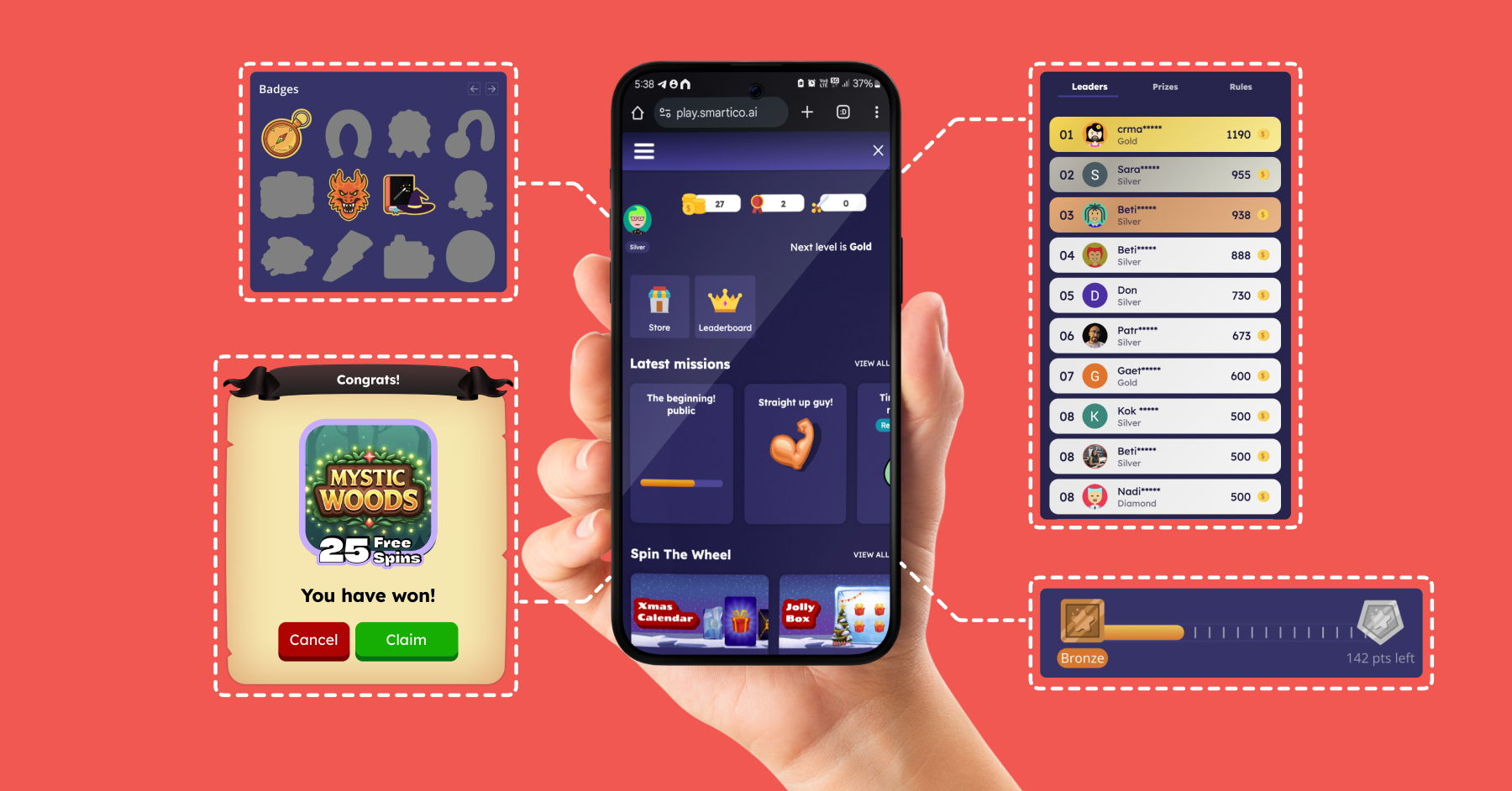
Smartico gives iGaming operators the tools to run VIP management properly: Automação de CRM para detectar sinais precoces de churn e acionar intervenções personalizadas, Modelos de IA para pontuar o potencial VIP precocemente e classificar jogadores em risco, um mecanismo de bônus que precifica recompensas de acordo com o comportamento individual, e gamificação com mecânicas que mantêm jogadores de alto valor engajados entre os pontos de contato pessoais. Tudo isso roda em uma única camada de dados, para que nada precise ser reconciliado entre sistemas. Agende uma demonstração para ver como os operadores gerenciam programas VIP na prática.
{{cta-banner}}
Perguntas frequentes
1. O que é um jogador VIP no iGaming?
Um jogador no nível mais alto de volume de depósito, frequência de sessão e valor vitalício (LTV). O limite exato varia de acordo com o operador e o mercado, mas a definição prática é um jogador cujo valor justifica um nível de atenção, tratamento e custo significativamente diferente da base de jogadores padrão.
2. Como os operadores identificam jogadores VIP?
Por meio da frequência e volume de depósitos em um período contínuo, variedade de jogos, padrões de sessão e, cada vez mais, por meio de pontuação preditiva baseada em IA que sinaliza o potencial VIP precocemente, antes que o jogador ultrapasse qualquer limite formal. Agir com base em sinais precoces é onde se constrói a maior parte da fidelidade.
3. Que benefícios os jogadores VIP esperam?
Um contato dedicado, suporte mais rápido e personalizado, ofertas vinculadas ao seu comportamento real, prioridade em saques e acesso a experiências ou conteúdos não disponíveis para jogadores padrão. Benefícios financeiros são importantes, mas são a base, não o diferencial.
4. Quantos níveis VIP um programa deve ter?
De três a cinco é a faixa prática para a maioria dos operadores. Menos níveis criam menos incentivo à progressão; mais níveis tornam as diferenças de benefícios difíceis de comunicar e entregar de forma significativa.
5. O que leva os jogadores VIP a abandonar a plataforma?
O mais comum: sentir-se ignorado ou receber um tratamento genérico, uma falha no serviço sem uma resposta pessoal rápida, ou uma oferta da concorrência que chega quando o jogador já se sente desvalorizado. Raramente os termos financeiros, por si só, causam a perda de jogadores VIP em um programa bem gerido.
6. Como equilibrar a personalização com a escala?
Utilize a automação para pontos de contato rotineiros, gestão de níveis e ofertas padrão, e reserve o contato humano para intervenções, momentos de relacionamento e conversas de recuperação. A pontuação de churn baseada em IA ajuda uma pequena equipe VIP a concentrar seus esforços nos jogadores que mais precisam de atenção em cada momento.
7. Quais obrigações de jogo responsável se aplicam aos programas VIP?
A maioria dos mercados licenciados exige o monitoramento comportamental dos jogadores VIP, processos de escalonamento documentados quando surgem sinais de risco e gerentes VIP treinados para conduzir conversas sobre jogo responsável. Os detalhes variam conforme a jurisdição, mas a tendência em mercados europeus e outros mercados regulamentados é de requisitos cada vez mais rigorosos.
Este artigo foi útil? Se sim, considere compartilhá-lo com outros profissionais do setor como você.

