Machines Read, People Decide: What 865,000 AI Agent Calls Show About Casino CRM
Four months of AI agents working inside a casino CRM: 30 times more brands, whole journeys built from one message, and why people still make 78% of the changes.
Why this matters
The Model Context Protocol (MCP) lets an AI assistant use the tools of another system. There are now more than 10,000 public MCP servers, and the main MCP packages are downloaded about 490 million times a month. But almost nothing is published about what AI agents actually do once they are connected, and most agent research is about writing code.
In July 2026 we opened the Smartico MCP server. Claude, ChatGPT or an operator's own agent can now read and change a casino or sportsbook CRM: campaigns, customer journeys, messages, bonuses and reports. This study shows what the first four months looked like.
From 4 brands to 121 in 16 weeks
Use grew in steps, as brands moved from trying the server to using it in daily work. By mid-October, AI clients made almost 200,000 calls a week, and many brands used the server every week.
What the AI does: reads first, then builds
An AI looks before it acts. Six in ten calls only read: the list of campaigns, one journey, a bonus template, the brand's settings. One in eight calls is analysis on the brand's own data. The AI most often looks at message delivery, player profiles, campaign results and bonuses.
A quarter of the calls change something, and most of those build customer journeys. Adding, updating and copying the steps of a campaign flow is 6 in 10 change calls. Next come messages (email, push, popups, inbox) and campaign settings.
Machines read, people decide
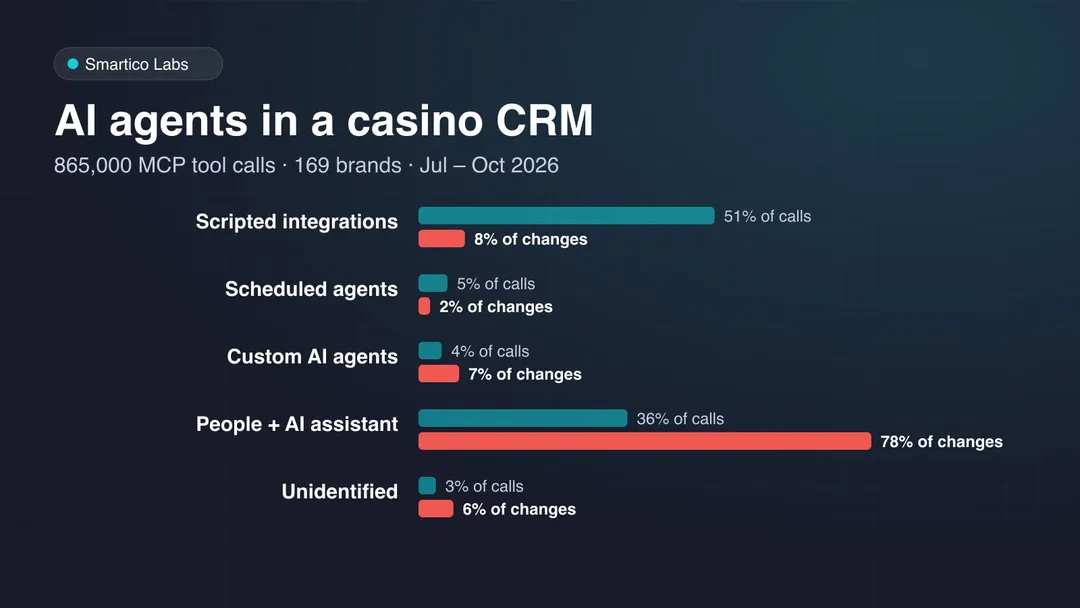
We grouped every access token by how it behaves. The share of calls and the share of changes split apart:
- Scripts make half of all calls, at machine speed. Most of it is bulk reading for reports. They make fewer than 1 in 10 changes.
- Scheduled agents run on a timer. Some are AI models that wake up at the same minute of every hour and run the same task.
- Custom-built AI agents are an operator's own code with a language model inside, with no chat app in between.
- People with an AI assistant work in Claude, ChatGPT and other chat apps. They make about a third of the calls and 78% of the changes.
Operators already let machines read for them. But when something in the CRM changes, a person is almost always in the conversation.
The clock shows the same split. People with an AI assistant keep office hours. Machines work all week: one in four of their calls is made on a weekend.
Claude does most of the work
Claude in the browser and the mobile app makes one in five calls and more than half of all changes. Claude Code and the Claude desktop agents add another quarter of the changes. Together, Claude apps make at least 3 in 4 changes in Smartico CRM. ChatGPT, Codex, Cursor and other AI apps make about 4%.
The largest group by calls is not a chat app at all: 40% of calls come from code that operators wrote themselves, mostly in Python and Node.js.
One message, fifty actions
In a chat, the person writes, the AI works, and then the AI answers. Most of these turns are small: more than half need three calls or fewer.
But sometimes one message starts a long run. A person asks "build a 7-day welcome flow with an email, a push and a bonus on day 3", and the AI creates it step by step on its own. Turns of 50 calls or more are only 1 in 40 turns, but they make half of all changes from chat apps.
The biggest sessions go further. Sessions with 100 changes or more made about 400 changes each on average: whole sets of journeys, built at a pace no person could click through. A typical session is short, about 5 minutes, but 1 in 10 runs longer than 45 minutes.
The AI fixes its own mistakes
AI models make mistakes, but they also read the error messages. When a database query fails, the AI writes a working one within three tries 86% of the time, and two times in three on the very next try. When our server refuses a change and says what is missing, the AI gets the change through 69% of the time.
In early August, 3 to 4 calls in 100 ended in an error. By mid-October, it was about 1 in 100. Two things helped. Brands moved from first tries to daily work. And we kept teaching the server to explain mistakes: instead of a plain error, it now asks a question such as "this field must be whole hours", and the AI fixes the call.
What reaches players
Most changes are drafts and settings. Fewer than 1 in 100 changes act directly on players, for example starting a campaign or giving players a prize. Three safeguards limit what an AI can do:
- Access profiles. Each token is a viewer, an analyst, an editor or has full access. The AI does not even see the tools it may not use.
- Dry runs. The AI can show a change before it saves it. Almost 1 in 5 new or changed items was previewed first.
- Network rules. A brand can allow MCP access only from its own IP addresses.
How this compares
- People stay in charge. In Anthropic's study of almost a million agent tool calls (February 2026), at most about 73% appear to have a person in the loop. In our CRM, people make only a third of the calls, yet nearly 8 in 10 changes.
- Beyond code. Software engineering is about half of all agent tool calls in Anthropic's data, and areas like marketing and sales are a few percent each. We have not found another vendor that has published usage data from its own MCP server.
- A failed call is not a failed task. In Scale's MCP Atlas benchmark, problems with tools cause about half to two thirds of failed agent tasks. In real CRM work, fewer than 3 in 100 calls failed or were refused, and the AI fixed most of those on its own.
What this means for operators
- AI already does real CRM work. It builds journeys and messages, and it checks the data before it changes anything. It does much more than answer questions.
- Let the AI build, and keep people for the decisions. Give each token the lowest access it needs, preview bulk changes, and keep a person in the loop for anything that reaches players.
- Use scripts and AI for different jobs. Scripts are cheap for repeated reads and reports. An AI model is worth it when a task needs judgement, or when mistakes must be fixed along the way.
FAQ
How do casino operators use AI agents in their CRM?
Mostly to read data first and then build. In Smartico CRM, AI agents check the data before they change anything, then build journeys and messages. After a single request, the AI sometimes works on its own for 50 steps or more, and these long runs make half of all changes.
Do AI agents make CRM changes on their own?
Rarely. Scripts and bots make half of all calls but fewer than 1 in 10 changes. People working with an AI assistant make 78% of the changes, and fewer than 1 in 100 changes act directly on players.
What is an MCP server for a CRM?
MCP (Model Context Protocol) is an open standard that lets AI assistants such as Claude or ChatGPT use a product's tools. The Smartico MCP server gives them access to Smartico CRM through a token with the rights you choose, so a CRM team can ask for a report or build a campaign in a chat.
Which AI assistant do CRM teams use most?
In our data, Claude apps make at least 3 in 4 of all changes. People also work through ChatGPT and other chat apps, and some operators run their own custom-built agents.
Data and method
- Source. Smartico MCP server logs, 2 July – 19 October 2026: every tool call, with its brand, access token, tool, result and duration. Only production brands are counted; Smartico demo, test and training setups and Smartico staff are left out. Most numbers use 1 September – 19 October. The analysis of apps and agents uses the last four weeks.
Show the full methodHide the full method
- Who is calling. We group each access token by the app it connects from and by the timing of its calls. Calls less than a second apart mean a script. Sessions that start at the same minute every hour mean a scheduler. Pauses of a few seconds mean a language model is choosing each next step. These are rules, not labels.
- Terms. A change is a successful create, update or action call; previews are not changes. A question is the server refusing a call and saying what to fix. A turn is the work the AI does between two messages from the person. A mistake counts as fixed when one of the next three calls uses the same tool and succeeds.
- Limits. This covers the first four months of use. One faulty integration is left out of the weekly error rates.
- Privacy. We report totals and shares only. No brand, person or integration is named.
How to cite
Smartico (2026). Machines read, people decide: what 865,000 AI agent calls show about casino CRM. https://www.smartico.ai/resources/labs/ai-agents-casino-crm-mcp-usage
The Smartico MCP server connects Claude, ChatGPT and other AI apps to your CRM. See what teams use it for, how to set it up and how access is controlled.
More from Smartico Labs
 Data study
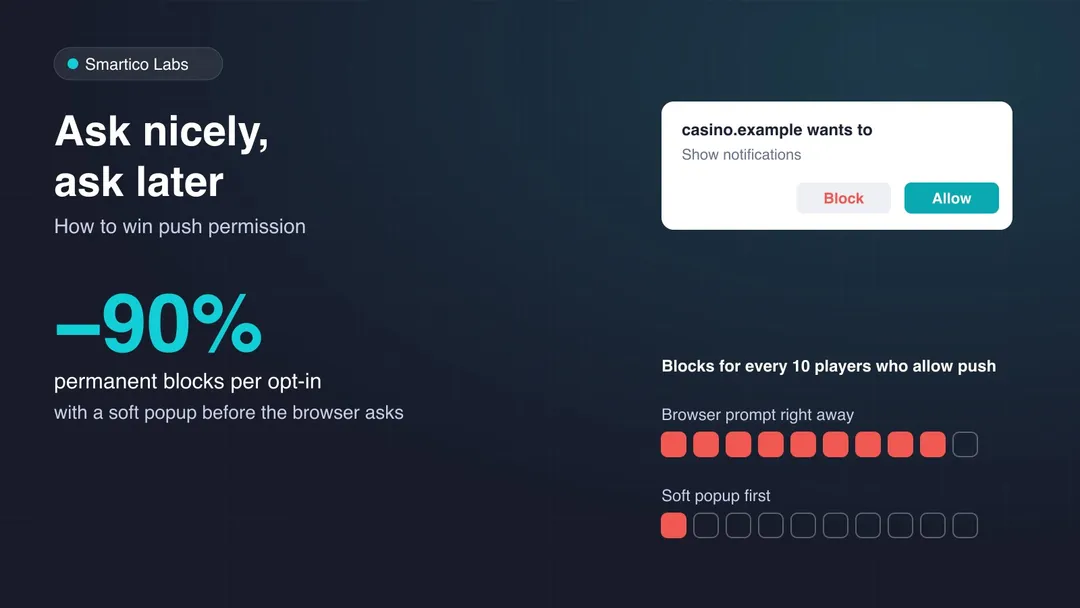
Ask Nicely, Ask Later: How to Win Push Permission Without Losing Players for Good
Asking for push permission straight away loses about one player for good per opt-in. A soft popup first cuts those losses by 90%. Data from tens of millions of casino players.
 Data study
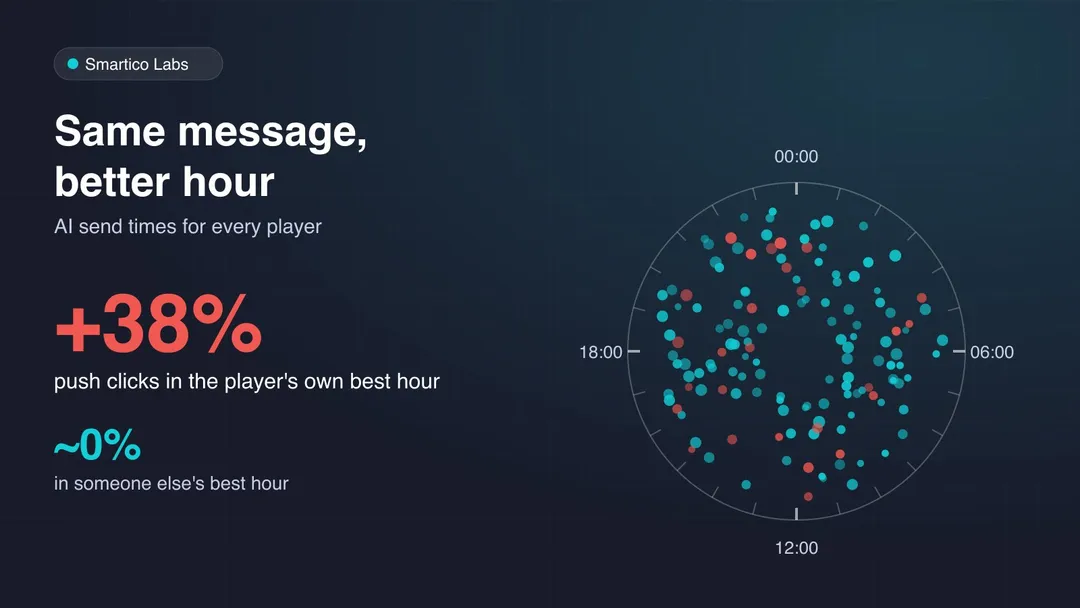
Same Message, Better Hour: AI Send Times Lift Push Clicks by 38%
Send time optimization tested on casino players: a push sent in the player's own AI-predicted best hour got 38% more clicks. Someone else's best hour did almost nothing.
 Data study
Doodles vs Plain Promo Popups: A Study of Smartico Brands, 2023–2026
21.8 billion popup views on Smartico, 2023–2026. At brands that added doodles, the median doodle got 2.4× the response of the same brand’s plain promo popups.
Try what we build
Much of our R&D is open to try: a demo casino, games made in Vibe Studio and the code we publish.